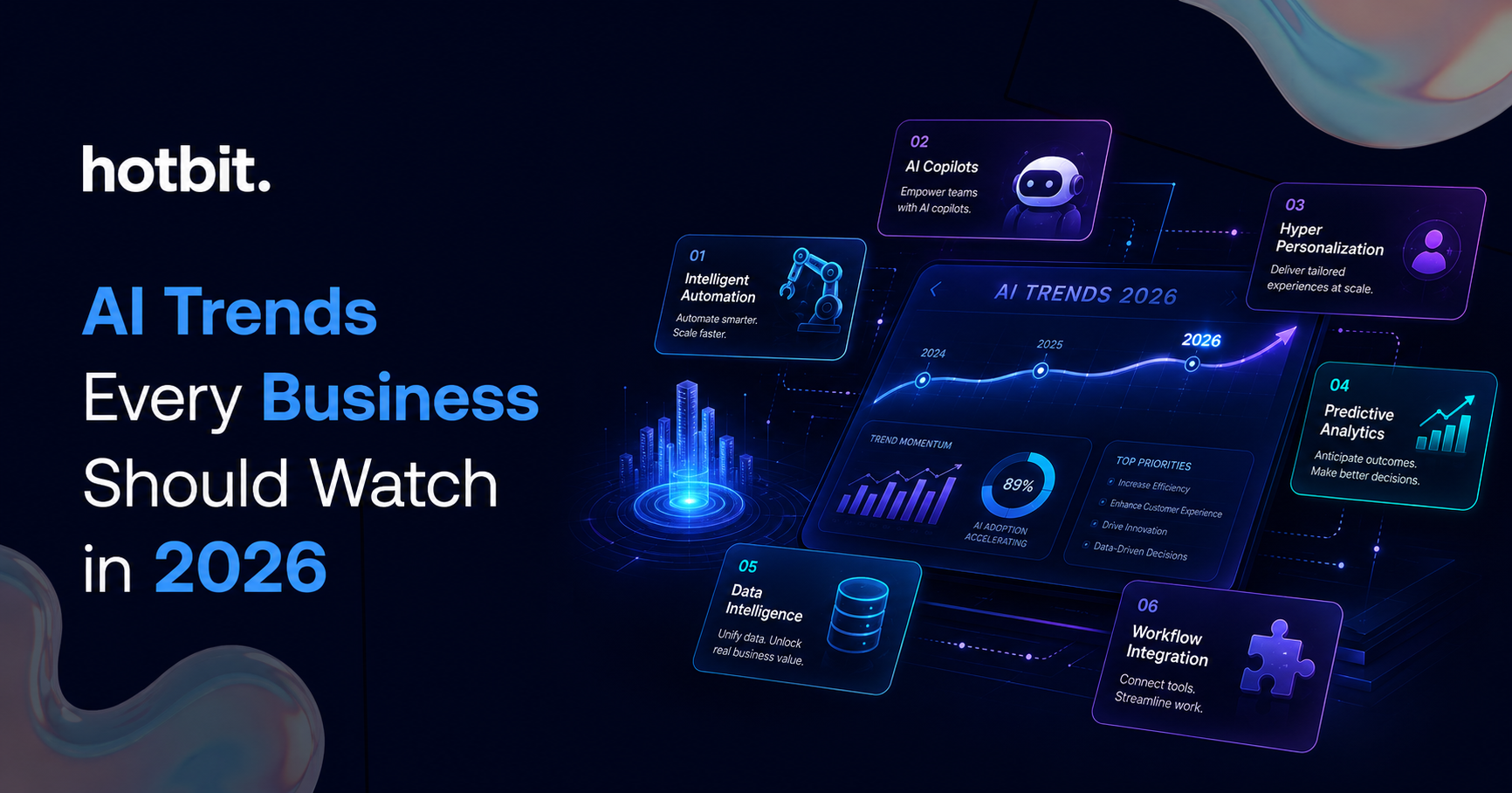
AI Trends Every Business Should Watch in 2026

AI Trends Every Business Should Watch in 2026 start with one signal every leader needs to see clearly: the AI conversation has moved from experimentation to execution. Enterprises that treated 2025 as a pilot year are now under pressure to prove returns, govern their agents, and lock down where their data lives. Gartner forecasts worldwide AI spending will reach $2.5 trillion in 2026, a jump of more than 40% over last year, yet most organizations are still working out how to convert that spend into results.

The businesses that command this shift will not be the ones spending the most. They will be the ones who understand exactly which four forces are rewriting enterprise AI this year, and who move first. This is the breakdown built for that decision.

What Are AI Trends Every Business Should Watch in 2026?

AI Trends Every Business Should Watch in 2026 are the shifts in enterprise AI adoption that move the technology from isolated pilots into core operating infrastructure. This is not a hype cycle. It is a recalibration of how enterprise software gets built, bought, and run: agentic systems that act rather than assist, tighter governance, and cloud architecture built around data sovereignty.

Businesses that treat these shifts as an IT-only conversation are the ones most likely to fall behind. The next era of enterprise technology runs on intelligence, not platforms, and 2026 is the year that recalibration becomes unavoidable.
Consider a mid-size logistics operator running route planning, inventory forecasting, and customer support through separate legacy systems. In 2026, an agentic layer connects those systems, reroutes shipments around a delay, and flags the exception to a human only when judgment is genuinely required. That is the practical shape of the four trends below, not an abstract concept reserved for large technology companies.

Understanding the Framework: Four Shifts Reshaping Enterprise AI

1. Agentic AI is moving from experimentation to real-world business operations in 2026.

Gartner predicts that 40% of enterprise applications will include AI agents by year-end, helping automate complex workflows. As AI becomes embedded in existing business software, organizations must prioritize governance, integration, and oversight to scale successfully.

2. The spend-versus-ROI gap widens.

While AI adoption continues to grow, many businesses still struggle to generate measurable returns. According to McKinsey, only 6% of organizations qualify as AI high performers despite widespread AI use. Research from IDC and Microsoft shows that strong ROI depends on clear KPIs, quality data, and effective governance. Organizations that scale AI strategically are far more likely to achieve sustainable business value than those relying on isolated pilot projects.

3. Data sovereignty becomes a board-level cloud decision.

Businesses are rethinking where their data is stored and processed as privacy regulations and compliance requirements continue to evolve. Gartner predicts that more than 75% of enterprises in Europe and the Middle East will move some workloads to sovereign or regional infrastructure by 2030.
This shift extends beyond regulated industries. Organizations operating across multiple regions need cloud strategies that prioritize data residency and compliance from the outset, helping reduce future legal, operational, and security risks.

4. Governance and workforce readiness catch up to adoption.

As businesses scale AI, governance is becoming just as important as the technology itself. Organizations need clear policies, human oversight, compliance measures, and employee training to deploy AI responsibly.
Companies that invest in governance and workforce readiness are better prepared to scale AI successfully while reducing operational, compliance, and security risks. Building these capabilities early creates a stronger foundation for long-term AI adoption.

Are You Ready to Command This Shift?

The cost of standing still is measurable. Gartner warns that more than 40% of agentic AI projects will be canceled by 2027, driven by escalating costs, unclear business value, and weak risk controls, not by any failure of the technology itself. Businesses that scale agentic AI without a parallel investment in governance, data infrastructure, and workforce readiness are building the exact conditions behind that statistic.

Stanford’s AI Index Report puts a number on the infrastructure race underpinning all four trends: AI data center power capacity has already reached 29.6 gigawatts globally. Enterprises that move now, with a purpose-built strategy across agentic AI, ROI measurement, sovereign cloud, and governance, will be the ones leading their industry rather than reacting to it.
The starting point is rarely a bigger AI budget. It is an honest audit of where your current AI initiatives sit against the four shifts above, followed by a roadmap that ties each one to a measurable business outcome rather than a headline feature.

How Hotbit Infosoft Helps You Act on These Trends

Hotbit Infosoft, a digital-first technology company specializing in AI Automation, Product Engineering, Business Transformation, Cloud, Team-as-a-Service, and iGaming & Fantasy solutions, builds the infrastructure that turns these trends into an advantage rather than a liability. Our AI Automation team takes agentic AI workflows from proof of concept into governed, production-ready systems, while our Cloud practice designs sovereign, future-ready architecture built around your data residency requirements from day one.

Don’t follow the race; lead it. Talk to an Expert and build your 2026 AI roadmap with Hotbit Infosoft.

Frequently Asked Questions (FAQs)

What are the most important AI trends every business should watch in 2026?

The most significant AI trends every business should watch in 2026 include the rise of agentic AI, the growing focus on measuring AI ROI, data sovereignty influencing cloud strategies, and stronger AI governance with workforce upskilling. Together, these trends are reshaping how organizations adopt and scale AI across their operations.
Agentic AI refers to AI systems that can plan, execute, and adapt tasks across multiple workflows with limited human intervention. According to Gartner, enterprise adoption of AI agents is expected to increase significantly through 2026, making governance, integration, and oversight essential for organizations implementing these technologies.
Many organizations invest in AI without clear business objectives, governance frameworks, or performance metrics. Research from McKinsey and IDC suggests that businesses that align AI initiatives with measurable KPIs, high-quality data, and cross-functional ownership are more likely to achieve sustainable returns than those relying on isolated pilot projects.
Data sovereignty refers to keeping data and workloads within the legal jurisdiction where they are collected or processed. As organizations expand globally and regulations evolve, cloud architectures increasingly need to account for data residency, privacy requirements, and regional compliance from the beginning of an AI initiative.
As AI becomes embedded in everyday business operations, governance helps ensure systems remain secure, transparent, compliant, and aligned with organizational goals. Effective governance includes policies for AI usage, audit trails, risk management, human oversight, and employee training.