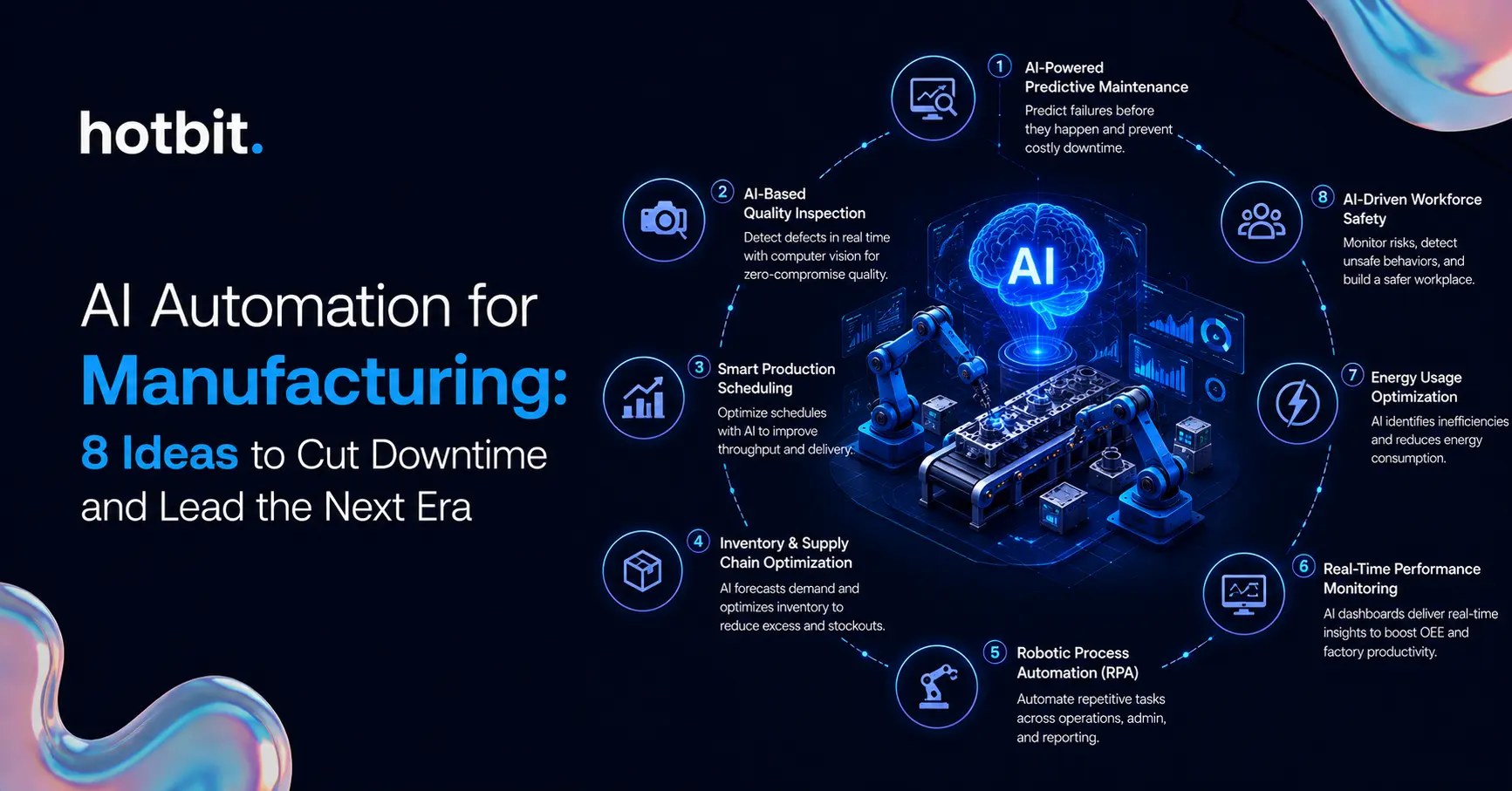
AI Automation is rewiring how manufacturers hit uptime, quality, and delivery targets and the plants that adopt it first are pulling away from the rest. The pressure to cut downtime, reduce waste, and outpace the next production cycle isn’t coming; it’s already here. Every quarter a manufacturer waits is a quarter a competitor spends closing the gap.
According to McKinsey & Company, 88% of organizations now use AI in at least one business function. though most remain stuck in pilot mode without the enterprise-wide impact that separates leaders from the rest. For manufacturers, the question isn’t whether to adopt AI Automation. It’s which process to rewire first.
It runs across four layers of a plant: equipment, quality, planning, and back-office operations. Rewire even one layer and downtime, waste, and manual work start dropping fast.
For a CTO or Operations Manager evaluating where to start, the layers aren’t equally urgent. Equipment and quality tend to carry the highest cost of inaction, since a missed failure or an undetected defect reaches the customer before anyone catches it.
None of these layers run in isolation. A predictive maintenance model is only as sharp as the sensor data feeding it, and a forecasting model is only as useful as the ERP data it can actually see. The manufacturers getting real value from AI Automation treat data quality as the starting point, not an afterthought.
That starting point matters more than the technology choice itself. A plant with clean, well-labeled sensor data can get meaningful results from a modest predictive maintenance pilot; a plant without it will struggle even with the most advanced model on the market.
Here’s where manufacturers are already putting AI Automation to work:
1. Predictive maintenance
Predictive maintenance reads vibration, temperature, and pressure data to flag equipment failures before they happen, replacing fixed maintenance schedules with condition-based intervention. Unplanned downtime costs U.S. manufacturers an estimated $50 billion a year.
McKinsey & Company research puts the upside at a 30–50% cut in unplanned downtime and a 20–40% extension in equipment life real ranges, not guarantees, since results depend on the asset and the data feeding the model. Manufacturers running older equipment often see the fastest payback here, since legacy machines rarely have condition-based monitoring built in from the factory. Retrofitted sensors close that gap without a full equipment replacement.
2. AI-powered visual inspection
Computer vision models trained on thousands of product images catch cracks, misalignments, and surface flaws at line speed, spotting what tired eyes and inconsistent lighting miss. Unlike rule-based machine vision, these models get retrained on new production data as defect patterns shift, provided that data is representative and validated.
The payoff shows up in fewer warranty claims, less scrap, and quality teams freed up for root-cause work instead of manual sorting. High-mix production lines, where defect types shift with each product run, tend to benefit the most.
3. Demand forecasting and inventory optimization
AI-driven forecasting reads historical sales, seasonality, macroeconomic signals, and supplier lead times to call what to produce, and when. With enough historical and contextual data behind it, this can outperform static spreadsheet models and cut two expensive problems at once: overproduction that ties up working capital, and stockouts that stall customer orders
Manufacturers running multiple SKUs across regional plants can layer these models by product line, region, or customer tier for sharper accuracy. The models improve as more sales cycles feed back into them, making the second year of use typically stronger than the first. Planning teams that pair the forecast with supplier lead-time data get the biggest lift in accuracy.
4. Robotic process automation for back-office work
RPA puts software bots on repetitive, rules-based back-office tasks purchase order entry, invoice reconciliation, compliance reporting, ERP data syncing without touching the shop floor. Most manufacturing back offices still run heavy manual data entry across disconnected ERP, MES, and CRM systems, and RPA closes that gap without a full systems overhaul.
Paired with AI document extraction, it reads unstructured supplier invoices and packing slips and routes them for approval automatically. Finance and procurement teams typically feel the impact first, since those roles carry the heaviest document volume. It’s often the fastest of the eight ideas to deploy, since it rarely requires new hardware.
5. AI-driven supply chain optimization
AI supply chain models ingest supplier performance, shipping conditions, and demand signals to recommend sourcing decisions, reroute shipments, and flag supplier risk before it hits production. Traditional supply chain software reacts after a disruption is reported.
Some AI-enabled systems assess disruption risk continuously and suggest alternatives before the delay lands a real advantage for manufacturers running multi-tier, cross-border supply chains where one late component can stall an entire line. Manufacturers sourcing from several countries tend to see the clearest case for this investment, since a single-region supply chain carries far less variable risk to model.
6. Digital twins for production simulation
A digital twin is a live, data-fed replica of a production line, machine, or facility, built to test changes a new product variant, a shift schedule change, a layout redesign before they touch the real floor. Manufacturers run “what-if” scenarios in the twin instead of the plant, catching bottlenecks and safety issues in simulation.
Siemens and PTC, both established industrial software providers, build digital twin platforms that plug directly into plant-floor sensor data. This idea works best once a facility already has predictive maintenance sensors in place, since the twin needs that same live data stream. Manufacturers planning a major line redesign often build the twin first to de-risk the physical change.
7. Generative AI for documentation and planning
Generative AI takes on manufacturing’s documentation load: drafting standard operating procedures, summarizing quality audit findings, writing shift handover reports, and answering technician questions against equipment manuals in plain language. It doesn’t touch the physical line, but it strips hours of manual writing and searching from engineering, quality, and operations teams.
Most manufacturers start with internal knowledge-base search before expanding into automated report drafting. Plants with high technician turnover often see the fastest return, since new hires reach competency faster with instant access to institutional knowledge.
8. AI-based energy management
AI energy management tracks real-time power draw across machinery, HVAC, and lighting to flag equipment pulling more than its baseline and surface waste before it shows up on the bill. Where a facility’s equipment and utility tariff structure allow it, these systems also flag eligible processes that can shift to lower-cost periods.
The same consumption data also serves as sustainability reporting, feeding into ESG and compliance disclosures without separate infrastructure. Manufacturers already tracking energy costs by line get the fastest read on where automation pays for itself.
Adoption isn’t the hard part anymore. Scaling is McKinsey & Company found that only 6% of organizations qualify as “AI high performers,” capturing significant enterprise value from AI; most are still running pilots that never leave the lab.
The gap isn’t about access to the technology. It’s about which manufacturers commit to one process, prove the return, and build from there instead of waiting for a perfect rollout plan.
McKinsey & Company’s research also points to where the payoff concentrates: cost reductions from AI show up most heavily in manufacturing, IT, and software engineering, ahead of almost every other function surveyed. That’s a direct signal that manufacturers sitting on the sidelines are leaving the largest available gains on the table.
That gap is only going to widen. Manufacturers who rewire a single high-cost process this year will be scaling their second and third use case while competitors are still scoping their first. Speed of commitment, not size of budget, is what separates the two groups.