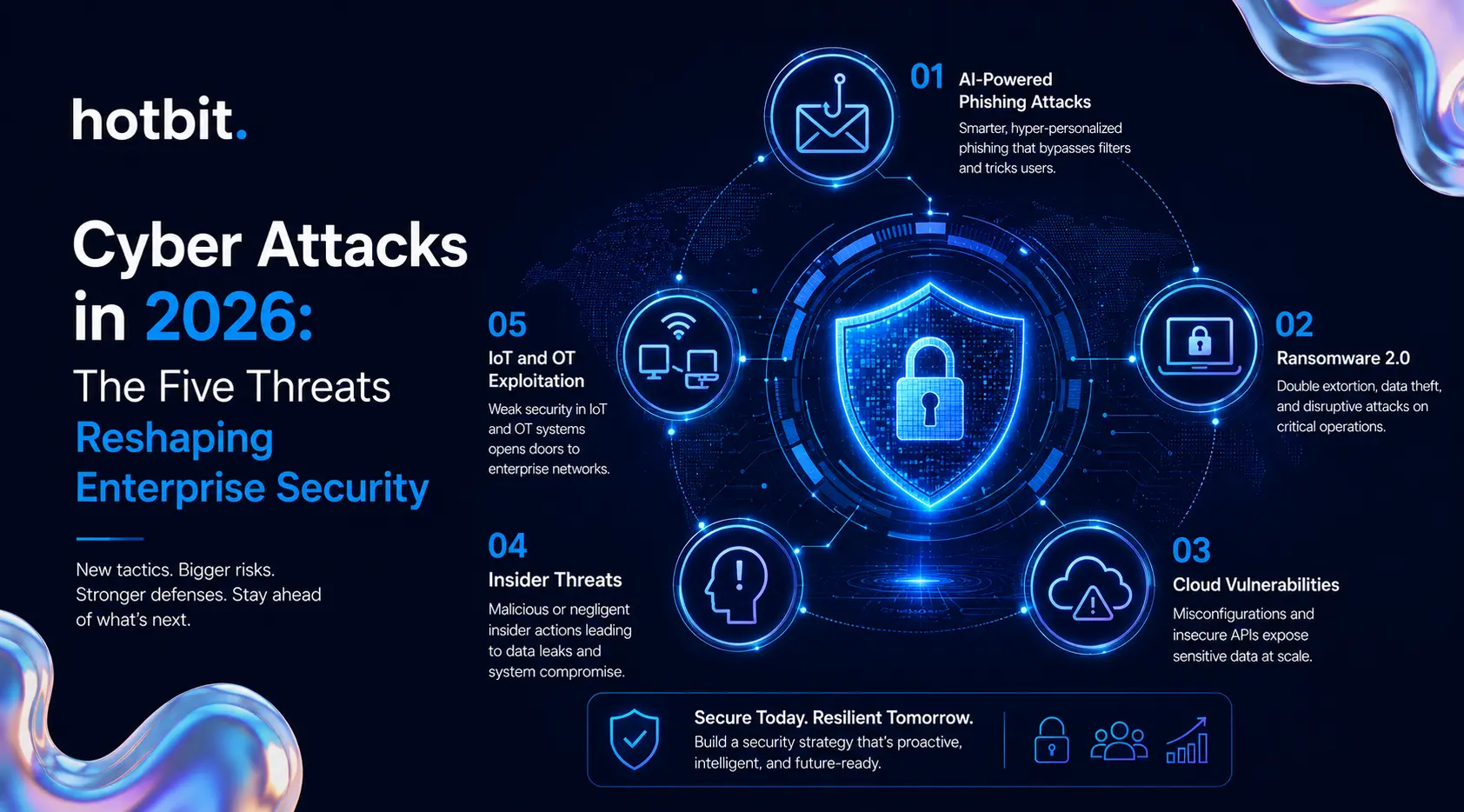
Cyber attacks in 2026 no longer wait for a mistake; they manufacture one. Attackers now write, launch, and adapt campaigns faster than most security teams can review a single alert. According to IBM’s 2025 Cost of a Data Breach Report, phishing accounted for 16% of the breaches studied, at an average cost of $4.8 million per incident.
For enterprise leaders, that figure reframes the conversation. The question isn’t whether an attack will land; it’s how fast the business can see it and shut it down.
Cyber attacks in 2026 span five recurring categories: phishing, ransomware, business email compromise, credential and identity attacks, and AI-augmented social engineering. Each targets a different weak point: email trust, unpatched systems, human judgment, or exposed credentials. None of these attack types are new. What’s changed is the speed and precision generative AI brings to each one.
This is a working framework, not a complete inventory. Supply-chain compromise, insider threats, and DDoS activity remain relevant depending on a company’s industry and infrastructure. The five below are where enterprise security teams are spending the most attention heading into 2026.
Different datasets measure these categories in different ways: initial access vectors, incident counts, or survey responses among them. That distinction matters for any leader building a defense budget around the numbers below.
These categories also aren’t isolated from each other. A single phishing email can open the door to ransomware, and a compromised credential can turn into a business email compromise before a security team even logs the original alert. Treating each attack type as connected, rather than as a separate line on a compliance checklist, changes how a defense budget should be built.
There’s no single authoritative SDLC taxonomy; organizations and textbooks split or combine activities differently but one commonly used breakdown divides software delivery into seven core phases:
Criminals impersonate a trusted sender a bank, vendor, or colleague to push a recipient toward a malicious link, a fake login page, or a compromised attachment. IBM’s researchers have shown that generative AI can cut the time needed to draft a convincing phishing email from as long as 16 hours of manual work down to about five minutes, letting a single attacker run far more targeted campaigns. IBM’s data also shows breaches that take longer than 200 days to contain cost organizations $5.01 million on average, versus $3.87 million for faster-contained incidents.
Email filtering alone no longer covers the risk. Phishing resistance now depends on layered controls, including staff training and behavior-based detection that flags unusual sender patterns rather than just known bad addresses. Attackers increasingly treat phishing as the opening move rather than the whole attack, using a single successful click to establish a foothold for ransomware or credential theft later in the same campaign.
Ransomware locks or steals a company’s data and demands payment for its return, or its silence. In CrowdStrike’s 2025 survey of roughly 1,100 security leaders, 78% of surveyed organizations reported a ransomware attack in the past year, and only 38% of those affected said they had actually fixed the vulnerability that let attackers in. That gap is the real risk. A meaningful share of surveyed organizations remain exposed to a repeat attack through the same weakness.
Ransomware volume also continues to shift by sector and by quarter, with different industries moving in and out of the top-targeted list over time. Sector-specific risk should be checked against current data rather than assumed to be fixed. Recovery planning, not just prevention, belongs in any 2026 ransomware strategy. Executives should also expect ransom demands to keep climbing wherever backups are unreliable or untested, since a working backup remains one of the few controls attackers can’t negotiate around.
3. Business Email Compromise
An attacker impersonates an executive, vendor, or finance contact to redirect a wire transfer or invoice payment. BEC often involves no malware at all; it runs entirely on convincing an employee that a request is legitimate. IBM’s 2025 research shows that some email-driven and account-compromise incidents rank among the costliest and slowest to contain. AI-generated deepfake audio is starting to let attackers imitate an executive’s voice directly, not just their writing style.
Procedural controls close this gap where technical filters can’t. Verifying payment changes through a separate, known channel remains one of the simplest, most reliable defenses available. Finance and accounts-payable teams remain the most common target, simply because they’re positioned to move money quickly once a request looks legitimate.
4. Credential and Identity Attacks
These attacks target the login itself, using stolen, purchased, or brute-forced credentials to walk through the front door instead of breaking in. IBM’s 2025 research places compromised credentials among the top five initial attack vectors, at roughly 10% of breaches studied and up to 186 days to identify. Microsoft has reported roughly 600 million identity-attack attempts a day across its telemetry, with more than 99% still password-based.
Basic credential hygiene still closes a large share of the gap. Multi-factor authentication and zero-trust access policies remain a direct countermeasure against this category, regardless of how sophisticated the attacker’s tooling becomes. Password reuse across personal and corporate accounts continues to be one of the most common ways a single leaked credential turns into a wider breach.
5. AI-Augmented Social Engineering
Built to work around trained human judgment, these attacks call for a stronger response: technical detection paired with recurring, scenario-based staff training rather than a single annual awareness session. Voice and video impersonation, not just text, are becoming part of this category as generative tools mature beyond written content.
Generative AI is already reshaping the volume and precision of these attacks, and the trend line points further in that direction. Gartner projects that generative AI will factor into 17% of all cyberattacks by 2027 a forward-looking estimate, not a 2026 measurement, but a clear signal of where attacker tooling is headed. Enterprise leaders who wait for that shift to fully arrive will be defending yesterday’s threat model against tomorrow’s attacker.
That shift, from periodic review to continuous posture management, is the real dividing line for 2026. Businesses that make it now will spend next year responding to fewer surprises.
Budget conversations for 2026 increasingly start with a simple question: how long would it take the business to notice if one of these five attack types succeeded today? For many organizations, the honest answer is still measured in weeks, not hours. Boards are starting to ask that question directly, which means security leaders need an answer grounded in current data rather than last year’s audit. The businesses that can answer with confidence today are the ones that treated these five attack types as an ongoing program, not a one-time project.