
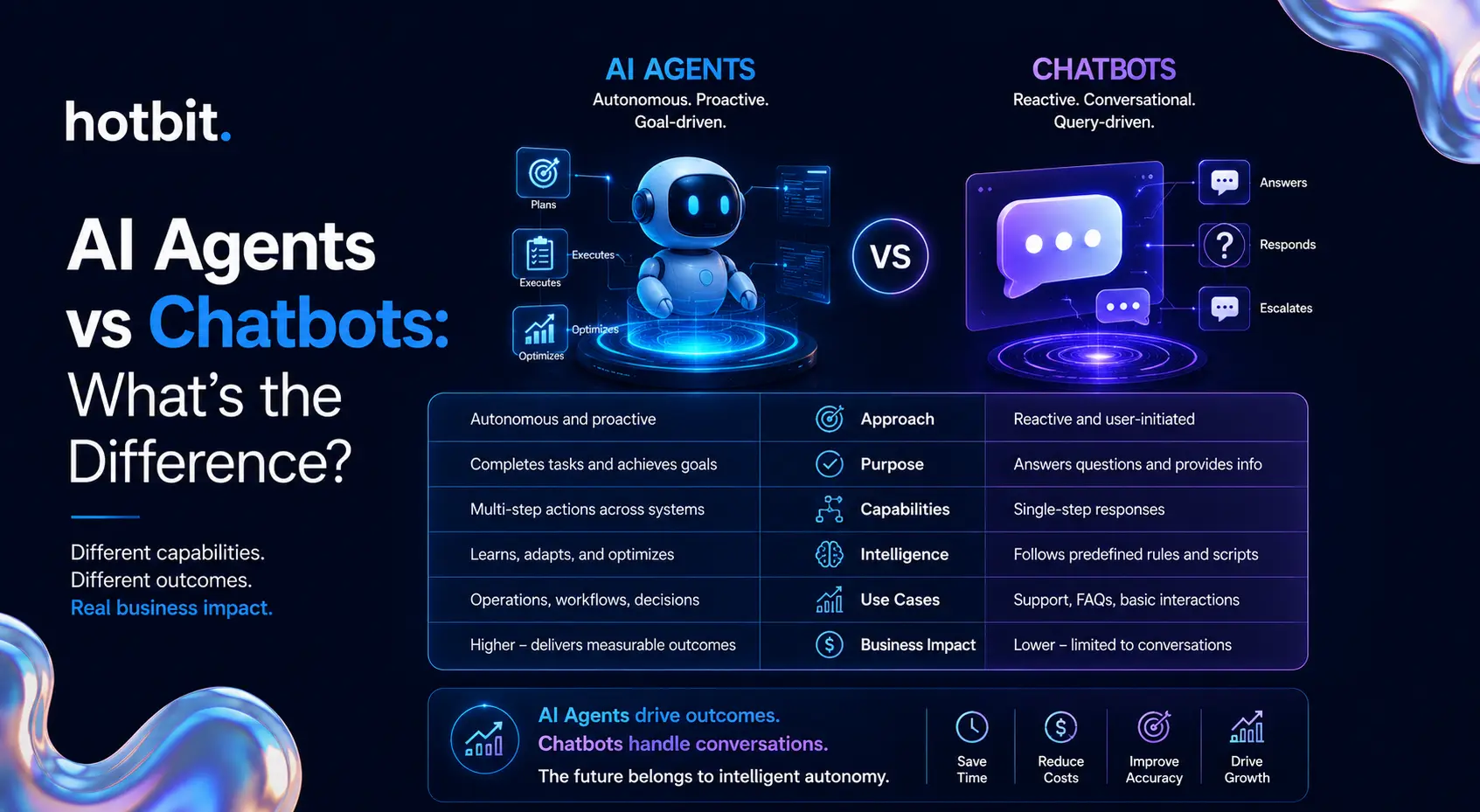
Every enterprise buying AI right now is really asking one question, whether they realize it or not: are we purchasing a conversation, or a worker? Chatbots and AI agents get pitched under the same banner, but they are built to do fundamentally different jobs. Confusing the two is an expensive mistake to make at scale.
What Are AI Agents vs Chatbots?
The two are not always separated by a hard wall. Modern chatbots increasingly borrow tool-calling and workflow features from agents, and the boundary will keep blurring as the category matures. What has not blurred is intent: chatbots are still designed around conversation first, and agents are designed around task completion first.
Understanding the framework
Function
A chatbot answers a question. An agent completes a task and reports back.
Autonomy
A chatbot waits for the next prompt before doing anything else. An agent keeps moving through a multi-step process on its own.
Memory
A chatbot’s context usually resets with the conversation. An agent holds a goal in memory across the full task
System access
A chatbot typically reads from a knowledge base. An agent reads and writes to live databases, APIs, and business systems.
Decision-making
A chatbot follows scripted logic or retrieves a matched answer. An agent reasons through changing conditions and adjusts its own plan.
Oversight
A chatbot gets reviewed conversation by conversation. An agent gets governed by guardrails, then checked on outcomes.
Where each one fits in your stack
Website FAQ and order status
A chatbot handles the volume, and it does so well. There is no task to complete, only a question to answer.
Support ticket resolution
An agent looks up the order, checks policy, issues a refund or credit, and closes the ticket in one connected pass.
Internal knowledge lookup
A chatbot surfaces the right document fast. It does not need to act on what it finds.
Invoice reconciliation
The Real Risk: Confusing a Chatbot for an Agent
That is the real risk of this shift: not the technology, but the mismatch between what a business buys and what a business actually needs. An agent deployed without the right oversight can act on bad information at scale, fast, across live systems. A chatbot misapplied to a task it cannot finish just wastes a customer’s time. Neither failure mode is acceptable, but they call for different fixes, and they start with knowing which system is actually in front of you.
That is the real risk of this shift: not the technology, but the mismatch between what a business buys and what a business actually needs. An agent deployed without the right oversight can act on bad information at scale, fast, across live systems. A chatbot misapplied to a task it cannot finish just wastes a customer’s time. Neither failure mode is acceptable, but they call for different fixes, and they start with knowing which system is actually in front of you.
How do I know if my business needs an agent instead of a chatbot?
Can a chatbot be upgraded into an agent later?
What is the biggest mistake businesses make when adopting AI agents?
How Hotbit Infosoft Can Help
Hotbit Infosoft is a digital-first technology company specializing in AI Automation, Product Engineering, Business Transformation, Cloud, Team-as-a-Service, and iGaming & Fantasy solutions, and we build agentic and conversational systems purpose-built for how a business actually operates, not a generic bot bolted onto a website. Our AI Automation team scopes the right architecture, chatbot, agent, or a combination of both, before a single line of code gets written, so the system a business deploys matches the job it actually needs done. Ready to find out which one your business needs? Talk to an expert and start scoping your build.