
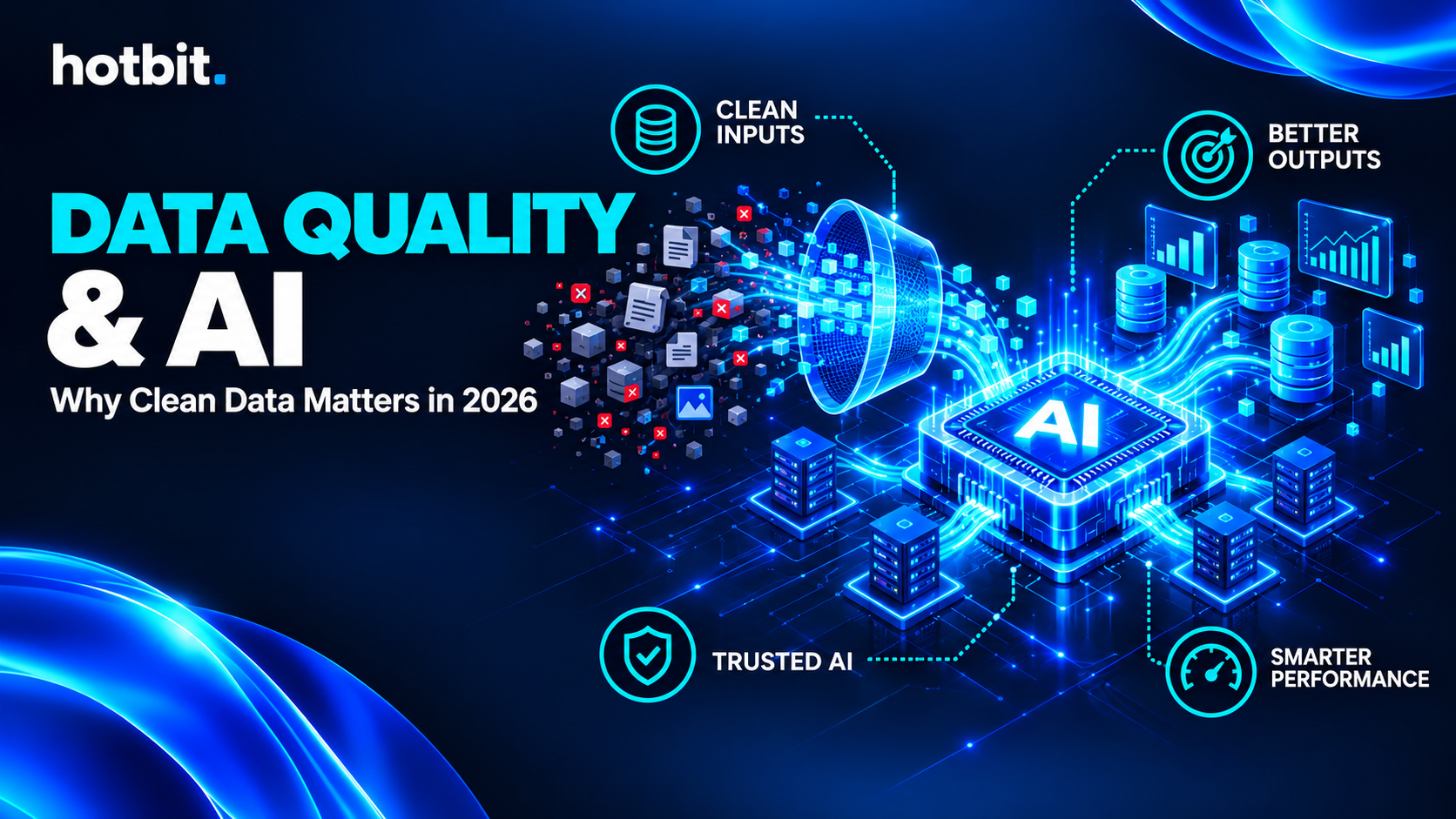
Data quality and AI are now inseparable: a model may struggle to distinguish reliable inputs from unreliable ones, so flawed data can produce flawed decisions at machine speed. Gartner predicted in February 2025 that organizations would abandon 60% of AI projects that lack AI-ready data through 2026. That figure is a forecast, not a confirmed result, and the firm published it in its original press release.
Hotbit Infosoft, a digital-first technology company specializing in AI Automation, Product Engineering, Business Transformation, Cloud, Team-as-a-Service, and iGaming & Fantasy solutions, builds on one principle: a model is only as reliable as the data beneath it. As businesses evaluate technology trends for businesses in 2026, data quality should remain a priority. Here is what clean data means for AI, what poor data costs, and how to fix yours before it undermines your next investment.
What Is Data Quality and AI?
Data quality and AI is the practice of making sure the data used to train, ground, and run artificial intelligence is fit for the specific job those systems perform. Clean data is data an AI system can safely learn from and act on.
The AI standard is stricter than the traditional one. IBM notes that AI data quality also covers representativeness, bias, label accuracy, and noise. A table can pass every standard check and still fail an AI use case if it lacks coverage or context. Gartner frames data quality as how usable and applicable data is for an organization’s priority use cases, including AI and machine learning. Reliable data is also important for agentic workflow engineering, where AI agents depend on relevant, accurate information to support workflow execution.
Six dimensions that decide AI outcomes
These six form a working set selected for AI use cases, not a universal standard. Each fails in a recognizable way:
- Accuracy: values must match real-world facts, or the model delivers confident but wrong answers.
- Completeness: missing fields become gaps the model guesses at or ignores.
- Consistency: the same entity must look the same across systems, or outputs contradict each other.
- Timeliness: stale inputs can produce outdated recommendations, while changes in data patterns or real-world relationships can degrade model performance over time.
- Uniqueness: duplicates double-count records and skew training weights.
- Representativeness: data must reflect the full range of real-world cases, or bias follows
Gartner lists nine common dimensions and advises against measuring everything at once. Pick the two or three that matter most for each use case. Timeliness carries extra weight for live products. A fantasy sports platform depends on match and event feeds arriving on time, which is why iGaming & Fantasy engineering treats data freshness as a core requirement.
Are You Ready for the Cost of Poor Data Quality?
Readiness is the weak point. A Gartner survey of 1,203 data management leaders, conducted in July 2024, found that 63% of organizations either lacked the right data management practices for AI or were unsure whether their practices were adequate. The cost is just as clear: poor data quality costs organizations at least $12.9 million a year on average, according to Gartner research from 2020. That is a historical Gartner estimate, not a current measure of AI-specific losses, and actual costs vary by organization. It also predates the generative AI wave.
Visibility is the second problem. A Gartner survey cited on the same research page reports that 59% of organizations do not measure data quality. Gartner does not state the survey date there. Without measurement, teams cannot price what bad data costs or prove a fix worked. Automated checks built through AI Automation make that measurement continuous instead of periodic.
Poor data breaks AI systems in five predictable ways:
- Biased training data: a model that underrepresents certain customers or scenarios performs unevenly on edge cases.
- Inconsistent, siloed records: Gartner names inconsistency across sources as the hardest quality problem, and a model reading two versions of one customer may not know which record is authoritative without reconciliation rules.
- Stale inputs and drift: IBM notes that data drift and concept drift degrade performance as new data departs from training data.
- Mislabeled examples: wrong labels teach wrong rules, and fine-tuning may not fully compensate for them afterward.
- Missing ownership: Gartner observes that business leaders rarely see data quality as their responsibility, so errors persist until an AI output exposes them.
Seven Steps: Getting Your Data AI-Ready Before Launch
This sequence is a recommended approach drawn from published Gartner guidance, not a formal Gartner methodology. Each step targets a specific failure mode.
- Define the use case first. Gartner advises aligning internal and external data sources with specific AI use cases. Quality is always judged against the use case.
- Audit existing data. Profile every source for duplicates, gaps, format conflicts, and stale records.
- Choose two or three metrics. Set a target for each and track it over time.
- Clean at the source. Fix errors where data enters the system. Validation rules built into Product Engineering workflows, forms, and APIs stop bad records early.
- Assign owners and governance. Name an owner for every data domain. Gartner recommends developing AI governance requirements with legal and business leaders. A structured Business Transformation program embeds that ownership into daily operations.
- Automate monitoring. Gartner recommends DataOps and data observability to track patterns and adjust. Modern Cloud platforms make automated checks and lineage tracking easier to run at scale.
- Review continuously. Revalidate whenever sources, business rules, or customer behavior change, because drift never stops.
Teams without in-house data engineers can add capacity fast through Team-as-a-Service, which places pre-vetted professionals inside the project team.
Generative AI and RAG: Why Retrieval Data Sets the Ceiling
Generative AI, retrieval-augmented generation (RAG), and AI agents act on retrieved information, not only on predicted numbers. RAG retrieves documents from a company knowledge base before the model writes an answer. If that base holds outdated policies, duplicate files, or wrong permissions, the model repeats them with confidence.
Quality here means document freshness, deduplication, clear metadata, and correct access controls. Clean data alone does not guarantee reliable answers, because retrieval design, model behavior, and evaluation also matter. Gartner adds that generative AI will rapidly change how technical professionals ensure data quality, so the same technology can help clean the data it depends on. If you need help improving data quality and building reliable AI solutions, contact our team to discuss your project requirements.
How Hotbit Infosoft Builds AI on Clean Data
Hotbit Infosoft treats data readiness as an early milestone of any AI engagement, ahead of model selection. The approach follows the roadmap above: confirm the use case, audit the data, build validation into pipelines, name owners, and monitor after launch. Trusted by 200+ global brands, with a presence in India, Singapore, Mauritius, and Saudi Arabia, Hotbit covers the pipelines, platforms, and application-level validation that AI depends on. If your next AI initiative rests on data you cannot yet trust, Talk to an Expert and let’s make it happen.
Frequently Asked Questions About Data Quality and AI
1. Why is data quality important for AI?
Data quality is essential for AI because models depend on reliable data to generate accurate predictions, responses, and insights. Poor-quality data can introduce bias, increase errors, and lead to misleading results. High-quality data helps businesses build more reliable AI systems and make informed decisions.
2. What is AI-ready data?
AI-ready data is information prepared for a specific AI application. It should be accurate, sufficiently complete, consistent, relevant, and representative of the intended use case. Depending on the project, preparation may include data cleaning, labeling, deduplication, normalization, and privacy checks.
3. How does poor data quality affect AI performance?
Poor data quality can cause inaccurate predictions, biased outputs, inconsistent responses, and unreliable business decisions. It can also increase AI development and maintenance costs because teams need to spend more time correcting errors, validating outputs, and improving data pipelines.
4. How can businesses improve data quality for AI projects?
Businesses can improve data quality by auditing data sources, correcting inaccurate records, removing duplicates, addressing missing values, and assigning clear data ownership. Automated validation, continuous monitoring, and regular quality assessments help maintain reliable data as business requirements evolve.
5. How does data quality affect generative AI and RAG systems?
Data quality influences the relevance and reliability of information used by generative AI and retrieval-augmented generation (RAG) systems. Outdated documents, duplicate files, and incorrect metadata can lead to misleading answers. Maintaining a clean, current knowledge base and evaluating retrieval performance helps improve response quality, although it cannot eliminate every AI error.
Disclaimer
The statistics, forecasts, and industry insights in this article are based on the cited sources and their respective publication dates. Gartner’s prediction about AI projects lacking AI-ready data is a forecast, not a confirmed outcome. Historical estimates may not reflect current conditions, and actual results vary by organization, data maturity, and AI use case. This article is for informational purposes only and does not constitute technical, legal, or business advice.