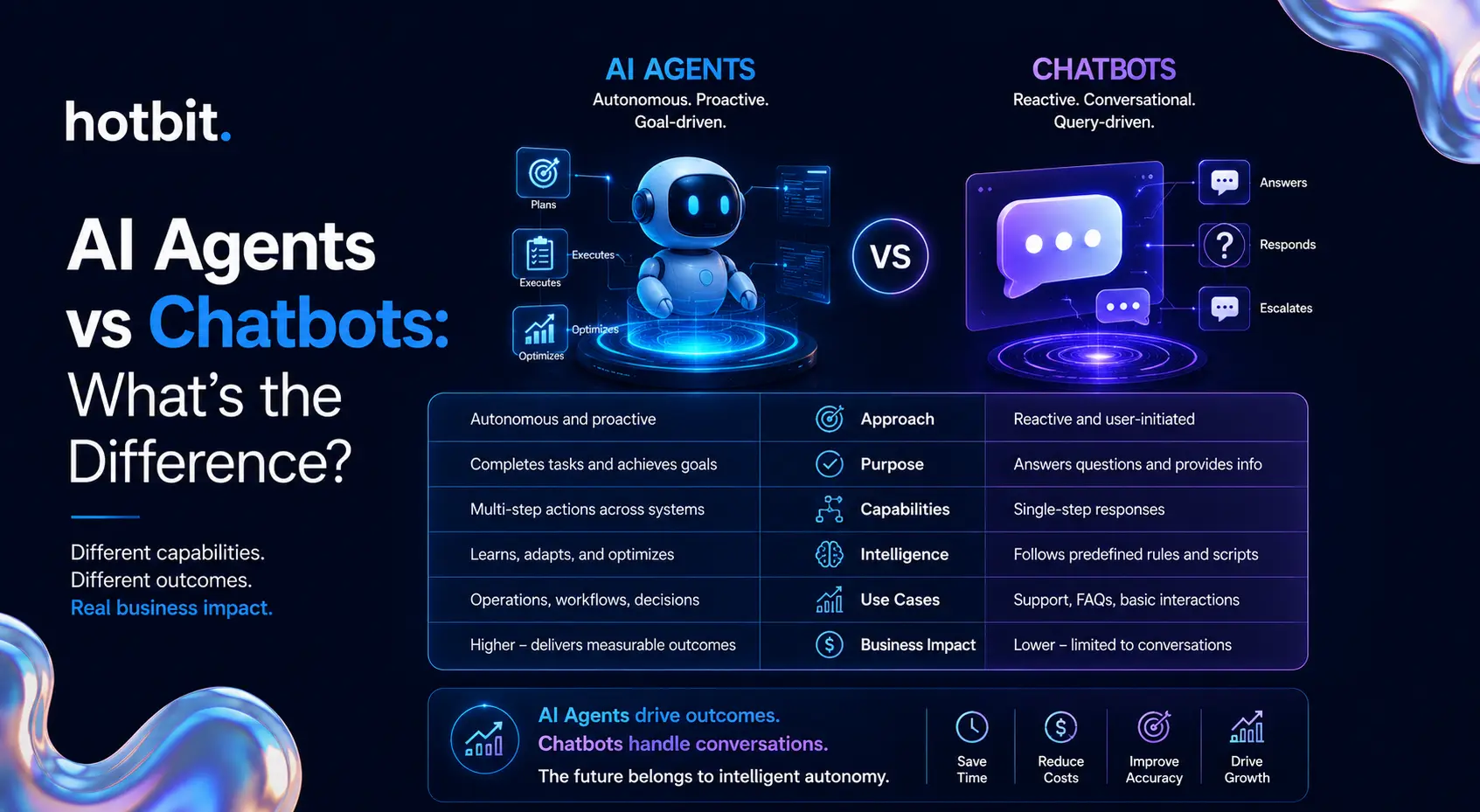
AI Agents vs Chatbots: What’s the Difference?

Every enterprise buying AI right now is really asking one question, whether they realize it or not: are we purchasing a conversation, or a worker? Chatbots and AI agents get pitched under the same banner, but they are built to do fundamentally different jobs. Confusing the two is an expensive mistake to make at scale.

Gartner projects that up to 40% of enterprise applications will run task-specific AI agents by the end of 2026, up from less than 5% in 2025. That shift is not cosmetic. It marks the difference between software that talks and software that acts, and it is already reshaping how businesses budget for AI.

What Are AI Agents vs Chatbots?

A chatbot is a conversational tool, built on a script or a language model, that responds to what a user types. It answers questions, guides simple workflows like order tracking or password resets, and hands the conversation to a person once the request moves outside its scope. Most chatbots, rule-based or generative, operate turn by turn: one message in, one response out.
An AI agent is a different kind of system. Built on a foundation model, it plans a goal, uses tools or system access, and carries a task through to completion with far less turn-by-turn approval than a chatbot needs. Instead of narrating a workflow, it runs one. That distinction narrate versus run is the entire shift agentic AI represents for enterprise software.

The two are not always separated by a hard wall. Modern chatbots increasingly borrow tool-calling and workflow features from agents, and the boundary will keep blurring as the category matures. What has not blurred is intent: chatbots are still designed around conversation first, and agents are designed around task completion first.

Think of a retail example. A chatbot tells a shopper their package is delayed. An agent notices the delay before the shopper asks, checks the cause against carrier data, issues a credit within policy, and updates the order record, all without a person routing each step. Same starting point, two entirely different capabilities behind it.

Understanding the framework

Function

A chatbot answers a question. An agent completes a task and reports back.

Autonomy

A chatbot waits for the next prompt before doing anything else. An agent keeps moving through a multi-step process on its own.

Memory

A chatbot’s context usually resets with the conversation. An agent holds a goal in memory across the full task

System access

A chatbot typically reads from a knowledge base. An agent reads and writes to live databases, APIs, and business systems.

Decision-making

A chatbot follows scripted logic or retrieves a matched answer. An agent reasons through changing conditions and adjusts its own plan.

Oversight

A chatbot gets reviewed conversation by conversation. An agent gets governed by guardrails, then checked on outcomes.

Which one a business needs depends on the job, not the hype cycle. Deflecting a support ticket is a chatbot task. Resolving one end-to-end, refund included, is agent territory.

Where each one fits in your stack

Website FAQ and order status

A chatbot handles the volume, and it does so well. There is no task to complete, only a question to answer.

Support ticket resolution

An agent looks up the order, checks policy, issues a refund or credit, and closes the ticket in one connected pass.

Internal knowledge lookup

A chatbot surfaces the right document fast. It does not need to act on what it finds.

Invoice reconciliation

An agent pulls records from more than one system, flags mismatches, and routes exceptions without waiting for a person to kick off each step.
Security monitoring
An agent watches for anomalies continuously and can respond in real time. A chatbot has no role here at all.
A business rarely needs to choose only one. Most mature stacks run a chatbot for first-line conversation, then escalate to an agent, or a person, whenever the request requires action rather than information. Layering the two well, rather than replacing one with the other outright, is usually the fastest path to a working system.

The Real Risk: Confusing a Chatbot for an Agent

McKinsey’s 2025 State of AI Global Survey found that 23% of organizations are already scaling agentic AI in at least one business function, with another 39% experimenting. Two years ago, that category barely existed inside enterprise planning. Now it is where the next wave of software budget is heading, and the businesses treating agents as “chatbots with a new label” are the ones about to fall behind.
Gartner’s own market data backs this up. Agentic AI spending is forecast to overtake chatbot and assistant spending by 2027, as budgets shift from conversational tools toward systems built to finish work rather than just describe it. Customer service is the clearest early proof point: Gartner projects that agentic AI will autonomously resolve 80% of common customer service issues by 2029, cutting operational costs by roughly 30%. That is not a marginal efficiency gain. It is a different operating model.
The catch is real, and worth stating plainly. Gartner also predicts that over 40% of agentic AI projects will be canceled by the end of 2027, driven by unclear business value, rising cost, and governance that never caught up to what the agent was actually allowed to do. In a June 2025 announcement, Gartner estimated that only around 130 of the thousands of vendors marketing “agentic AI” met its bar for genuine agentic capability the rest were chatbots and automation tools repackaged for a hotter category.

That is the real risk of this shift: not the technology, but the mismatch between what a business buys and what a business actually needs. An agent deployed without the right oversight can act on bad information at scale, fast, across live systems. A chatbot misapplied to a task it cannot finish just wastes a customer’s time. Neither failure mode is acceptable, but they call for different fixes, and they start with knowing which system is actually in front of you.

That is the real risk of this shift: not the technology, but the mismatch between what a business buys and what a business actually needs. An agent deployed without the right oversight can act on bad information at scale, fast, across live systems. A chatbot misapplied to a task it cannot finish just wastes a customer’s time. Neither failure mode is acceptable, but they call for different fixes, and they start with knowing which system is actually in front of you.

Businesses that get this right treat the decision as an architecture question, not a vendor pitch. What does the task actually require: a conversation, or a completed action? Who reviews the outcome, and how often? What system access does this tool genuinely need, and what should it never touch? Answer those before signing anything, and the “chatbot versus agent” debate stops being confusing.
Governance is not an afterthought here; it is the deployment. An agent with database write access and no guardrails is a liability the moment conditions change in a way nobody scoped for. The businesses pulling ahead are not the ones moving fastest into agentic AI. They are the ones matching autonomy to oversight from the first design conversation, then scaling only once that pairing holds up under real load.

How do I know if my business needs an agent instead of a chatbot?

Look at what happens after the answer is given. If the task ends with information delivered, a chatbot covers it. If the task ends with a system updated, a record changed, or an action taken across more than one platform, that is agent territory, and it needs the oversight to match. When in doubt, map the full task from request to resolution before choosing either architecture.

Can a chatbot be upgraded into an agent later?

Not by adding a feature. A chatbot needs planning ability, persistent memory across steps, and real tool or system access to function as an agent, and that generally means a different underlying architecture rather than an update to an existing one. Businesses that try to stretch a chatbot into agent-level work usually end up rebuilding from the ground up anyway.

What is the biggest mistake businesses make when adopting AI agents?

Buying a chatbot marketed as an agent, then discovering the gap only after deployment. Gartner’s estimate that just around 130 vendors out of thousands met its bar for genuine agentic capability is the clearest signal that procurement, not technology, is where most projects actually fail.

How Hotbit Infosoft Can Help

Hotbit Infosoft is a digital-first technology company specializing in AI Automation, Product Engineering, Business Transformation, Cloud, Team-as-a-Service, and iGaming & Fantasy solutions, and we build agentic and conversational systems purpose-built for how a business actually operates, not a generic bot bolted onto a website. Our AI Automation team scopes the right architecture, chatbot, agent, or a combination of both, before a single line of code gets written, so the system a business deploys matches the job it actually needs done. Ready to find out which one your business needs? Talk to an expert and start scoping your build.

Frequently Asked Questions (FAQs)

What is the main difference between AI agents and chatbots?

Chatbots are primarily designed for conversation, answering questions, and guiding users through defined workflows. AI agents are designed to plan and execute multi-step tasks using tools, APIs, and business systems with greater autonomy.
It depends on the task. A chatbot is ideal for FAQs, basic customer support, and information retrieval. An AI agent is better suited to tasks that require multiple steps, system access, decision-making, or completing an action from start to finish.
A chatbot can gain agent-like capabilities, but moving to agent-level functionality may require significant architectural changes. Planning, persistent task context, tool access, system integrations, and appropriate safeguards are typically needed.
Neither is universally better. Chatbots are effective for high-volume conversational tasks, while AI agents are better for multi-step processes that require action. Many businesses can benefit from using both together.
AI agents can create greater risks when they have access to live business systems and can take actions autonomously. Businesses should use appropriate access controls, guardrails, monitoring, testing, and human oversight based on the agent’s level of autonomy.