
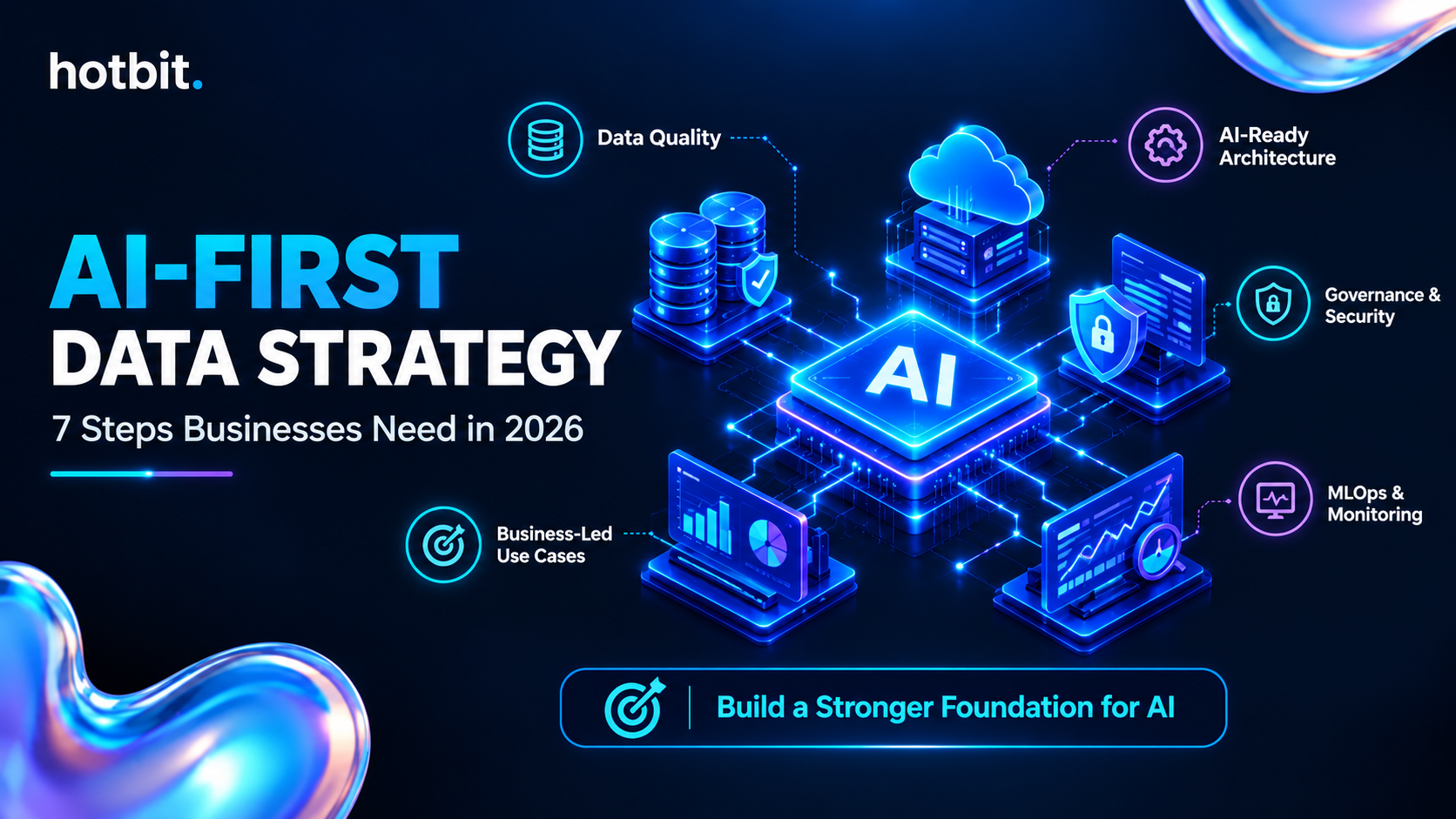
An AI-first data strategy designs data collection, quality, governance, and architecture around AI systems instead of bolting AI onto existing reporting. According to Gartner, organizations are forecast to abandon 60% of AI projects that are unsupported by AI-ready data through 2026. The businesses that rewire their data foundation first are the ones that move AI from pilot to production.
What Is an AI-First Data Strategy?
An AI-first data strategy makes AI use cases the primary driver of every data decision. It defines what data you collect, how you clean and govern it, where you store it, and how models and applications consume it. The plan starts with the business outcome an AI system must deliver, then works backward to the data required.
Traditional data strategies often emphasize reporting and business intelligence. An AI-first strategy builds for machine-readable, well-labeled, continuously refreshed data that models can learn from and act on. It treats data as a product with owners, quality standards, and service levels. Done well, it can shorten model deployment, reduce rework, and give leaders more confidence in AI outputs.
AI-first vs. traditional data strategy
Dimension | Traditional Data Strategy | AI-First Data Strategy |
Primary goal | Reporting and business intelligence | Predictions, automation, and AI-driven decisions |
Data consumers | Analysts and executives | Models, AI agents, and applications |
Data types | Mostly structured | Structured, unstructured, and streaming |
Quality standard | “Good enough” for dashboards | Labeled, consistent, and continuously validated |
Governance | Access control and compliance | Lineage, bias monitoring, model risk, and compliance |
Ownership | Central IT team | Domain-level data product owners |
Organizations rarely switch overnight. Start with the data behind your highest-value AI use case and expand from there.
The five pillars of an AI-first data strategy
Each pillar addresses a specific cause of AI project failure:
- Use-case alignment: every data investment links to a measurable outcome, such as lower churn, faster claims processing, or reduced downtime.
- Data quality: data is accurate, complete, consistent, and labeled to the standard models require.
- Unified architecture: trusted data across separate systems is reachable through governed access, using a centralized platform such as a cloud data warehouse or lakehouse, or a federated approach.
- Governance and security: policies define ownership, access, lineage, privacy, and responsible AI use.
- People and operating model: teams hold the data engineering, MLOps, and domain skills to run the strategy daily.
Weakness in any one pillar limits the value of the other four. Technology purchases alone do not create an AI-ready organization.
AI-First Data Strategy: How to Build One in Seven Steps
Each step produces a concrete deliverable, and teams can run steps in parallel once the first two are complete.
1. Define business-led AI use cases
Start with three to five use cases ranked by business value and data feasibility. Write each as a measurable goal, such as “reduce invoice processing time by 40%.” Use cases set the scope of every later decision and stop unfocused data collection.
2. Audit your current data assets
Catalog every source, its owner, format, refresh frequency, and quality. The audit exposes silos, duplicates, and gaps before they stall a model. It also shows whether current practices can support the planned use cases.
3. Set data quality standards
Define thresholds for accuracy, completeness, timeliness, and consistency for each use case. Automate validation inside pipelines so errors are caught at ingestion, not after a model fails in production.
4. Modernize your data architecture
Provide governed access to trusted data across systems, centralized or federated as each use case demands. Match batch, streaming, or near-real-time pipelines to latency needs, and plan for structured and unstructured content and elastic compute. Platforms such as Snowflake and Databricks are common options.
5. Establish governance and responsible AI controls
Assign data owners, document lineage, and set access and retention rules. Add controls for bias, explainability, and regulatory requirements. Building governance early can reduce the cost and complexity of later remediation.
6. Build the right team
Combine data engineers, ML engineers, analysts, and domain experts. When hiring is slow, Team-as-a-Service gives you pre-vetted specialists and can shorten recruitment time.
7. Operationalize with MLOps and continuous improvement
Automate model deployment, monitoring, and retraining. Track data drift and model performance against the business metrics set in step one. An AI-first data strategy is a living system, so review it quarterly.
AI-Ready Data Architecture and Governance: Where Strategy Meets Infrastructure
An AI-ready data architecture delivers clean, governed, and timely data to machine learning models and AI applications at scale. It typically combines storage for structured and unstructured data, batch or streaming ingestion pipelines, a metadata catalog, and security controls in one managed environment. These capabilities can also support AI automation solutions by making reliable data available for AI-driven workflows.
Models read from trusted sources, so results stay consistent across departments. Cloud platforms can scale storage and compute independently, but costs depend on workload design, resource usage, and cost controls. Businesses with legacy on-premises systems usually phase the move, migrating the data behind their top-priority AI use case first.
Data governance for AI
Governance in an AI-first data strategy keeps AI data accurate, secure, traceable, and lawful. It extends traditional governance with training-data lineage, bias testing, explainability, and human oversight of automated decisions. Understanding how AI agents are changing business operations in 2026 can also help organizations evaluate the governance requirements of increasingly autonomous workflows.
Strong governance answers four questions for every dataset. Who owns it? Where did it come from? Who may use it, and for what purpose? How long is it retained?
Privacy laws such as India’s Digital Personal Data Protection Act and Saudi Arabia’s Personal Data Protection Law impose specific obligations. Which provisions apply depends on jurisdiction, the data processed, and phased commencement dates, so legal or compliance teams should confirm.
AI-First Data Strategy: Why Data Readiness Decides AI Results
The last era of data served dashboards. The next serves models, and adoption is already outpacing readiness. McKinsey & Company’s 2025 State of AI survey, fielded in June and July 2025, found that 88% of respondents say their organizations use AI in at least one business function. That is a survey result, not a count of every organization worldwide, and value depends on the data underneath.
Poor data quality is the cost of ignoring that. According to Gartner, it costs organizations an average of $12.9 million per year. The estimate comes from a 2020 survey of data quality solution reference customers, so treat it as a historical benchmark, not a current cost for every organization. Models trained on inconsistent, duplicated, or outdated records produce unreliable predictions, and unreliable predictions erode stakeholder confidence fast.
Data volume adds pressure. IDC’s 2018 Data Age 2025 research, sponsored by Seagate, projected that the global datasphere would reach 175 zettabytes by 2025. That is a historical forecast, not a measurement of the volume actually reached. Businesses that standardize early build a compounding advantage in every AI initiative that follows.
Common Challenges: Five Failure Points to Fix Early
The most common challenges are data silos, poor data quality, skills gaps, unclear ownership, and legacy infrastructure. Complexity and cost vary, and each one needs an explicit owner and a timeline:
- Data silos: departments store data in separate tools, which blocks a single view of the customer or operation. A shared platform and data catalog help resolve this.
- Poor data quality: duplicate and inconsistent records reduce model accuracy. Automated validation and master data management reduce errors.
- Skills gaps: few teams have enough data engineers and ML specialists. An experienced provider shortens the learning curve.
- Unclear ownership: data without an owner decays. Name a product owner for each critical dataset.
- Legacy infrastructure: some older systems cannot stream or scale without upgrades or integration layers. Phased modernization can lower risk and cost.
According to Gartner, a summary of its 2025 conference session reports an estimate that more than 50% of generative AI projects fail. The estimate covers generative AI projects specifically, not all AI projects, and it is separate from the AI-ready data forecast cited earlier. Address these five challenges early and you shrink that risk.
Business Functions: One Data Foundation, Many AI Use Cases
The same governed data foundation can feed multiple AI applications, and reusable infrastructure may reduce the effort each later use case requires. Outcomes depend on implementation and data quality:
- Operations: predictive maintenance and demand forecasting can reduce downtime and waste through AI Automation.
- Customer service: AI assistants can resolve routine queries using unified customer data.
- Finance: automated reconciliation and anomaly detection can improve accuracy and speed.
- Product development: usage data guides features, and Product Engineering teams build AI capabilities directly into applications.
- Gaming and fantasy platforms: player analytics, fraud detection, and personalization often rely on low-latency data pipelines, a focus of Hotbit’s iGaming & Fantasy work.
These applications feed the wider Business Transformation agenda, where data becomes the base for new operating models.
Measuring Success: Data Health and Business Outcomes
Success is measured by two sets of metrics. Data health shows whether the foundation is sound: accuracy rate, completeness, duplicate rate, pipeline uptime, and data freshness. Business outcomes show whether it pays off: model performance (precision, recall, drift rate), delivery speed from idea to production model, and impact in cost saved, revenue gained, or hours automated.
Report both sets together to leadership. Set a baseline before launch, review monthly, and retire any metric no one acts on.
How We Can Help: Build Your AI-First Data Strategy with Hotbit Infosoft
An AI-first data strategy turns scattered data into a reliable engine for automation, prediction, and growth. As organizations adopt AI-driven workflows, understanding how AI is changing the role of software developers can help them evaluate the skills and engineering practices needed to build and maintain these solutions.
Hotbit Infosoft, a digital-first technology company specializing in AI Automation, Product Engineering, Business Transformation, Cloud, Team-as-a-Service, and iGaming & Fantasy solutions, has delivered 100+ success stories for 200+ global brands across 12+ industries.
With 15+ years of delivery experience across India, Singapore, Mauritius, and Saudi Arabia, our Cloud practice helps you select and migrate to the architecture that fits your workloads. Start by assessing data readiness against your first AI use case, then book a consultation and let us build the foundation with you.
AI-First Data Strategy: Frequently Asked Questions
What is an AI-first data strategy?
It is a plan that designs data quality, governance, and architecture around AI requirements. It starts with business use cases and works backward to the data needed. The goal is reliable, scalable AI outputs, not reports built for human analysts alone.
How do you build a data strategy for AI?
Build it in seven steps: define business-led AI use cases, audit existing data, set quality standards, modernize architecture, establish governance, build a skilled team, and operationalize with MLOps. Start with one high-value use case, prove results, then expand across other functions.
What are the key components of an AI data strategy?
The key components are use-case alignment, data quality, unified architecture, governance and security, and skilled people. A weakness in any one limits AI performance, so assess all five before scaling.
Why is data important for AI strategy?
Data is the raw material models learn from, so data quality sets the ceiling on model accuracy. Gartner estimates that poor data quality costs organizations an average of $12.9 million per year. Reliable data reduces rework, improves predictions, and builds trust in automated decisions.
What is the difference between data strategy and AI strategy?
A data strategy governs how an organization collects, stores, and manages data. An AI strategy defines where AI creates business value. The two depend on each other: AI strategy sets the goals, and data strategy supplies the trusted data needed to reach them.
Disclaimer
This article is for informational purposes only and does not constitute legal, financial, or professional advice. Statistics and industry forecasts are based on the cited sources and may change over time. Results from AI and data strategy implementations vary depending on business needs, data quality, infrastructure, and implementation. Consult qualified professionals for advice specific to your organization.