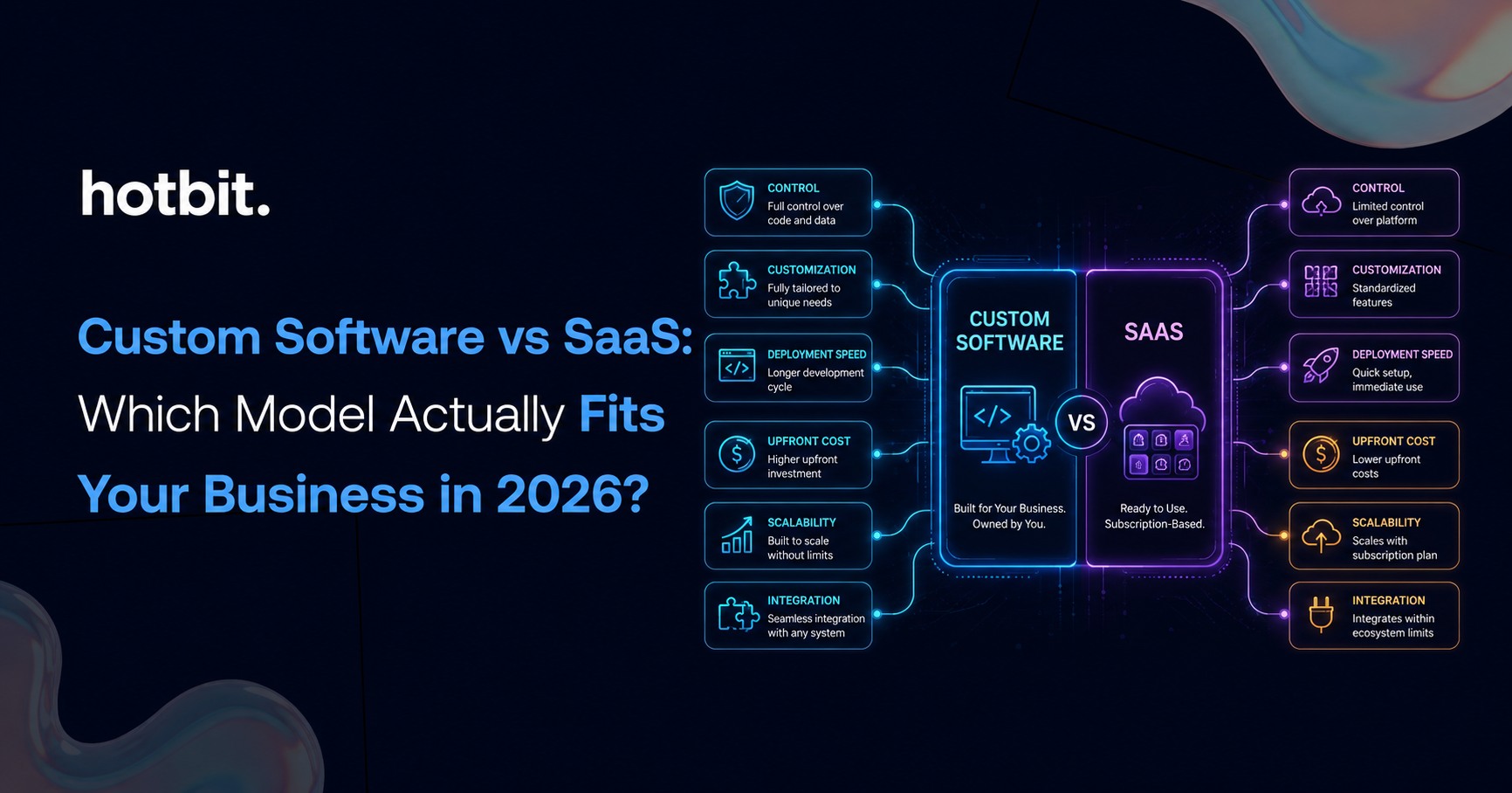
Custom Software vs SaaS: Which Model Actually Fits Your Business in 2026?

Every growing company eventually faces the same fork in the road: build a system around your business, or adapt your business around someone else’s system. Custom software vs SaaS is that decision in its purest form, and getting it wrong is expensive in either direction: either you overpay for a custom build no one needed, or you hit a ceiling with a SaaS tool that was never designed for your scale.

What Is Custom Software vs SaaS?

Custom software is an application designed, built, and owned by or exclusively for a single organization to match its specific processes, data structures, and integrations. SaaS is a subscription-based application, hosted and maintained by a third-party vendor, that many companies use simultaneously through a shared codebase with limited ability to change how it works.
The real difference is not price. It is ownership and fit. Custom software bends to match how you already operate. SaaS asks you to bend toward a standardized workflow instead. Neither approach is universally right; the right one depends on how standard, or how specialized, the underlying process actually is.

Understanding the Trade-Off

When custom software wins: your workflows, compliance requirements, or scale outgrow what any off-the-shelf product was built to handle. This is common among large enterprises running complex, high-volume operations, and in specialized segments with strict regulatory demands: insurance claims processing, healthcare records, proprietary supply chains. If your competitive advantage lies within a specific process, a purpose-built system protects that advantage rather than exposing it to a shared platform your competitors also use.
When SaaS wins: speed, budget, and standardization matter more than a perfect fit. Younger and growth-stage companies lean toward SaaS because low upfront cost and fast setup outweigh imperfect fit early on. It’s also the stronger call for functions that are genuinely identical across every company: email, basic CRM, expense tracking, where building something custom would only recreate a solved problem at a higher cost. The trade-off is dependency: pricing, features, and the tool’s continued existence sit with the vendor, not with you.

Why the Sticker Price Doesn't Tell the Whole Story

The most common mistake in this decision is comparing a SaaS subscription’s list price against a custom build’s development price without accounting for what happens over years, not months. SaaS costs frequently extend well beyond the subscription fee once you factor in integrations, rising per-seat licensing, customization, training, and ongoing administration. Custom software front-loads its cost instead; you pay more to build, then own the result with no recurring license fee compounding year over year. For a process you’ll still be running in five years, that difference often flips which option is actually cheaper.

Custom and SaaS Aren't Mutually Exclusive

Most mature technology strategies don’t pick one model exclusively. They run SaaS for standardized functions and build custom systems for the processes that differentiate the business. You might run email and HR on SaaS while building a custom platform for core product delivery, a customer-facing portal, or a regulated data workflow. This is where AI Automation and Product Engineering work alongside the SaaS tools you already rely on, rather than replacing every system in your stack.

How Hotbit Infosoft Helps You Decide

Hotbit Infosoft works with founders, CTOs, and operations leaders to map this decision against real business requirements, not a generic checklist. Our Business Transformation practice starts by identifying which of your processes are genuinely standard and better served by SaaS and which are specialized enough to justify custom development. If you need engineering capacity without building a full in-house team, our Team-as-a-Service model supplies pre-vetted professionals who can extend your team on either path, and we build on Cloud infrastructure designed to scale custom applications without the overhead that sinks many first builds. Talk to an Expert to map the right approach for your business.

The Bottom Line

Custom software vs SaaS isn’t a question of which model is universally better. It’s a question of which of your processes are standard enough for a shared product, and which are specialized enough to justify owning the code. Talk to an Expert and we’ll help you map out the right path or the right combination for where your business is headed.

FAQs: Custom Software vs SaaS

Is custom software cheaper than SaaS in the long run?

For complex or long-lived processes, often yes. Custom software tends to deliver stronger long-term ROI once a workflow is specialized, since SaaS costs frequently extend well beyond the subscription price through integrations, licensing, and administration.
Custom software is built and owned by one organization to match its exact processes. SaaS is a shared, subscription-based application licensed from a vendor, in which you adapt your workflow to fit the product rather than the reverse.
Small and younger businesses lean toward SaaS. Lower upfront cost and faster setup make it the more practical starting point before your processes become specialized enough to justify a custom build.
Yes. Most mature companies run SaaS for standardized functions like email or HR while building custom software for the processes that differentiate their business, such as core product delivery or regulated workflows.
SaaS can typically be deployed in days to weeks since it’s already built. Custom software generally takes several months to over a year, depending on scope, because it’s designed and developed specifically for you.
Regulated and specialized industries need workflows that match strict compliance requirements exactly. Some SaaS platforms can’t meet highly specialized regulatory needs without heavy configuration; a purpose-built system closes that gap from the start.