
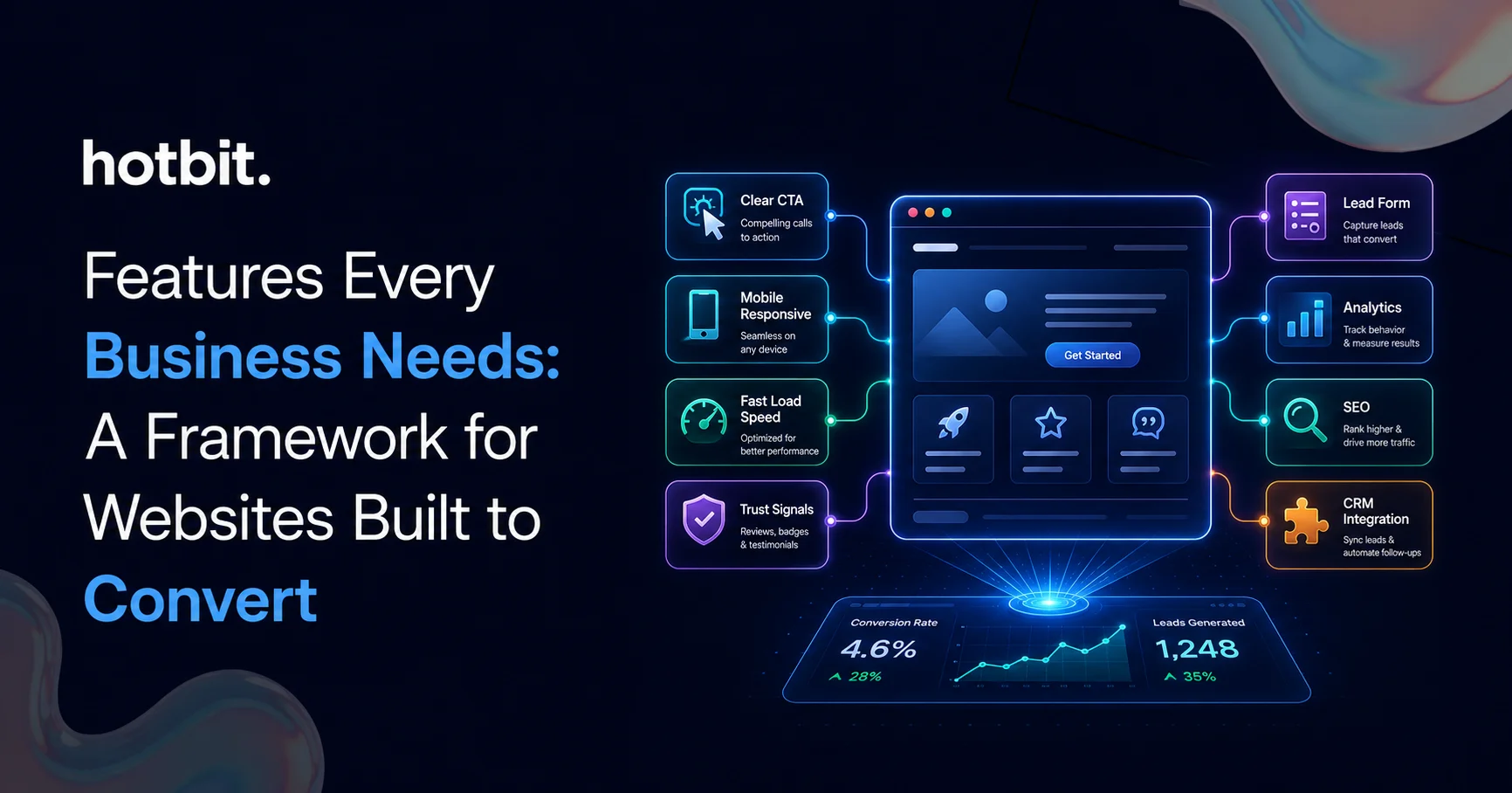
More than 60% of website traffic now comes from mobile devices, according to industry research, and a site not built for that reality is behind before a single word gets read. This breakdown covers the complete set of features every business needs to turn traffic into pipeline, not just page views.
Building a high-performing website requires the right technology partner. Hotbit Infosoft offers custom website development, Product Engineering, AI Automation, and Cloud solutions to help businesses build secure, fast, and conversion-focused websites.
What Are the Features Every Business Needs on a Website?
Understanding the Framework: 13 Features Every Business Needs
1. Mobile-responsive design. Text, images, and navigation need to resize automatically for any screen. A site that doesn’t do this loses visitors before the message even lands, and it signals to search engines that the experience wasn’t built for how people actually browse today.
2. Fast page speed. Every additional second of load time makes visitors more likely to abandon the page. Core Web Vitals LCP, INP, and CLS now factor directly into how Google ranks a site, so speed is a ranking input, not just a courtesy.
3. Clear navigation. Visitors decide within seconds whether a page is relevant to them. Navigation that doesn’t answer “what do you do and where do I go next” loses them in that window, no matter how strong the content underneath it is.
4. HTTPS encryption. The padlock in the address bar is a baseline requirement now, not a bonus. Its absence is a red flag visitors recognize instantly, and it can quietly suppress search visibility too.
5. Specific calls-to-action. Vague “Learn More” links do less work than a direct next step: “Talk to an Expert,” “Book a Consultation” placed near the top of every important page. Specificity shortens the distance between interest and action.
6. A findable contact page. Phone, email, and a working form belong in the footer and on their own page. Buried contact details cost trust fast, especially with buyers comparing several vendors in the same sitting.
7. SEO-structured, AI-citable content. Content built around real buyer questions, with direct answers near the top of each section, gets found by search engines and AI answer engines alike: AI Overviews, Perplexity, ChatGPT Search, Gemini. This is quickly becoming as important as traditional search ranking.
8. Accessibility. Building toward WCAG standards, alt text, keyboard navigation, and color contrast is a baseline expectation now, not an advanced feature. It also reduces legal exposure in several markets a growing business will eventually operate in.
9. Live chat or AI-assisted messaging optional. This is valuable for businesses that can actually staff or configure it well. A bot no one maintains does more harm than good, so this feature earns its place only with real ownership behind it.
10. Social proof. Named client outcomes move a buyer further than another paragraph of product copy. Specificity is what makes proof persuasive: a name, a result, a number, not a generic testimonial.
11. Privacy policy and cookie consent. These are expected by visitors and required by law in many of the markets a growing business will eventually serve. Treating this as a legal formality misses that it’s also a visible trust signal.
12. Analytics and conversion tracking. Tools like GA4 and Search Console show which pages convert and where visitors drop off. Without this, a business is guessing at what to fix and where to invest next.
13. Ongoing maintenance. Backups, security patches, and uptime monitoring keep a well-built site from quietly decaying into a liability. A site is never “done”; it’s maintained, or it’s degrading.
Are You Ready for What's Next?
Nearly 70% of small-business websites still don’t have a clear call to action on their homepage, which means most competitors are already leaving leads on the table. The gap between a website that performs and one that quietly underperforms usually isn’t design. It’s how many of these 13 features are actually built in, and how many were skipped to save time.
How We Can Help
Hotbit Infosoft builds this complete feature set into every business website we deliver, from the first architecture decision through post-launch maintenance, using purpose-built systems designed for what’s next rather than what’s already familiar. Our Product Engineering team treats speed, security, accessibility, and conversion as one connected system, not a checklist assembled after launch. Book a consultation and find out which of these 13 features your site is still missing.