
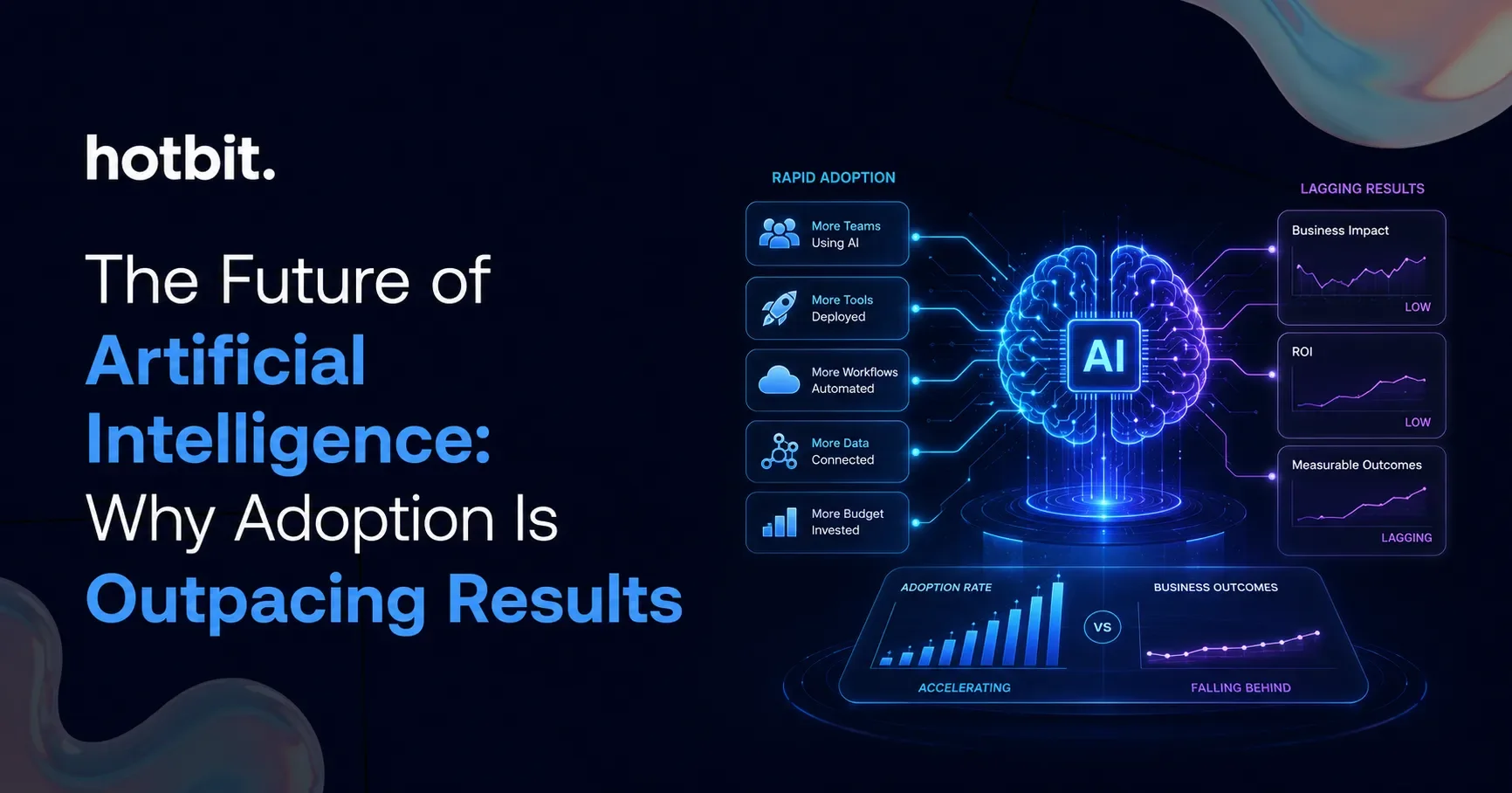
According to Gartner, worldwide AI spending will reach $2.52 trillion in 2026 a 44% year-over-year jump. That capital is moving fast, driven by enterprises and hyperscalers building out AI-optimized infrastructure. Whether it converts into results depends on decisions leadership teams make now, not in 2030.
The gap isn’t caused by weak technology. Foundation models, agent frameworks, and cloud infrastructure have matured rapidly, often faster than many organizations’ internal deployment processes. Leadership teams that recognize this early and build the governance and measurement discipline alongside technology often partner with Product Engineering Services to develop scalable AI-powered applications instead of isolated pilots.
What Is Driving the Future of Artificial Intelligence?
Three Forces Reshaping Enterprise AI
1. Agentic AI is moving from pilot to production. Agentic systems plan and execute multi-step tasks coding, research, customer workflows, internal operations with human checkpoints calibrated to how much is at stake. McKinsey’s 2025 State of AI survey found 62% of organizations are already experimenting with AI agents, and 23% report scaling one into at least one business function. That share is still climbing, and the gap between experimenting and scaling is exactly where most enterprise AI budgets are currently getting stuck.
2. AI infrastructure spending is compounding fast. IDC’s Worldwide Quarterly AI Infrastructure Tracker recorded $318 billion in global AI infrastructure spending for 2025, more than double the $153 billion spent the year before. Gartner projects infrastructure will claim roughly $1.37 trillion of total 2026 AI spend, by far the largest single category. This buildout is what makes production-grade AI accessible to mid-market organizations that don’t own the underlying hardware, shifting the constraint from compute access to execution discipline.
3. AI is embedding itself into consumer hardware. IDC forecasts Generative AI-capable smartphones will reach 54% of the global market by 2028. AI capability is no longer confined to the data center it now ships standard in the devices your team and your customers already carry, which raises the baseline expectation for every product and service interaction you deliver.
Are You Ready for the Shift to Agentic AI?
Adoption is no longer the bottleneck. Direction is. McKinsey’s 2025 research found 88% of organizations now use AI in at least one business function, up from 78% a year earlier. Yet only about a third have scaled any of it past the pilot stage, and a small minority report a measurable earnings impact.
How Hotbit Infosoft Helps You Build AI That Delivers
Our AI Automation team identifies which workflows carry a clear return before a single line of code gets written, builds the governance and human checkpoints directly into the system’s design, and measures impact from day one instead of retrofitting metrics after launch. That’s how a pilot becomes a production system instead of a line item nobody can justify a year later.
Ready to close the gap between AI spend and AI results? Talk to an Expert and build a roadmap designed for what’s next, not just what’s now.