
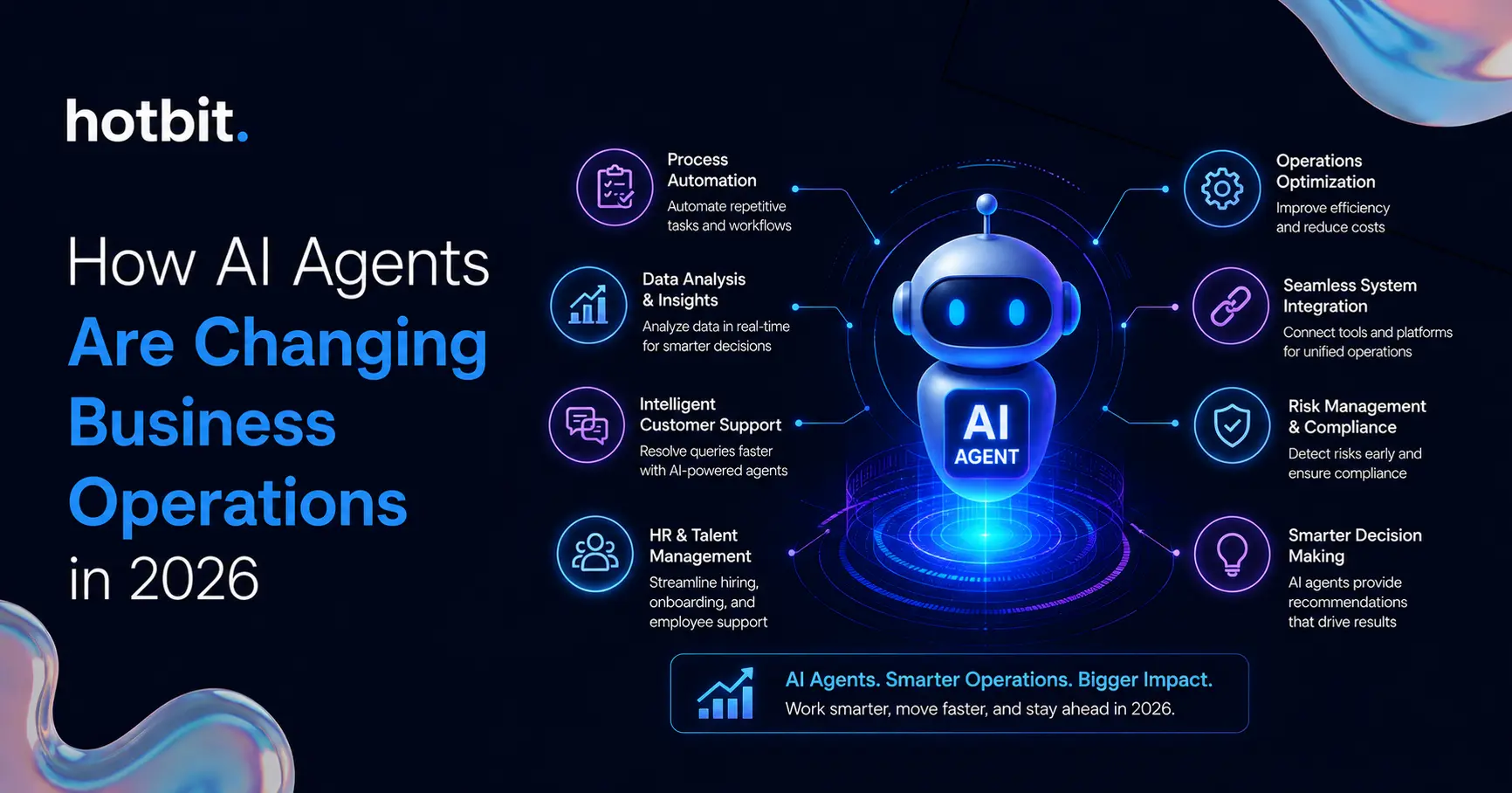
AI Agents don’t wait for instructions. They plan a task, decide the next step, and execute it inside your existing systems, then escalate only when something falls outside their scope. That shift, from responding to prompts to owning outcomes, is what separates an AI agent from a chatbot or a generic AI assistant.
Gartner projects that 40% of enterprise applications will carry task-specific AI agents by the end of 2026, up from less than 5% at the time of its 2025 forecast. That’s one of the fastest capability shifts enterprise software has seen. Adoption isn’t even, though some functions already run agents in production, while others are still stuck in supervised pilots.
What Are AI Agents in Business Operations?
An AI agent is a purpose-built system for one operational job, resolving a support ticket, matching an invoice, or screening a résumé. It senses its environment, makes a decision, and acts inside a system of record without waiting on step-by-step human input.
That’s different from generative AI tools, which only produce content on request. An agent connects to a specific system, a CRM, an ERP, a ticketing platform, and escalates to a human only when it crosses a defined confidence threshold.
Agentic AI describes the broader category: multiple coordinated agents handing work to each other across a workflow. Gartner expects roughly one-third of agentic AI implementations to combine agents with different skills by 2027, rather than relying on a single standalone agent.
Where AI Agents Operate Today
Six functions carry most of the real activity in 2026, though maturity still varies by industry and use case:
- Customer service — autonomous ticket resolution, refunds, and escalations.
- Finance and operations — invoice matching, expense auditing, and forecasting.
- Security and compliance — threat detection and policy enforcement.
- Sales and marketing — lead qualification and pipeline updates.
- Supply chain — inventory optimization and demand forecasting.
- HR — résumé screening and interview scheduling.
Functions with structured data and clear rules move first. Functions carrying regulatory complexity or judgment-heavy decisions move more slowly, and that gap defines where the real production activity sits right now.
The Gap Between AI Agent Pilots and Production
McKinsey’s 2023 research estimated that generative AI could generate $2.6 trillion to $4.4 trillion in annual value across 63 identified use cases. Agentic AI is expected to capture a growing share of that value as adoption matures; it isn’t a separate estimate of its own.
S&P Global’s Big Picture 2026 AI Outlook found that 58% of enterprises are actively pursuing agent capabilities. Turning that pursuit into live, reliable production use is the harder step, and it’s where most organizations are still working.
Finance, security, and customer service tend to move first because the data is structured and the rules are clear. Healthcare and government services move more cautiously, weighed down by regulatory complexity and judgment-heavy decisions
Consider a mid-size lender running invoice matching through an agent versus a hospital network automating triage decisions. Both are agentic AI, but the risk profile and the pace of adoption are nowhere near the same.
Are You Ready for AI Agents? The Governance Stakes
Gartner projects that more than 40% of agentic AI projects will be canceled by the end of 2027, citing escalating costs, unclear business value, and inadequate risk controls. Scoping, business value, and governance decide whether a project reaches production or gets shelved.
Three failure patterns show up again and again:
- Tasks scoped too broadly or ambiguously for the agent to execute reliably.
- No defined escalation path for edge cases.
- No measurable ROI target was set before the pilot began.
Businesses that treat a rollout like a software deployment, with a defined scope, a success metric, and a human-in-the-loop checkpoint, see materially different outcomes than those running an open-ended experiment.
BM’s 2026 Cost of a Data Breach Report found that organizations using AI and automation extensively across security operations reported breach costs roughly $1.93 million lower than those that didn’t and contained breaches about 65 days faster. Governance pays for itself directly.
AI Agents vs. Traditional Automation: What Actually Changed
The core difference is decision-making under uncertainty. Traditional automation RPA, if-then workflows follow predefined rules and struggle the moment input falls outside its expected pattern.
An AI agent interprets context and selects actions within defined boundaries instead. That’s closer to how a trained employee handles a task than how a fixed script does, though it still needs oversight.
Neither replaces the other outright. Many organizations can use both RPA for the deterministic, high-volume steps and AI agents for the judgment-heavy steps sitting on either side of them.
Picture an accounts-payable process: RPA pulls the invoice data into the system, and an AI agent decides whether a mismatch is a genuine exception or routine noise before it ever reaches a person. Each system does the part it’s actually built for.
How to Roll Out AI Agents That Scale in 2026
- Start with one workflow that already has clean data and a measurable outcome, such as invoice matching or Tier-1 ticket resolution, not an open-ended “customer experience” mandate.
- Set a specific ROI target and a review date before the agent goes live, not after.
- Define exactly when the agent escalates to a human, and audit those escalations monthly to refine the boundary.
- Layer in a second agent only once the first workflow is stable and measured.
That discipline is what separates the roughly one-third of enterprises Gartner expects to run collaborative, multi-agent systems by 2027 from the majority still stuck on isolated pilots.
The sequence matters more than the tooling. A well-governed rollout on a modest platform will outperform an ambitious multi-agent build with no escalation logic and no owner watching the ROI.
How We Can Help
AI Automation is where Hotbit Infosoft turns this shift into results: we scope one workflow, define the escalation path, and prove ROI before a second agent joins the system. Ready to move past the pilot stage? Book a consultation, and let’s map where an agent fits into your operations first.
Frequently Asked Questions (FAQs)
What is an AI agent in business?
An AI agent is a system that independently plans, decides, and executes a specific operational task, resolving a support ticket or matching an invoice without step-by-step human instruction. It escalates only when it hits a defined limit.
How are AI agents used in business operations?
AI Agents run autonomous workflows across customer service, finance, security, sales, supply chain, and HR, resolving tickets, matching invoices, detecting threats, qualifying leads, forecasting demand, and screening candidates, all within defined operational boundaries.
Are AI agents replacing jobs in 2026?
AI Agents are changing job roles more than eliminating them outright. Human work is shifting from executing routine tasks toward supervising agent output, handling exceptions, and managing the systems agents operate within, particularly in customer service and back-office finance.
What is the difference between an AI agent and RPA?
RPA generally follows predefined, rule-based workflows and can struggle with unexpected input. An AI agent evaluates context, adapts to variation, and makes bounded decisions better suited to tasks that involve judgment rather than pure repetition.
Why do AI agent projects fail?
Most AI agent projects fail from unclear scope, missing escalation paths, or no defined ROI target set before launch, according to Gartner, not from the underlying technology itself. Narrow scope and a measured outcome scale more reliably.
How much value can AI agents add to a business?
McKinsey’s 2023 research estimated generative AI could broadly add $2.6 trillion to $4.4 trillion in annual value across functions including customer service, finance, security, sales, supply chain, and HR. Agentic AI is expected to capture a growing share of that value as adoption matures, though realized value still depends on deployment discipline rather than the technology alone.