
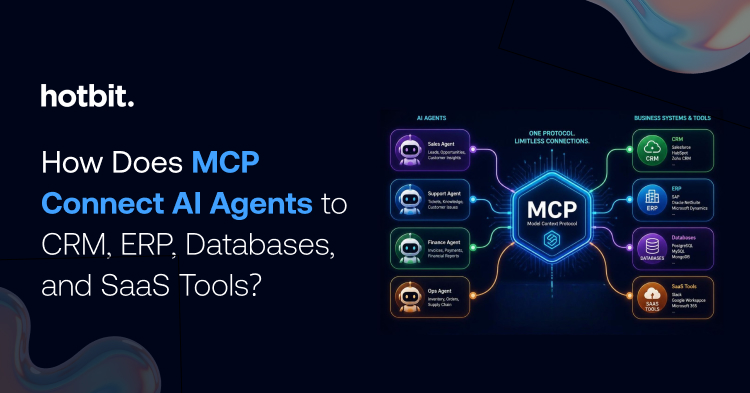
According to Gartner’s 2025 enterprise AI forecast, 40% of enterprise applications will embed task-specific AI agents by the end of 2026, up from less than 5% in 2025, and many enterprise AI agents require a secure way to reach CRM, ERP, database, and SaaS systems that already run the business.
A secure MCP server connection to an AI agent is a connection built on the Model Context Protocol (MCP), an open communication standard configured with authentication, authorization, permission scoping, and monitoring. This allows an AI agent to request data or trigger actions in external systems without requiring direct access to credentials or unrestricted systems.
The protocol defines how the AI agent and connected tools communicate, while the MCP server governs and secures those interactions. In practical terms, it acts as a controlled gateway, allowing an AI agent to read customer records, update ERP fields, or query databases without developers building a separate hard-coded integration for every tool.
This article walks through exactly how that connection works across CRM, ERP, database, and SaaS environments, what “secure” actually means in an MCP context, and why enterprise teams are standardizing on it in 2026.
What Is a Secure MCP Server Connection to an AI Agent?
How Does MCP Connect AI Agents to CRM Systems?
How Does MCP Connect AI Agents to ERP Platforms?
How Does MCP Connect AI Agents to Databases?
How Does MCP Connect AI Agents to Other SaaS Tools?
MCP vs. Traditional Point-to-Point API Integration: What's the Difference?
What Makes an MCP Server Connection Secure?
Authentication. Enterprise MCP deployments may use OAuth 2.0, JWT tokens, mutual TLS, and integration with an existing identity provider to authenticate users, applications, or sessions, depending on the implementation, rather than a single shared static credential.
Prompt injection. Content an MCP server pulls back from external tools can carry hidden instructions aimed at manipulating the agent’s next move. A secure implementation treats every tool result as untrusted input rather than a trusted command, and constrains what the agent can do regardless of what that result contains.
Data leakage prevention. Beyond scoping which tools an agent can call, mature implementations filter response fields, mask personally identifiable information before it reaches the model, and enforce tenant isolation controls designed to prevent one customer’s data from appearing in another session, with every access event captured in an audit trail.
Human-in-the-loop approval. For consequential actions an ERP financial posting, a CRM record deletion, a production database write the server layer can require explicit human confirmation before executing, letting enterprises extend agent access to sensitive systems incrementally rather than all at once.
Why Enterprises Are Adopting MCP for AI Agent Integration
Meanwhile, McKinsey’s State of AI 2025 research, which asked specifically about AI agents rather than AI use in general, finds 62% of organizations are at least experimenting with agents, but only 23% report scaling a deployment in even one business function a gap that points to integration and governance, not model capability, as the bottleneck.
A standardized, security-first connection layer like MCP is one of the tools closing that gap, and it’s why Hotbit Infosoft, a digital-first technology company specializing in AI Automation, Product Engineering, Business Transformation, Cloud, Team-as-a-Service, and iGaming & Fantasy solutions, builds MCP server architecture into its AI Automation engagements from day one.
MCP Security Checklist Before Production
Getting MCP Right the First Time
A secure MCP server connection is what turns an AI agent from a demo into a system a CRM, ERP, or database team is actually willing to trust with production access. The building blocks authenticated sessions, tool-level scoping, read/write separation, and centralized logging are well established; the work is in applying them correctly to each system an agent touches, and in designing the product engineering and cloud architecture around them from the start rather than bolting security on afterward.
Hotbit Infosoft designs and secures MCP server architecture as part of its AI Automation practice, connecting AI agents to CRM, ERP, database, and SaaS environments without exposing credentials or data your team hasn’t explicitly approved. Talk to an Expert to map out a secure MCP integration for your stack.
FAQ’s About AI Automation
What is MCP in AI?
How does MCP work with AI agents?
An AI agent acts as an MCP client and sends structured tool-call requests to an MCP server. The server authenticates the request, checks it against defined permission scopes, executes the narrowest action needed, and returns only the approved data. The agent never handles raw credentials directly.