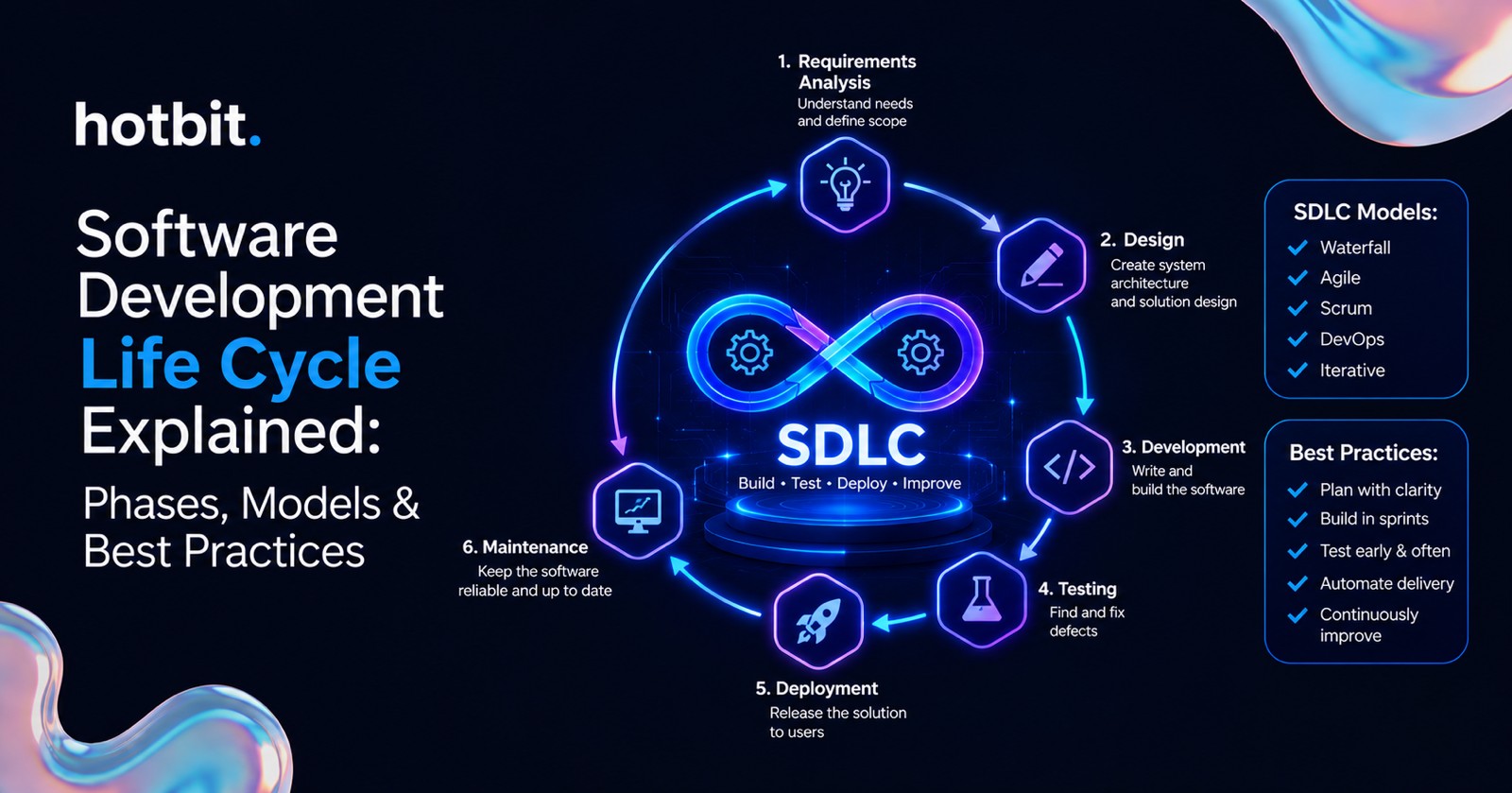
The Software Development Life Cycle (SDLC) turns a business requirement into working software through a defined, repeatable sequence: plan, build, test, deploy, maintain. Skip that structure and the cost shows up fast. According to a 2012 McKinsey and University of Oxford analysis of large IT projects with initial budgets above $15 million the average project ran 45% over budget, took 7% longer than planned, and delivered 56% less value than promised.
A disciplined SDLC doesn’t erase that risk on its own but it replaces a moving target with a structured way to manage requirements, quality, and delivery.
The SDLC is a framework that organizes software development and maintenance into a defined set of activities: planning, requirements analysis, design, development, testing, deployment, and maintenance. It helps teams manage requirements, quality checks, and handoffs in a structured way rather than handling development ad hoc.
Each activity can produce artifacts, decisions, or working software that inform the next stage. This makes the process more auditable and repeatable, whether a team follows a relatively linear sequence or repeats the same activities across overlapping iterations.
Organizations formalize the SDLC to reduce rework, improve budget control, and give stakeholders greater visibility into progress throughout the project. It provides structure without requiring every project to follow exactly the same development approach.
There’s no single authoritative SDLC taxonomy; organizations and textbooks split or combine activities differently but one commonly used breakdown divides software delivery into seven core phases:
Defines project scope, budget, timeline, resource allocation, and success criteria before any code is written. Weak planning is where most downstream cost overruns start.
Business analysts and stakeholders document functional and technical requirements in a formal specification. This is the phase most teams under-invest in, and the one that’s most expensive to revisit later.
Architects translate requirements into system architecture, database schemas, API contracts, and UI/UX wireframes. A strong design phase gives development a blueprint instead of a guess.
Engineers write, review, and integrate code against the approved design and coding standards. This is usually the longest phase, and the one most visible to stakeholders.
QA teams run functional, performance, security, and regression testing to verify the build against requirements. Compressing this phase to protect a launch date is one of the most common ways defects reach production.
The verified build moves to staging, then production, often through a CI/CD pipeline. Mature teams treat this as a repeatable, automated process rather than a one-off event.
The team monitors the live product, patches defects, applies updates, and manages ongoing performance and security. It’s also the phase most often left out of the original budget.
In sequential approaches, each phase typically gates the next before it begins. In iterative approaches, these same activities overlap and repeat within each increment instead of running once, start to finish. Either way, catching an unclear or incorrect requirement early tends to reduce downstream rework, though how much it saves varies by project, technology, and process.
The seven phases above can run under different sequencing models. Choosing between them is less about which model is objectively better and more about matching the sequencing to how stable the requirements actually are.
Waterfall runs linear each phase completes fully before the next begins. It can suit fixed-scope, compliance-driven projects where requirements are relatively stable and extensive upfront planning is appropriate, but it leaves little room to absorb changes once a phase has been signed off.
Agile is a family of iterative approaches, including Scrum and Kanban, built around evolving requirements and frequent stakeholder feedback. Iteration cadence varies by approach rather than following one fixed sprint length. It trades predictable, fixed-cost budgeting for continuous stakeholder involvement and the ability to redirect the backlog as market or user feedback comes in.
DevOps isn’t a phase model at all. It’s a set of practices: automation, shared ownership between development and operations, continuous delivery, and monitoring that layers on top of Agile, Waterfall, or a hybrid approach to compress the gap between code written and code running safely in production. Teams considering DevOps should expect a real investment in automation and CI/CD tooling before the payoff shows up in release frequency.
In practice, most mid-size and enterprise teams don’t run a pure version of any single model. A common pattern is Agile sprints for feature development, wrapped in a lightweight Waterfall-style gate for compliance sign-off, with DevOps practices layered on to automate the release itself. The model isn’t the point it’s a tool for controlling how much uncertainty the team is willing to carry at each phase. A team locking in a fixed-price contract with a client generally needs more Waterfall-style discipline up front; a team building a product against an unproven market generally needs more Agile-style room to change direction.
Most SDLC problems trace back to a small set of recurring root causes, and they tend to repeat across teams and industries regardless of which model is in use:
None of these are rare. The Standish Group’s CHAOS 2020 research classified about 31% of projects as successful, 50% as challenged, and 19% as failed under its methodology
a reminder that structured development practices reduce risk but don’t guarantee an outcome on their own. Execution, team capability, and stakeholder alignment carry as much weight as the process itself, and technical constraints like architecture choices or third-party dependencies can contribute to failure just as much as governance gaps.
The pattern behind most of these root causes is the same: a decision that should have happened in planning or requirements analysis instead gets made implicitly, mid-build, by whoever is closest to the problem at the time. That’s rarely the wrong person to make the call it’s the wrong phase for the call to be made in. Formalizing the SDLC doesn’t remove judgment calls from a project; it moves more of them earlier, when they’re cheaper to get wrong.