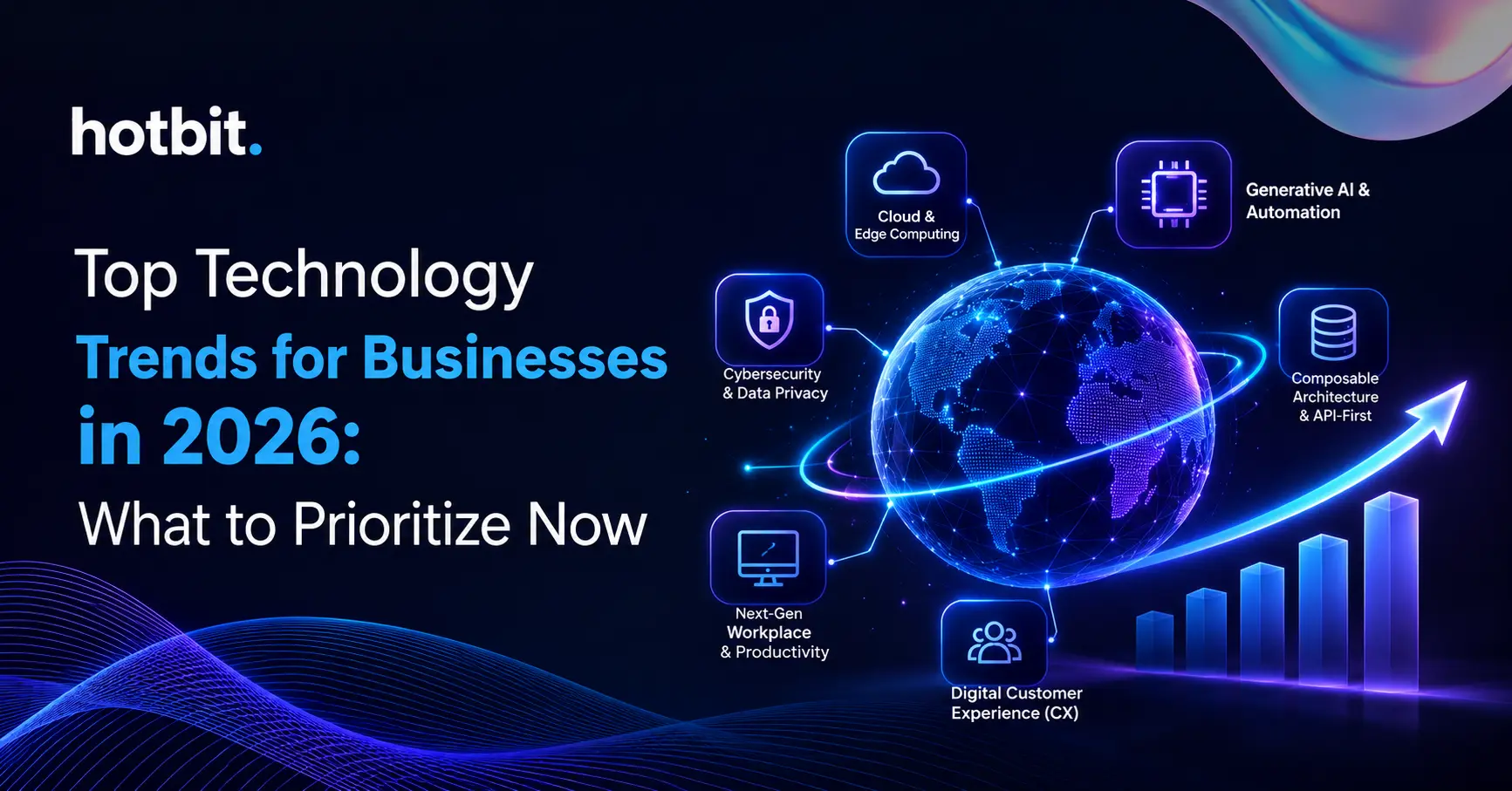
Top technology trends for businesses in 2026 aren’t a wish list they determine who scales AI and who stalls. According to McKinsey’s 2025 State of AI survey, 88% of organizations already use AI in at least one business function , yet most remain stuck in pilot mode rather than production.
The gap between adoption and impact is now the defining competitive line. Businesses pulling ahead this year aren’t the ones chasing every headline; they’re the ones matching each trend to a specific operational bottleneck and executing on it.
The top technology trends for businesses in 2026 fall into three groups: intelligence (agentic AI, domain-specific models, physical AI), infrastructure (AI-ready and sovereign cloud), and protection (governance and preemptive cybersecurity), plus the talent model businesses use to staff all three. This is Hotbit’s business-focused reading of Gartner’s Top Strategic Technology Trends for 2026, which groups ten trends into three themes: The Architect, The Synthesist, and The Vanguard. No single trend works alone.
A business that adopts agentic AI without governance isn’t building capability it’s stacking risk. The next era of enterprise technology rewards sequencing, not speed alone.
Modular AI agents that collaborate on multi-step tasks are one of Gartner’s headline 2026 trends, built to automate work no single model can handle alone. McKinsey found 62% of organizations experimenting with AI agents, but only 23% have scaled deployment into a business function; KPMG puts active deployment at 54% among large US firms, up sharply from 11% a year earlier. Start narrow-ticket triage, code review, internal search, and prove the return before expanding scope.
2. Domain-specific AI models
Models trained on a single industry’s data, terminology, and compliance rules can outperform generic large language models on accuracy, which is why Gartner names them a core 2026 trend. McKinsey shows adoption running highest in technology and software (88%) and financial services (79%), sectors where compliance stakes reward precision over generic, off-the-shelf tools. For regulated industries, this is the trend that determines whether AI becomes a liability or an asset.
3. AI-ready and sovereign cloud
Intelligence embedded into robots, drones, and smart equipment extends automation past the screen and onto the factory floor. IDC’s 2026 Manufacturing Industry FutureScape projects more than 40% of manufacturers will adopt AI scheduling tools within a year, rising to 65% by 2030, with predictive maintenance and quality control leading current deployments. For logistics, manufacturing, and retail businesses, this is often the most immediately relevant trend on the list.
5. Preemptive cybersecurity and AI governance
Gartner groups these under its protection theme a shift from reactive incident response toward continuously closing risk before it’s exploited. IDC research ranks governance and data-readiness gaps among the leading barriers stopping AI pilots from ever reaching production. Cybersecurity and governance investment needs to scale in step with AI investment, not trail behind it.
TaaS isn’t one of Gartner’s named 2026 trends, but it’s the talent model businesses use to execute the five above. Most organizations racing to operationalize agentic AI and domain-specific models simply don’t have the specialized engineering talent in-house, on the timeline the market demands. Access to pre-vetted specialists can offer a faster path to that talent than a traditional recruitment cycle, without the same fixed hiring commitment.
Together, these six trends cover where most 2026 technology budgets are already headed: infrastructure, intelligence, protection, and the talent to run all three.
IDC research shows a large share of AI pilots still fail to reach production due to governance and data-readiness gaps, not model quality the technology is ready; most organizations’ foundations aren’t. The businesses that win in 2026 are the ones that close that gap first.