
88% of organizations now use AI in at least one business function, up from 78% a year earlier. Most remain in the experimentation or pilot stage (McKinsey, The State of AI in 2025).
Gartner predicts that over 40% of agentic AI projects will be canceled by the end of 2027. The reasons include escalating costs, unclear business value, and inadequate risk controls.
This piece from Hotbit Infosoft looks at that gap directly. Hotbit Infosoft is a digital-first technology company specializing in AI Automation, Product Engineering, Business Transformation, Cloud, Team-as-a-Service, and iGaming & Fantasy solutions. The sections below separate the automation trends worth building around from the ones likely to stall in pilot mode.
What Is the Future of Automation?
McKinsey estimates that current generative AI and other technologies have the technical potential to automate activities accounting for 60–70% of employees’ time, not 60–70% of jobs. The acceleration is largely driven by generative AI’s improved ability to understand natural language, which is involved in work activities accounting for about 25% of total work time.
Trends Shaping Automation Through 2026
Automation Models Compared: RPA, AI Automation, Hyperautomation & Agentic AI
Benefits of Automation for Businesses
Bain’s 2024 survey found that automation leaders, meaning organizations investing at least 20% of their IT budget in automation, reported average cost savings of 22%. Organizations investing less than 5% reported savings of just under 8%.
Challenges to Scaling Automation
Technology isn’t the biggest obstacle to the future of automation. Execution is.
McKinsey’s 2025 State of AI survey found that 23% of respondents say their organizations are scaling an agentic AI system somewhere in the enterprise. Another 39% are experimenting.
How Hotbit Infosoft Supports Automation Programs
Hotbit Infosoft, a digital-first technology company specializing in AI Automation, Product Engineering, Business Transformation, Cloud, Team-as-a-Service, and iGaming & Fantasy solutions, works with founders, CTOs, and operations leaders to close that gap. The approach starts with scoping one workflow.
That approach spans document and data processing automation through to multi-step agentic workflows. Product Engineering and Cloud infrastructure support the automation once it’s running.
For regulated environments such as online gaming platforms, the same principles apply within jurisdiction-specific compliance requirements. Hotbit’s iGaming & Fantasy practice handles this work.
Businesses staffing up for an automation initiative can also draw on Team-as-a-Service (TaaS) to bring in relevant technical skill sets without a lengthy hiring cycle.
If you’re scoping where automation fits in a 2026 roadmap, talk to an expert at Hotbit Infosoft about your specific workflow.
The Bottom Line
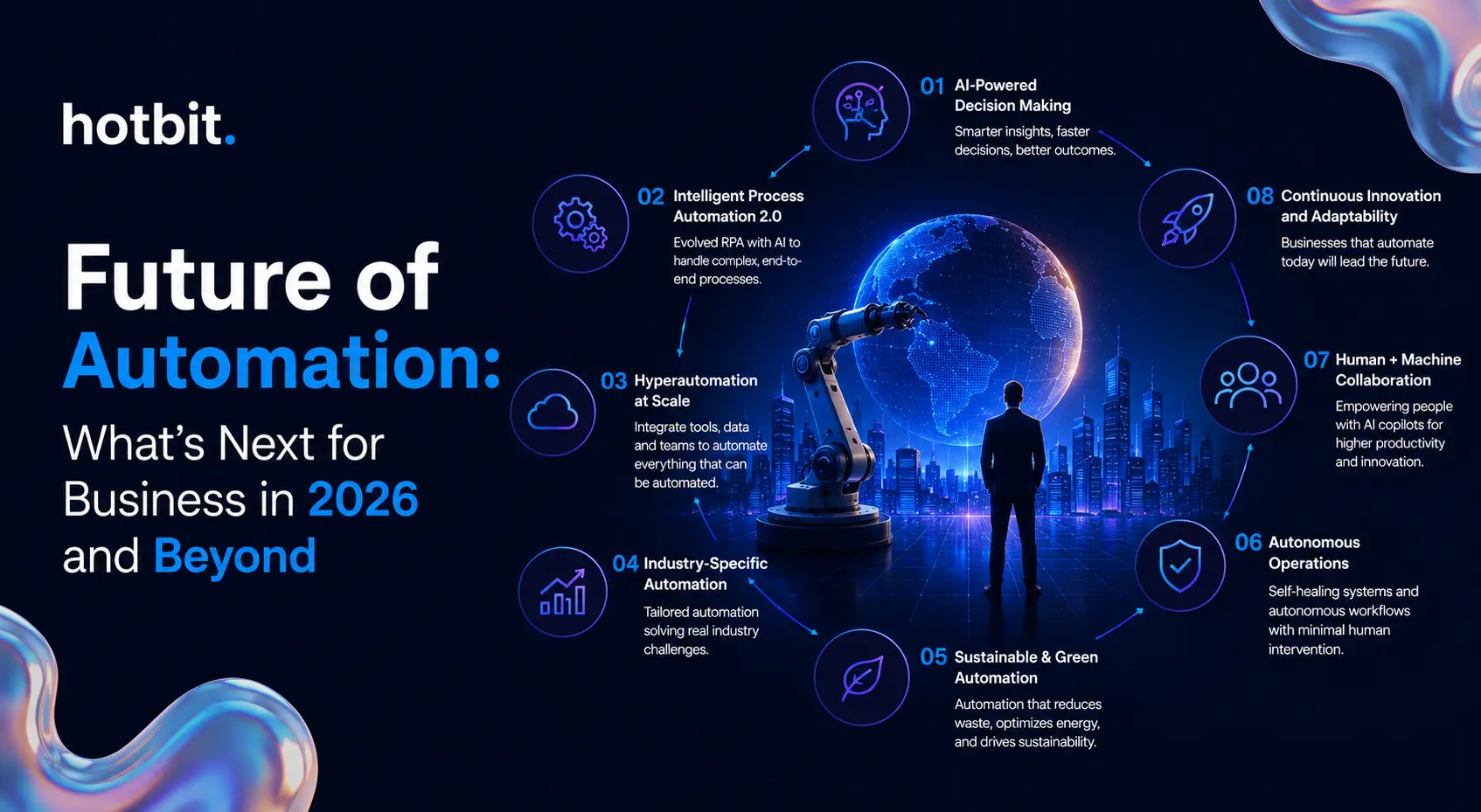
The future of automation isn’t a single technology. It’s the combination of RPA, AI automation, hyperautomation, and agentic AI, applied to workflows that used to require constant human coordination.
If you’re evaluating where automation fits in your 2026 roadmap, talk to an expert at Hotbit Infosoft to scope a workflow-specific automation plan.