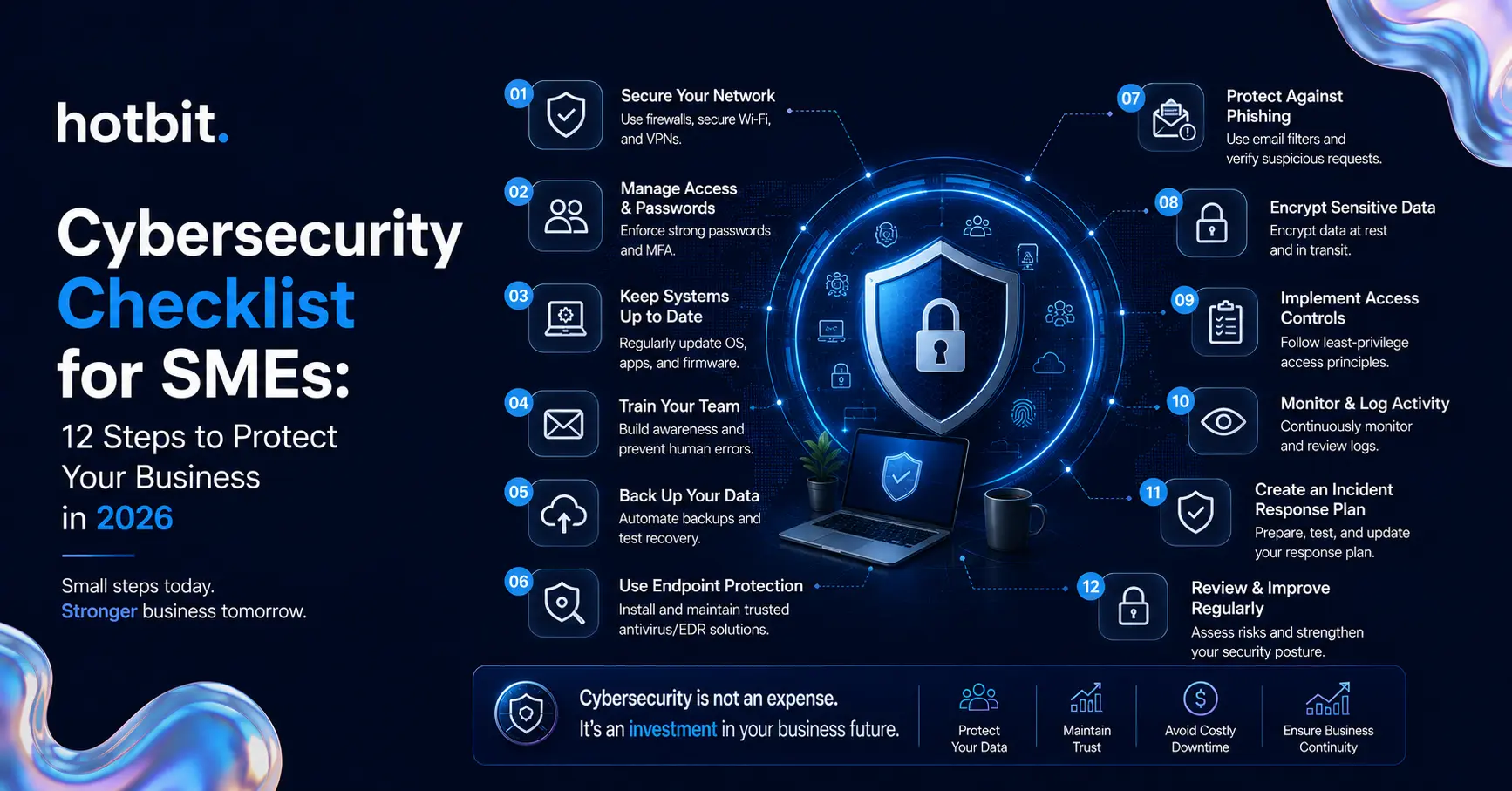
A cybersecurity checklist for SMEs turns scattered good intentions into a system: access controls, patching, backups, training, and incident response, tracked and executed on a schedule instead of left to chance. ,Small organizations now account for roughly 96% of ransomware victims, according to Verizon’s 2026 Data Breach Investigations Report (DBIR) and for the first time in the report’s 19-year history, vulnerability exploitation has overtaken stolen credentials as attackers’ top way in. Most SME security budgets were built for yesterday’s threat: firewalls and antivirus, not automated scans hunting unpatched systems at scale. This checklist closes that gap.
An SME cybersecurity risk is any gap in people, process, or technology an attacker can exploit to access, steal, encrypt, or disrupt business systems. Among the most significant: phishing-driven credential theft, unpatched internet-facing software, weak or absent multi-factor authentication (MFA), and third-party vendor compromise.
The Verizon DBIR found the human element present in 62% of breaches and third-party involvement in 48%, a 60% year-over-year jump. Risk today runs well past a company’s own network, into every vendor, contractor, and cloud tool with access to it.
SMEs combine valuable data with weaker defenses than large enterprises, and attackers know it. Verizon’s 2025 DBIR found ransomware present in 88% of small-business breaches versus 39% at larger organizations, a gap tied to thinner security teams, flatter networks, and slower patch cycles. Hiscox’s 2026 Cyber Readiness Report, surveying 1,000 US small businesses, found 56% were attacked at least once in the past year, averaging 2.38 attempts each.
The cost math settles the argument for prevention. IBM’s 2026 Cost of a Data Breach Report puts the global average at $4.99 million, while Techaisle’s SMB survey found average annual security-incident losses of $1.6 million. VikingCloud research found that 40% of SMEs say a $100,000 breach would put them out of business.
Twelve controls, prioritized by where 2026 breach data shows attackers actually get in:
1. Enforce MFA on email, VPN, and every third-party login one of the highest-impact controls against credential-based attacks.
2. Patch on a fixed cycle Median patch time has grown to 43 days, up from 32, even as unpatched systems became the top breach vector (Verizon 2026 DBIR).
3. Apply least-privilege acces so no account holds more reach than its role requires.
4. Maintain offline, tested backups Ransomware increasingly targets backup infrastructure directly, so isolated, verified backups meaningfully improve recovery odds without paying a ransom.
5. Run quarterly phishing simulations and role-based security awareness training.
6. Segment the network so one compromised device can’t reach everything.
7. Vet and monitor vendors third-party access is now tied to nearly half of all breaches.
8. Deploy endpoint detection and response (EDR) instead of antivirus alone, to catch behavior-based threats.
9. Encrypt sensitive data at rest and in transit.
10.Write and test an incident response plan before an incident forces your hand.
11. Review cloud configurations regularly Gartner’s often-cited analysis projected that through 2025, 99% of cloud security failures would be the customer’s fault, usually due to misconfigured storage or access settings, and researchers report the pattern holding into 2026.
Protection isn’t binary. Most SMEs sit somewhere between these two columns and should know which control to close first.
Most SMEs close this gap within 12–18 months as a general planning horizon, starting with MFA, patching, and backups, the controls tied most directly to initial access and ransomware resilience.
Closing these gaps consistently is harder than listing them. Building the capability in-house means hiring or training staff across identity, network engineering, and incident response a real commitment for a lean team to carry alone.