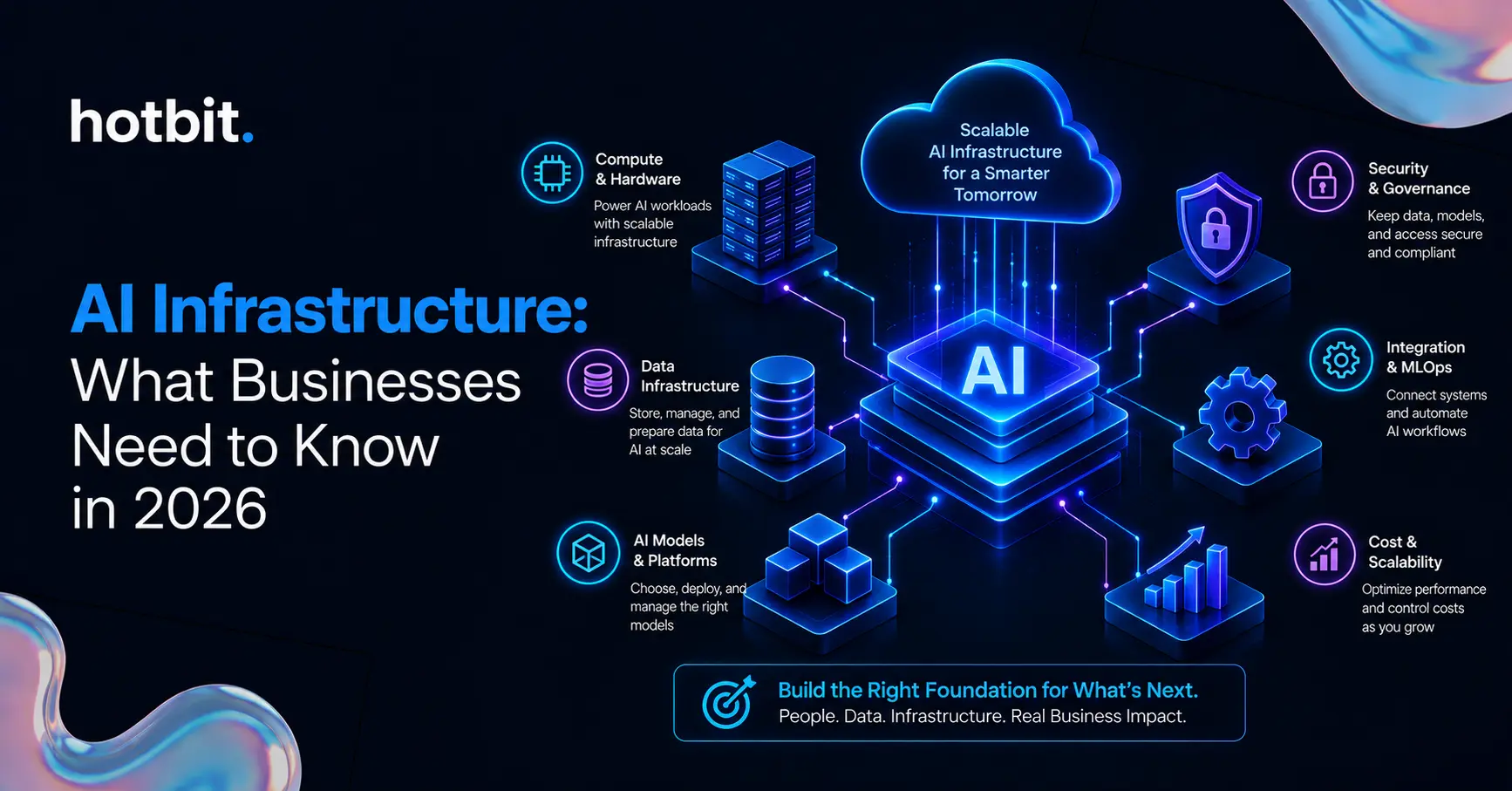
AI Infrastructure: What Businesses Need to Know in 2026

AI infrastructure decides whether your AI investment holds up outside a demo. In 2026, it’s the difference between businesses that scale AI successfully and businesses still explaining stalled pilots to their board. The compute, cloud, and data systems behind AI aren’t a technical afterthought anymore; they can play a major role in whether AI initiatives scale successfully.

As organizations scale these AI initiatives, access to specialized technical talent can be just as important as the infrastructure itself. A Team as a Service (TaaS) model can help businesses bring in skilled professionals when they need additional expertise to support AI projects and evolving technology demands.

According to Gartner’s May 2026 worldwide AI spending forecast, worldwide AI infrastructure spending is forecast to reach $1.43 trillion in 2026, up from about $976 billion in 2025, more than 45% of total AI spending. Infrastructure has become the largest category of AI spending. It’s no longer the plumbing behind the strategy; it can influence how quickly businesses move from pilot to production, and which ones stay stuck running the same three experiments a year from now. Get the infrastructure decision wrong, and no amount of model quality will fix it later, no matter how much you spent on the model itself.

What Is AI Infrastructure?

AI infrastructure is the technology environment that AI systems actually run on: compute, storage, networking, orchestration, and the data pipelines feeding all of it. It’s what turns a trained model into something your business can run at scale, workload after workload, without rebuilding the stack every time you add a new use case. As businesses plan their AI investments, understanding the technology trends for businesses in 2026 can help them prioritize the right infrastructure and capabilities. Get the foundation right once, and later AI projects can typically launch faster and at lower cost than the first one did.

General-purpose IT infrastructure was built for predictable, steady-state workloads: web traffic, transactions, email. AI infrastructure has to handle something different: bursty compute demand, continuous high-throughput data movement, and scaling that has to keep pace with model size and usage rather than a fixed budget line. Businesses that apply old infrastructure assumptions to new AI workloads are the ones who hit a wall the moment a pilot needs to become a product.
This distinction matters most at the decision-maker level. A CTO evaluating a single AI use case can often get by on borrowed capacity or a quick cloud trial. A CEO or Operations Lead planning AI across five business functions is making an infrastructure bet, whether they name it that or not, and the businesses that name it early are the ones who scale without a rebuild.

It’s also a useful way to think about where Industry 4.0 thinking is heading next. Industry 4.0: connected systems and automated processes. What comes next runs on infrastructure built to absorb AI workloads without buckling purpose-built, not retrofitted from whatever was already on the server room floor. APIs play an important role in connecting these systems and supporting business growth as infrastructure becomes more AI-driven. Businesses still treating AI infrastructure as an IT line item, rather than a board-level decision, risk falling behind competitors who already command their own capacity.

The five layers of the AI infrastructure stack

AI infrastructure is built from five interdependent layers, and a gap in any one of them limits what the rest can deliver. Strong compute paired with a weak data pipeline still leaves you waiting.

1. Compute

GPUs, TPUs, or AI-optimized servers handle model training and inference the engine room of every AI system- and the layer most businesses budget for first because it’s the most visible. It’s also the layer that scales the fastest in cost, which is exactly why the other four layers exist to keep it fully utilized

2. Storage

Fast, high-throughput storage keeps expensive compute utilized instead of sitting idle while it waits on data to arrive from slower systems. Undersized storage quietly throttles every other layer above it, no matter how much compute you’ve bought.

3. Networking

Low-latency connections link distributed compute nodes so training and inference don’t bottleneck at the wire, especially once workloads span more than one region or provider.

4. Orchestration

Platforms like Kubernetes schedule and scale workloads automatically as demand shifts, instead of forcing a manual intervention every time usage spikes or a model gets swapped for a newer one.

5. Data pipelines

Continuous pipelines clean, transform, and feed data into models the layer most businesses underestimate, and the one most likely to quietly cap everything built on top of it.

Cloud, on-premises, or hybrid: where it runs

Public cloud infrastructure gets you scalable compute fast, without the capital outlay of buying and maintaining hardware. It’s the right call for variable or experimental workloads that don’t yet justify a permanent footprint, making it attractive for early-stage AI pilots.
On-premises infrastructure hands you full control over data residency, latency, and compliance. That control matters most in regulated industries, or anywhere data-sovereignty rules aren’t optional; the cost of building it yourself is the price of that control.
Hybrid infrastructure combines both: sensitive workloads and core systems stay in a private environment, while compute bursts out to the cloud when training or peak inference demands it. For businesses that want cloud agility without losing control of their most sensitive data, hybrid is the model that gives you both without asking you to choose.
None of these three models is automatically correct. The right one follows your data sensitivity, budget, and latency needs, not whatever’s trending this quarter, and not what a competitor announced last month.
The cost profile shifts with each model, too. Cloud trades upfront capital for ongoing consumption cost tied to usage and model size, which is frictionless to start but needs active management as workloads grow. On-premises can offer greater control over infrastructure costs once the initial build is sized correctly, while hybrid introduces a mix of capital and usage-based costs that needs its own active management. Getting the model right the first time avoids paying twice: once to build it, and again to rebuild it.

Are You Ready for the Infrastructure Shift?

Most businesses aren’t struggling to adopt AI. They’re struggling to scale it past a pilot. According to McKinsey’s November 2025 State of AI report, 88% of organizations report regular AI use in at least one business function, but only about a third have begun scaling AI across the enterprise. That gap highlights the broader challenges businesses face moving from AI experimentation to enterprise-scale adoption, including infrastructure, data, governance, and organizational readiness. Gartner has made a similar point about the wider AI market: adoption is shaped as much by organizational and workforce readiness as by the size of the capital investment behind it.

For manufacturers exploring practical AI automation for manufacturing, these factors can determine how successfully an AI initiative moves from a pilot to a scalable production use case. Gartner has made a similar point about the wider AI market: adoption is shaped as much by organizational and workforce readiness as by the size of the capital investment behind it.

The usual friction points look the same across industries, whatever the sector:
  • Data scattered across disconnected systems instead of a governed pipeline
  • Compute capacity planned around a pilot, not a production workload
  • Unclear ownership over who governs AI infrastructure decisions
  • Networks built for transactional traffic, not AI-level throughput
  • No orchestration layer, so scaling means manual firefighting
  • Budget approved for AI tools before the infrastructure underneath them was ever assessed

Every quarter a business runs on this friction is a quarter its competitors spend closing the gap instead. The businesses already ahead of the race aren’t the ones with the biggest AI budget; they’re the ones who fixed their data and compute foundations before scaling, instead of after. Closing that gap starts before you buy anything.

  1. Audit first. Review your current data quality and compute capacity honestly. A technology purchase is not a strategy on its own, and skipping this step is how budgets disappear into unused capacity that nobody planned for.
  2. Map the real need. Identify which business functions genuinely need AI-driven scale and which need only lightweight automation, so you’re not overbuilding infrastructure for a pilot that was never meant to go enterprise-wide in the first place.
  3. Check pipeline maturity. Fragmented data will cap even a well-funded infrastructure investment, so fix the pipeline before you fix the compute sitting on top of it.
  4. Choose the right model. Decide on cloud, on-premises, or hybrid based on data sensitivity, latency, and budget, and revisit that decision as workloads grow rather than treating it as permanent.
  5. Build orchestration in from day one. Retrofitting monitoring and scaling after workloads go live costs more, in both time and budget, than designing for it upfront.
Businesses that follow that order avoid the costliest mistake in AI infrastructure planning: buying capacity before confirming what will actually run on it.

How Hotbit Infosoft Can Help

This is the groundwork Hotbit Infosoft, a digital-first technology company specializing in AI Automation, Product Engineering, Business Transformation, Cloud, Team-as-a-Service, and iGaming & Fantasy solutions, helps businesses get right before they scale AI across the organization. Our Cloud team builds the compute, storage, and orchestration foundations that AI workloads depend on, built for production rather than just a pilot, and our AI Automation team designs the workflows that run on top of it once it’s built. If you’re ready to see where your infrastructure actually stands, Talk to an Expert and let’s build what’s next.

Frequently Asked Questions (FAQs)

What is AI infrastructure in simple terms?

AI infrastructure is the combination of compute, storage, networking, orchestration, and data pipelines needed to run and scale AI applications. It provides the foundation for training, deploying, and managing AI workloads in production.
AI infrastructure helps businesses move AI from small pilots to reliable production workloads. The right infrastructure can improve scalability, manage costs, support data-intensive workloads, and reduce the need to rebuild systems as AI use expands.
According to Gartner’s May 2026 forecast, worldwide AI infrastructure spending is expected to reach $1.43 trillion in 2026, up from about $976 billion in 2025. Gartner also projects AI infrastructure to account for more than 45% of total AI spending.
There is no single best option. Cloud can suit businesses that need flexible, scalable compute, while on-premises infrastructure can provide greater control over data and infrastructure. Hybrid combines both and can be useful when businesses need cloud flexibility alongside private environments for sensitive workloads.
Start by auditing data quality and existing compute capacity, then identify the AI workloads that need to scale. Businesses should assess their data pipelines, choose a cloud, on-premises, or hybrid model based on their requirements, and include orchestration and monitoring from the beginning.