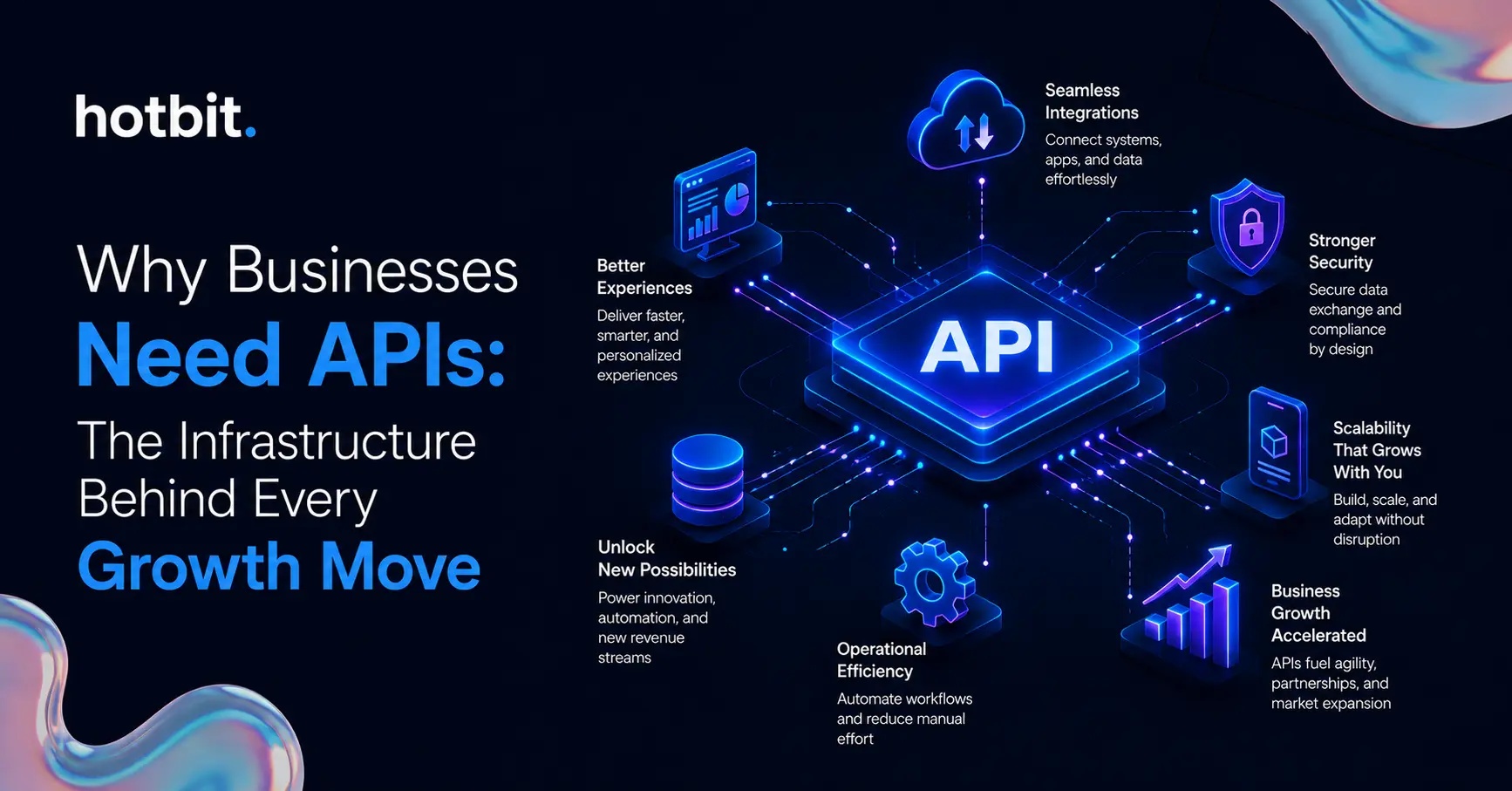
Why Businesses Need APIs: The Infrastructure Behind Every Growth Move

Every system a business runs CRM, payments, inventory, AI has to talk to every other system it touches. The companies that build that connectivity well move faster than the ones that don’t. The gap between the two is widening every quarter.
Gartner projected that more than 80% of enterprises would use generative AI APIs or deploy GenAI-enabled applications in production by 2026, up from under 5% in 2023. ,That shift didn’t happen because APIs got trendy. It happened because APIs became the only practical way to connect legacy systems, cloud platforms, and AI tools without rebuilding a business from the ground up.

What Is an API?

An API Application Programming Interface is a defined set of rules that lets one piece of software request data or functionality from another. Think of it as a waiter carrying an order from the customer to the kitchen and bringing the result back. Neither side needs to know how the other operates internally.

In a business, that means a CRM, an accounting platform, a mobile app, and an AI model can all exchange information automatically. No manual re-entry. No custom-built connection for every new tool.
A retailer’s inventory system can feed live stock data straight into its checkout page. A bank’s core ledger can hand off transaction data to a budgeting app, with the customer’s consent, in real time. One interface, built once, reused everywhere.

Why Businesses Need APIs: The Core Drivers

APIs solve five problems at once. That’s exactly why they’ve moved from IT infrastructure to boardroom strategy.
1. Faster integration
Engineering teams build the connection once and reuse it across every future integration, instead of starting from zero with each new tool.
2. Scalable growth
New partners, markets, and third-party tools plug in without forcing a rebuild of core systems.
3. Sharper customer experience
Live order tracking, instant payment confirmation, and personalized recommendations all run on real-time data exchange between systems.
4. New revenue
A company’s own data or functionality can become a product other businesses pay to access internal infrastructure turned into a monetizable asset.
5. AI readiness
Every automation platform and enterprise AI application needs a secure channel into live business data. That channel is an API.

This is where Cloud infrastructure and API strategy start to overlap. The businesses scaling fastest treat both as one connected system, not two separate projects running on separate timelines.

Are You Ready to Build an API-First Business?

Postman’s 2025 State of the API report found that roughly two-thirds of organizations now call APIs mission-critical to their operations. That’s not a future prediction. It’s where most of the market already stands.
The businesses still running on point-to-point integrations are the ones falling behind. Every new tool means another custom-built connection. Every system update means another manual fix somewhere else in the stack. That model doesn’t scale, and it doesn’t support AI.
The pattern shows up across every industry. Open banking APIs let fintechs and banks share account data securely. Retailers connect inventory, payment, and shipping systems in real time. iGaming operators use APIs to plug new titles and markets into existing platforms without rebuilding core infrastructure from scratch.

An API-first approach replaces fragile, one-off connections with infrastructure built to grow. It’s the same shift driving Business Transformation initiatives across every industry right now: modernize the connective layer first, and every capability built on top of it moves faster.

How Hotbit Infosoft Can Help

Hotbit Infosoft designs and builds API architecture through its Product Engineering practice, treating connectivity as a foundation rather than an afterthought. That foundation is what makes AI Automation initiatives work in production, not just in a pilot. When a client needs to scale delivery faster than an in-house team can hire, Hotbit’s Team-as-a-Service (TaaS) model embeds pre-vetted engineers directly into the build. If your systems aren’t built to talk to each other yet, Talk to an Expert and find out what an API-first foundation looks like for your business.

Frequently Asked Questions (FAQs)

What is an API in simple terms?

An API (Application Programming Interface) is a set of rules that allows different software applications to communicate and exchange data. It enables systems such as CRMs, payment gateways, cloud platforms, and AI tools to work together without requiring manual data entry or custom integrations for every connection.
APIs help businesses integrate systems faster, automate workflows, improve customer experiences, and support digital transformation. They also make it easier to connect cloud services, third-party applications, and AI platforms while reducing development time and operational complexity.
Most enterprise AI applications and automation platforms rely on APIs to securely access live business data. APIs allow AI tools to retrieve information, trigger workflows, and interact with business systems in real time, making intelligent automation possible.
An API-first approach enables businesses to build scalable, reusable, and secure integrations from the beginning. It improves collaboration between development teams, accelerates product launches, simplifies future integrations, and creates a stronger foundation for cloud adoption and AI initiatives.
APIs provide value across industries including finance, retail, healthcare, logistics, manufacturing, gaming, and SaaS. They enable secure data sharing, real-time system integration, digital services, and seamless customer experiences regardless of industry.
Hotbit Infosoft designs and develops scalable API architectures through its Product Engineering practice, helping businesses integrate systems, modernize legacy applications, and prepare for AI-driven automation. Its expertise spans cloud integration, business transformation, and Team-as-a-Service (TaaS) to support organizations at every stage of digital growth.