
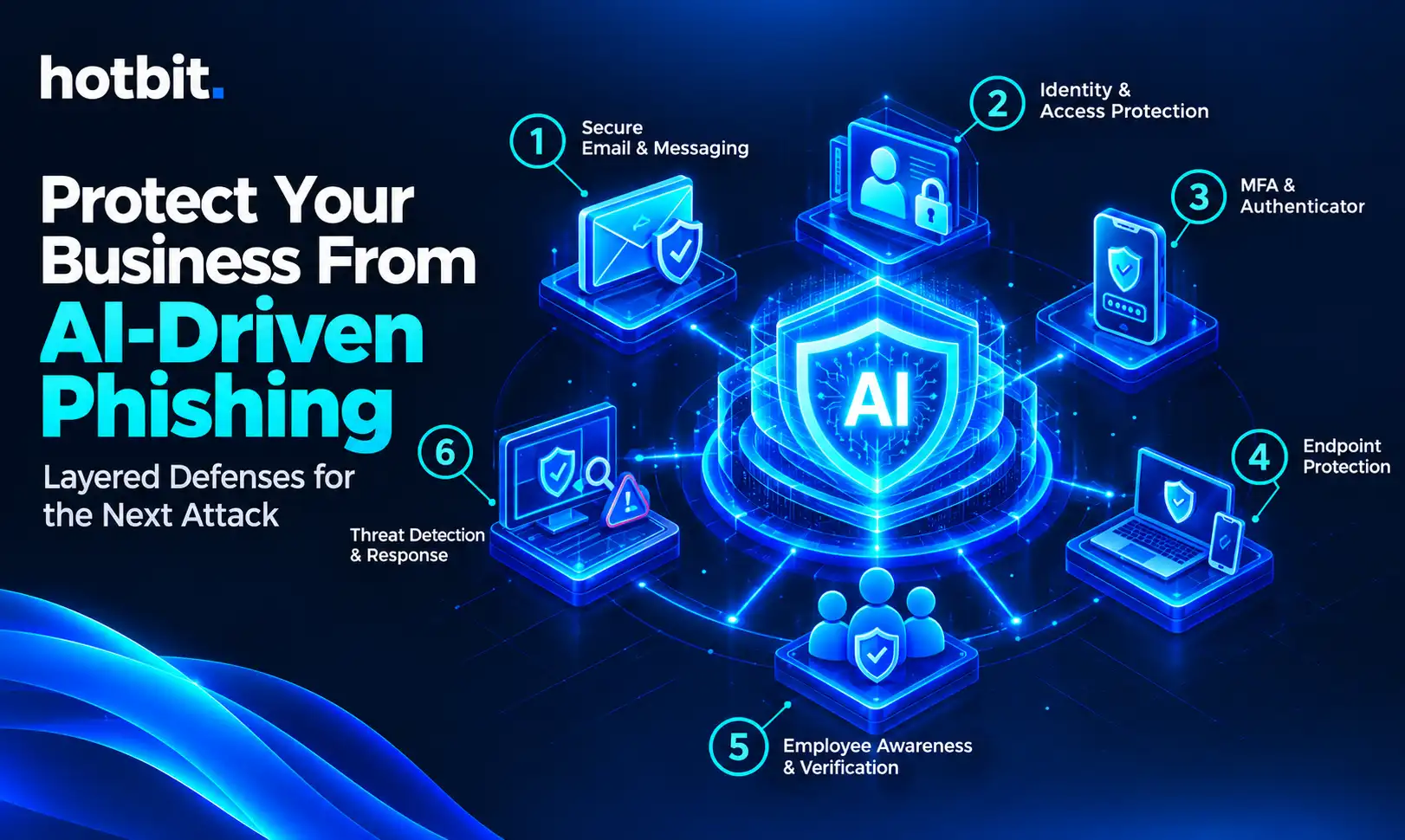
AI-driven phishing uses AI tools to craft personalized messages, voice clones, and deepfakes that slip past the warning signs your team was trained to spot. The typos are gone. The executive impersonation is now fluent, timely, and tone-matched. Businesses should therefore take a proactive approach to AI security by developing a secure AI strategy that addresses these evolving threats.
According to IBM, the global technology company behind the annual Cost of a Data Breach Report, AI-driven attacks rose 56% in its 2026 report, led by AI deepfake impersonations and AI-enabled malware (IBM). To protect your business from AI-driven phishing, combine phishing-resistant multi-factor authentication (MFA), AI-assisted email filtering, out-of-band payment verification, simulation-based training, and a rehearsed incident-response plan.
What Is AI-Driven Phishing?
AI-driven phishing refers to phishing and social-engineering attacks where attackers use AI to create, personalize, or adapt deceptive messages, voice calls, images, or videos. These attacks are designed to appear more convincing and can target individuals or organizations.
As AI systems become more capable of planning and carrying out tasks across business workflows, understanding how AI agents are changing business operations is also important for organizations evaluating the security risks associated with increasingly automated systems.
The main goals of AI-driven phishing are to steal login credentials, redirect payments, obtain sensitive information, or deliver malware. AI can help attackers create messages that are more personalized and harder to identify as fraudulent.
Gartner, a research and advisory firm, predicts that 17% of total cyberattacks and data leaks will involve generative AI by 2027. Gartner source
Gartner, a research and advisory firm, predicts that 17% of total cyberattacks and data leaks will involve generative AI by 2027. As businesses adopt AI and other emerging technologies, it is also important to recognize the broader technology gaps that can increase operational and security risks. These digital transformation warning signs can help businesses identify areas where outdated systems, disconnected data, or limited technology capabilities may require attention.
Here is how the threat has shifted
Attribute | Traditional Phishing | AI-Driven Phishing |
Message quality | Spelling and grammar errors | Polished, fluent, tone-matched |
Personalization | Generic templates | Uses public data on role, projects, and contacts |
Channels | Mostly email | Email, SMS, chat, voice clones, deepfake video |
Best defense | Spam filters and basic awareness | Behavioral analysis, phishing-resistant MFA, out-of-band verification |
Table 1: Traditional phishing compared with AI-Driven phishing.
AI-Driven Phishing Defense: Seven Controls That Close the Gap
No single tool covers email, SMS, voice, and video. These seven controls work as one system.
The seven-control defense framework
- Phishing-resistant MFA: Hardware security keys and passkeys are designed to resist phishing, making it much harder for attackers to capture credentials through fake sites. The Cybersecurity and Infrastructure Security Agency (CISA), the US government’s cyber defense agency, recommends FIDO-based authentication over SMS codes (CISA). Start with administrators, finance staff, and executives.
- AI-assisted email security: It analyzes sender behavior, message context, and link reputation to catch what signature-based filters miss. Enforce DMARC, SPF, and DKIM to strengthen email authentication and reduce domain spoofing.
- Out-of-band verification: Confirm every bank-detail change, wire transfer, or password reset through a call to a known number. Add two-person approval above a set payment threshold.
- Realistic simulations: Verizon, the telecommunications company behind the annual Data Breach Investigations Report, found the human element in 62% of breaches in its 2026 report (Verizon). Run quarterly simulations covering voice, SMS, QR-code, and email lures, and reward employees who report.
- Least privilege: Give each account only the permissions its role requires, so one stolen credential cannot unlock everything. Apply conditional access and session timeouts through your Cloud identity platform.
- Automated triage: A report-phish button routes suspicious messages to a central queue, where automation scores, quarantines, and removes matching emails from other inboxes.
- Measured results: Track click rate, report rate, and time to remediation every month. A rising report rate can signal stronger awareness when read alongside click rates and phishing volume.
The Cost of Waiting: What AI-Driven Phishing Does to Your Bottom Line
According to the FBI’s Internet Crime Complaint Center (IC3), business email compromise accounted for roughly $3 billion in reported losses in 2025. These losses show how quickly phishing-related attacks can become a serious financial risk for businesses.
IBM’s 2025 report found that phishing was the most common initial attack vector, involved in 16% of breaches, with an average cost of $4.8 million per breach. AI-driven phishing can make attacks more convincing and harder to identify.
Acting quickly can help reduce the impact of a phishing incident. Businesses should prepare their teams, review their security procedures, and rehearse their first-hour response before an attack happens.
How Hotbit Infosoft Helps You Stay Ahead of AI-Driven Phishing
Hotbit Infosoft, a digital-first technology company specializing in AI Automation, Product Engineering, Business Transformation, Cloud, Team-as-a-Service, and iGaming & Fantasy solutions, engineers the systems around your security tools. We build AI Automation workflows for triage and quarantine, and embed passkey and verified-sender features into customer-facing products through Product Engineering. We do not replace dedicated security products. We make your defenses repeatable and ready for what’s next. Ready to strengthen your workflows? Talk to an Expert to discuss how your automation and security processes can be hardened against AI-driven threats.
Frequently Asked Questions About AI-Driven Phishing
What is AI phishing?
AI phishing is a cyberattack in which criminals use AI tools to craft convincing messages, clone voices, and create deepfake video. These attacks impersonate executives, vendors, or colleagues with accurate context and polished language. Their goal is to steal credentials, redirect payments, or install malware.
How is AI used in phishing attacks?
Attackers use AI to research targets, write personalized messages in many languages, and vary wording to evade filters. They also clone voices and produce deepfake video. According to Verizon’s 2026 report, generative AI now bolsters 15 different attack techniques, which makes layered defenses essential.
How can businesses protect themselves from phishing attacks?
Businesses protect themselves by enforcing phishing-resistant multi-factor authentication, deploying AI-assisted email filtering, and verifying payment changes through a second channel. They also run regular phishing simulations, limit user access to essential systems, and rehearse an incident-response plan. Layered controls matter because no single tool stops every attack.
How can you tell if an email is AI-generated phishing?
Check the sender’s actual domain, the urgency of the request, and whether it bypasses normal process. AI makes messages polished, so grammar is no longer a reliable signal. Verify any request involving money, credentials, or sensitive data through a separate channel, such as a call to a known number.
What should you do if an employee clicks a phishing link?
Isolate the device from the network, reset the employee’s credentials, and revoke active sessions immediately. Notify the security team, scan for malware, and review logs for lateral movement. Report the incident to your national cybercrime authority, such as the FBI’s IC3, if money or data was lost.
Disclaimer
This article is provided for general informational and educational purposes only. The cybersecurity threats, statistics, recommendations, and examples discussed are based on publicly available information and may change as threats and security practices evolve. This content does not constitute professional cybersecurity, legal, or financial advice. Businesses should assess their own security requirements and consult qualified cybersecurity professionals before implementing security controls or making decisions based on this article. Hotbit Infosoft does not guarantee that any specific security measure will prevent all phishing attacks, data breaches, or other cyber threats.