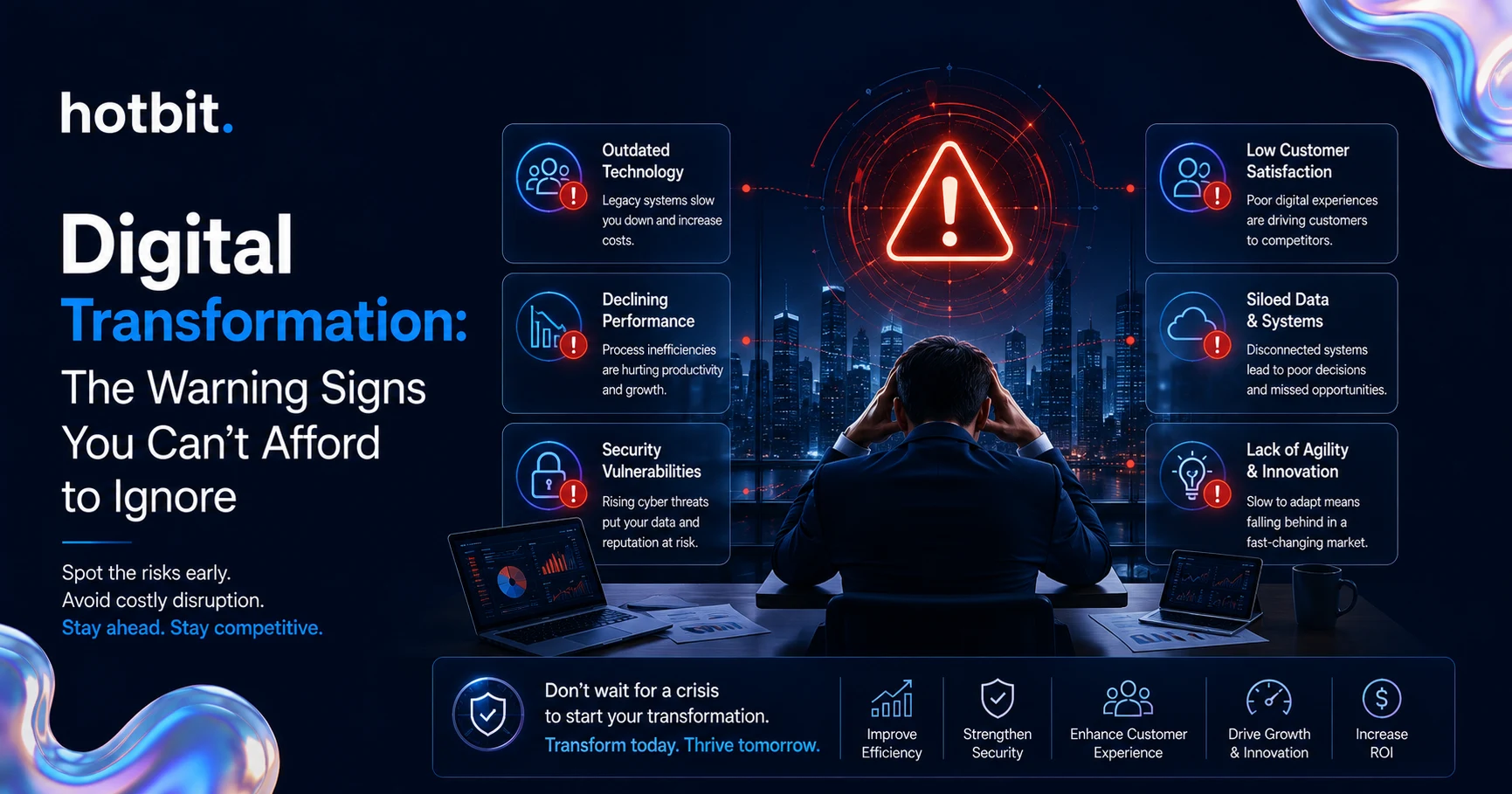
Digital transformation is no longer optional for businesses that want to compete on speed. The last era ran on manual processes and legacy platforms; the next runs on connected, intelligent systems, and the companies still waiting to make that shift are already losing ground to the ones that didn’t.
According to Gartner’s 2026 CIO and Technology Executive Survey, only 48% of digital initiatives meet or exceed their intended business outcomes, even as 94% of CIOs expect major changes to their plans within the next 24 months. That gap between ambition and results rarely comes down to budget. It comes down to timing and how clearly a business can read its own warning signs before a competitor does.
Most companies don’t announce a transformation moment. Instead, it arrives quietly, as friction in the processes a team runs every day, in the data leadership can’t fully see, and in the systems that were purpose-built for a smaller, simpler version of the business. Recognizing that friction early is what separates a company shaping the next era of its industry from one still reacting to the last.
This matters more now than it did even two years ago. Customers compare every buying experience against the fastest one they’ve had recently, regardless of industry, and competitors are folding automation and AI into their operations at a pace that compounds month over month. A business that reads its own warning signs early gets to choose the timing and shape of its transformation, while one that waits for a crisis rarely gets that choice.
None of the signs below require a business to be struggling to matter. Some of the clearest candidates for transformation are companies that are growing quickly and simply outrunning the systems they built years earlier. The friction shows up as cost, not crisis, which is exactly why it’s easy to miss until it’s expensive to fix.
Digital transformation is the process of rebuilding how a business operates by replacing manual, disconnected workflows with automated, cloud-connected systems built on real-time data. It touches every layer of the organization: how work gets done, how decisions get made, and how customers experience the brand from first contact to renewal.
This shift also looks different depending on where a business starts. A company running mostly on spreadsheets faces a different transformation path than one already on the cloud but still siloed by department. What stays constant is the outcome: a business that can absorb growth, adapt to new demands, and compete on speed rather than catching up to it.
In practice, this often means replacing a manual order-approval chain with an automated workflow tied to a live inventory system, or replacing a patchwork of departmental spreadsheets with a single cloud-based platform that finance, sales, and operations all draw from. Neither example is dramatic on its own. Together, across an entire organization, they add up to a fundamentally different way of operating.
This is also why digital transformation looks slightly different by industry, even though the underlying signs are the same. A manufacturer might feel it first in production data that doesn’t reach the floor in real time, while a services business might feel it in a sales team quoting manually as a competitor’s portal quotes instantly. The trigger differs, but the underlying gap manual, disconnected, and slow does not.
1. Manual, repetitive work still runs the business
Spreadsheets, email approvals, and manual data entry consume hours that could go toward higher-value work.
Every manual step also compounds human error as transaction volume grows, which makes this the earliest and most common sign that digital transformation is overdue. Automating even one of these processes, especially when it follows the same steps every time, is often the fastest way to free up real operating capacity.
2. Data lives in disconnected silos
Sales, finance, operations, and customer service each keep their own separate records, with no shared source of truth between them.
Leaders end up making decisions on outdated or incomplete information, simply because no single system gives them the full picture, and a connected data architecture doesn’t require collapsing every system into one platform, just making those systems talk to each other, which is usually a faster and less disruptive fix than most teams expect.
3. Customer experience lags behind digitally-enabled competitors
Buyers, especially in B2B markets, now expect self-service portals, instant quotes, and real-time order tracking as standard rather than a premium feature.
4. Growth means adding headcount, not smarter systems
A business that can only grow revenue by adding proportionally more staff has outgrown its current technology stack.
Purpose-built digital systems are designed to absorb additional order volume, customer accounts, or transaction complexity with less proportional manual effort, which helps protect margin as the business scales rather than eroding it often the sign finance leaders notice first, well before it shows up on an operations dashboard.
5. Leadership lacks real-time visibility
When executives depend on weekly or monthly reports pulled together by hand, decision-making is often based on delayed or outdated data.
Real-time dashboards, built on connected data platforms, close that gap and give leadership a live view of revenue, operations, and customer metrics as they happen rather than a rearview one assembled days later, which changes how quickly a leadership team can respond to a problem before it grows.
6. Legacy systems are blocking new capabilities
7. Competitors are already moving faster with AI and automation
Every quarter a business delays its own transformation is a quarter a competitor spends compounding an advantage in speed, cost, or customer experience. This shift isn’t limited to large enterprises anymore; mid-size teams are closing the gap fast.
McKinsey has historically found that roughly 70% of large-scale transformation efforts fail to meet their goals, most often due to a lack of clear leadership sponsorship and a defined roadmap. That statistic isn’t a reason to wait. It’s a reason to move deliberately: the businesses pulling ahead aren’t the ones with the biggest budgets; they’re the ones executing a focused, well-governed plan built around their own gaps, not a vendor’s product list.
The good news is that none of this requires transforming every system at once. Most businesses that come out ahead start with the one or two signs causing the most immediate friction, prove the value there, and expand from a foundation that’s already working rather than a plan that’s still theoretical.