
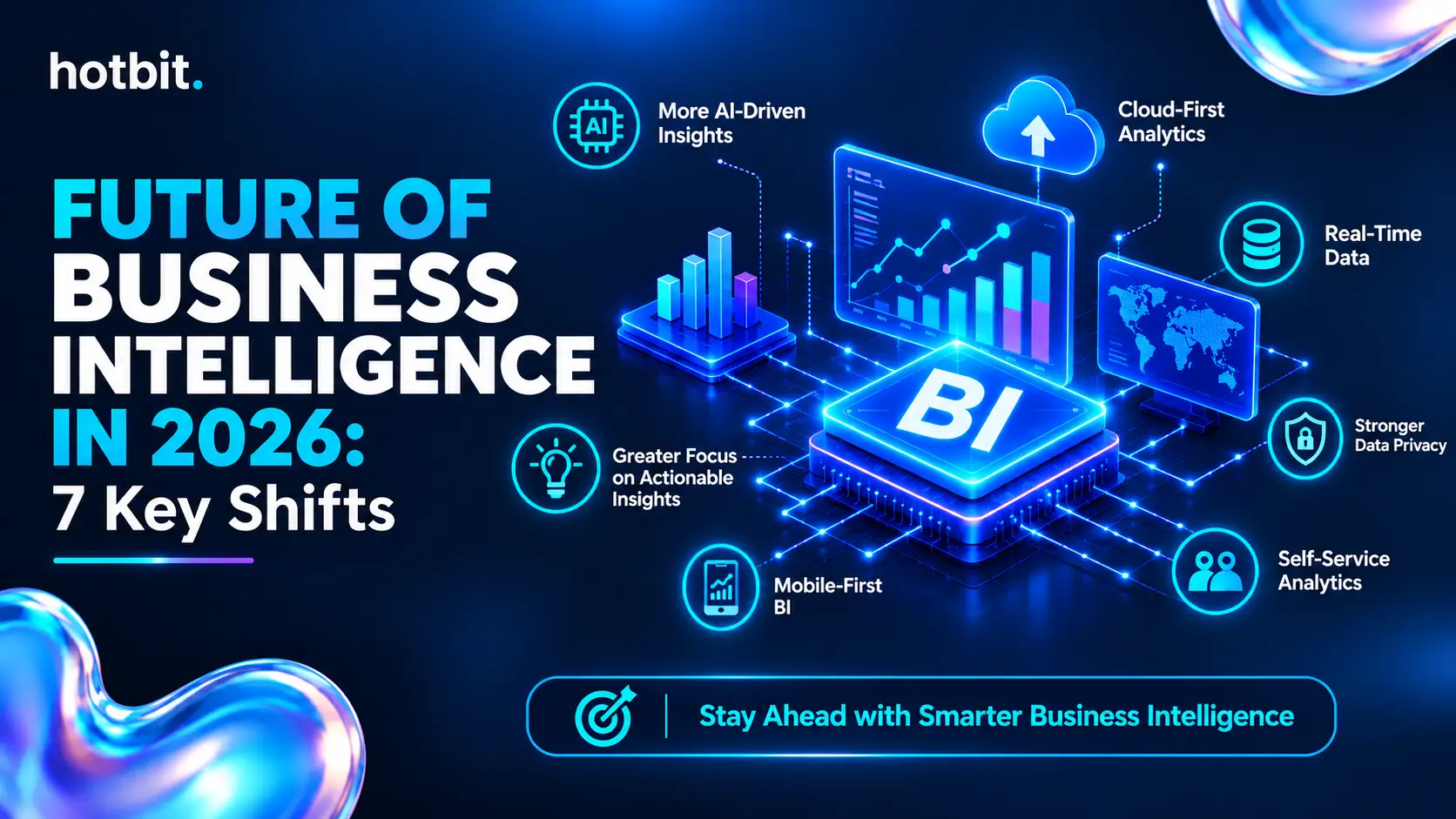
The future of business intelligence in 2026 belongs to governed, AI-driven analytics that help answer questions, flag anomalies, and recommend next actions. Traditional dashboards explain what happened, while AI-assisted analytics can also help investigate changes and guide next actions. Understanding the differences between generative AI and traditional business intelligence can help businesses evaluate how AI-powered analytics fit into their decision-making processes. According to Gartner, the global research and advisory firm, its June 16, 2026 announcement on data and analytics trends forecasts that more than 10% of enterprises will operate as AI-first organizations by 2030.
What Is the Future of Business Intelligence in 2026?
The future of business intelligence in 2026 is the shift from static, retrospective dashboards to AI-native analytics that help answer questions, detect anomalies, and recommend actions with less reliance on an analyst. Business intelligence (BI) is the set of tools, processes, and data practices that turn raw business data into decisions.
In 2026, BI adds three capabilities: AI agents that help investigate metrics, semantic layers that establish consistent, governed definitions for business metrics, and real-time pipelines that complement batch refreshes. Gartner names AI agents, semantics, and platform convergence as the leading data and analytics trends of 2026. Businesses can further strengthen these capabilities by adopting domain-specific AI models for business, which are designed to address industry-specific requirements, improve contextual understanding, and support more relevant AI-driven insights.
Treat BI as part of your Business Transformation strategy, not a reporting side project.
Understanding the framework: 7 shifts reshaping BI
- Agentic analytics. AI agents can be configured to monitor KPIs, investigate anomalies, and recommend actions, subject to data quality and human oversight. The Model Context Protocol (MCP), an open standard that connects AI applications to external tools and data sources, standardizes access, while permissions decide what agents can reach. According to Gartner, agentic analytics challenges the traditional BI developer role.
- Semantic layers. They establish consistent definitions for business metrics, helping dashboards, queries, and AI agents use the same terms for KPIs. A semantic layer improves consistency but does not guarantee accuracy, so outputs still need validation.
- Natural-language self-service. Business users ask questions in plain English and receive charts and explanations, with accuracy tied to the underlying data. According to Gartner’s Predicts 2026 report, by 2028, 60% of self-service analytics users will use general-purpose large language models (LLMs) for ad hoc and exploratory analysis, while production reporting stays on traditional analytics and BI platforms.
- Real-time streaming. Streaming complements batch processing for time-sensitive decisions, and Gartner lists agentic data streaming among its six top 2026 trends. Not every business needs it; use case, infrastructure, and budget decide.
- Decision intelligence. It models business decisions explicitly, helping organizations apply consistent rules, governance, and accountability to automated recommendations.
- Platform convergence. Data engineering, warehousing, BI, and AI tooling are increasingly converging, although many organizations still use multiple platforms, so your Cloud architecture is still a BI decision.
- Embedded insights. Analytics moves inside the CRM, ERP, and customer portals where your teams already work. Embedded analytics is often built through Product Engineering, which puts insight inside customer-facing products.
Traditional BI vs. AI-Native BI: Where the Two Meet
Traditional BI mainly reports what happened, while AI-native BI adds AI-assisted investigation and recommendations that people still validate. The two are not separate categories: Microsoft Power BI, Tableau, and Google Looker, three widely used BI platforms, are integrating AI capabilities into existing reporting features.
Capability | Traditional BI | AI-Native BI (2026) |
Primary output | Dashboards and scheduled reports | AI-assisted answers and suggestions |
User interaction | Filters and predefined views | Natural-language questions and AI agents |
Data freshness | Often scheduled batch refreshes | Real-time or scheduled, depending on the use case |
Metric definitions | May vary across reports and tools | Can use a shared semantic layer |
Analyst role | Reporting, analysis, and modeling | Validation, governance, modeling, and strategy |
Table 1: Traditional BI compared with AI-native BI across five capabilities.
Are You Ready for AI-Governed Decisions?
Speed without governance is risk. According to Gartner, explicitly modeled business decisions will be five times more trusted and 80% faster than ungoverned decisions by 2029. Businesses looking to balance innovation, accountability, and operational efficiency can explore this AI governance framework to understand the key principles and strategies for building responsible AI systems.
Recalibrate now: define your KPIs once, move time-sensitive data to streaming, and pilot one agentic use case before the market sets the pace. Adoption varies by data maturity, so start where the payoff is clearest.
How Hotbit Infosoft Helps You Lead the Shift
Hotbit Infosoft, a digital-first technology company specializing in AI Automation, Product Engineering, Business Transformation, Cloud, Team-as-a-Service, and iGaming & Fantasy solutions, helps businesses explore AI-driven analytics, improve data workflows, and build technology aligned with their operational needs. Its AI Automation and Business Transformation teams can support this work. As the company continues to grow its technology capabilities, professionals interested in exploring career opportunities at Hotbit Infosoft can learn more about joining its team. Talk to an Expert to discuss your requirements.
How Hotbit Infosoft Helps You Lead the Shift
Hotbit Infosoft, a digital-first technology company specializing in AI Automation, Product Engineering, Business Transformation, Cloud, Team-as-a-Service, and iGaming & Fantasy solutions, helps businesses explore AI-driven analytics, improve data workflows, and build technology aligned with their operational needs. Its AI Automation and Business Transformation teams can support this work. Talk to an Expert to discuss your requirements.
Explore how our Business Transformation, Cloud, Team-as-a-Service, and iGaming & Fantasy solutions can help your business improve operations through AI-driven analytics and smarter workflows. Contact our experts to discuss your technology requirements and find the right solution.
FAQs: Business Intelligence in 2026
What is the future of business intelligence?
The future of business intelligence is increasingly AI-assisted, conversational, and capable of supporting real-time use cases. AI agents are beginning to complement dashboards with conversational analysis and recommendations. Governed semantic layers keep answers consistent. According to Gartner, AI agents, semantics, and platform convergence are the leading data and analytics trends of 2026.
Will AI replace business intelligence?
AI will not replace business intelligence; it will reshape it. According to Gartner, by 2028, 60% of self-service analytics users will use general-purpose LLMs for ad hoc analysis, while production reporting stays on BI platforms. BI platforms will continue supporting governed reporting, analysis, and visualization, while AI increasingly provides a conversational interface for accessing business insights.
What are the top business intelligence trends in 2026?
The top business intelligence trends in 2026 are agentic analytics, semantic layers, natural-language self-service, real-time data streaming, decision intelligence, platform convergence, and embedded insights. Each trend moves BI from reporting past results toward automated, governed decisions. Organizations should prioritize semantic layers and data governance first.
What is agentic analytics?
Agentic analytics uses AI agents to monitor data, investigate changes, and recommend or trigger actions with limited human prompting. Unlike static dashboards, analytics agents can monitor metrics on configured schedules or event triggers and help investigate why a metric changed. Gartner research published in September 2026 states that agentic analytics challenges the traditional role of the BI developer.
How can a business prepare for AI-driven business intelligence?
Start by auditing data quality and defining core metrics in one semantic layer. Next, move high-value data to real-time pipelines. Then pilot one agentic use case, such as KPI monitoring. Finally, set decision governance and train teams. Review progress quarterly against business outcomes.
Disclaimer
Disclaimer: This article is for informational and educational purposes only. Business intelligence trends, AI capabilities, and industry predictions may change over time. Gartner forecasts and statistics are based on its published research and should not be considered guaranteed outcomes. Businesses should evaluate their specific requirements, data quality, security, and compliance needs before adopting AI-driven business intelligence solutions.