
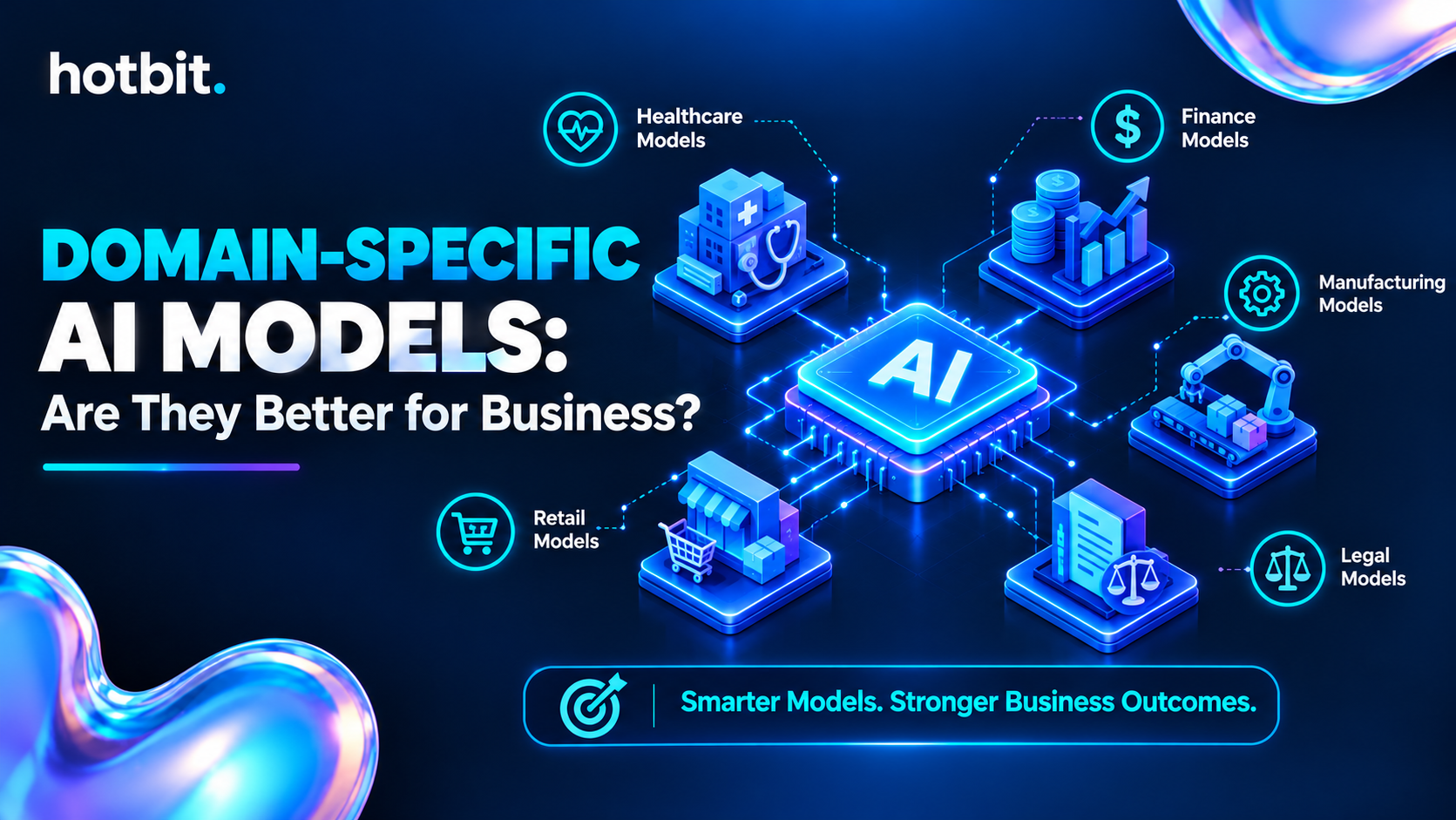
Domain-Specific AI Models are trained on one industry’s data, and on narrow, accuracy-critical tasks they can outperform general-purpose AI. According to Gartner, more than 50% of the generative AI models enterprises use will be specific to an industry or business function by 2027, up from roughly 1% in 2023.
As businesses adopt specialized technologies, choosing the right ERP system is another important consideration for aligning software capabilities with industry requirements and business processes. The shift is already underway, and the open question is where specialist models beat the generalists you run today.
What Are Domain-Specific AI Models?
Domain-Specific AI Models are machine learning models built or adapted to perform tasks within one industry, function, or body of specialist knowledge. They learn from curated data such as clinical records or legal contracts, which helps them recognize specialist vocabulary. Gartner describes them as models trained or fine-tuned on industry-specific or business-process-specific data.
BloombergGPT, built by Bloomberg for financial text, and Med-PaLM 2, developed by Google for medical questions, are the best-known examples.
Understanding the framework: three ways to adopt them
- Training from scratch: builds a new model on a large domain data set, for unique data and strict control needs.
- Fine-tuning: updates a foundation model’s parameters on domain data, for consistent tone, format, and terminology.
- Retrieval-augmented generation (RAG): retrieves company documents at query time without changing model parameters, for knowledge search and question answering.
A foundation model is a large model trained on broad data. Gartner advises looking for off-the-shelf, domain-specific models you can train or tune before building your own. That sequence can keep early costs lower and prove value before heavy investment.
Domain-Specific AI Models vs General-Purpose Models: Where Each Wins
Scope is the dividing line. Domain-specific models master one field, while general-purpose models cover many fields with broader, less specialized training. Gartner analyst Arunasree Cheparthi says organizations are turning to specialist models for four potential gains: accuracy, cost, reliability, and relevance. Each gain depends on data quality, design, and deployment, with AI-powered data analytics and business intelligence helping organizations turn relevant data into actionable insights.
Where domain-specific models can win
- Accuracy: can be higher on well-defined tasks when trained on quality domain data, confirmed by testing against a baseline
- Cost: smaller models need less hardware per request, which can lower inference costs at high volume
- Reliability: grounding in trusted data can lower hallucination risk, though high-stakes outputs still need evaluation and human review
- Control: smaller models can run in a private cloud or on company infrastructure, keeping sensitive records under your command
Specialist models do not automatically deliver security or compliance. Access controls, encryption, logging, and configuration still decide that.
Where general-purpose models win
General-purpose models fit varied, unpredictable, or low-stakes work. They need no data preparation, so a team can prototype in days. Drafting across many topics and requests that change weekly suit them well. The strongest setups combine both: a general model for open-ended requests and a specialist model wherever verified accuracy matters. Choosing the right deployment approach also involves understanding the differences between Edge AI and Cloud AI.
Domain-Specific AI Models by Industry: Where Specialist Beats Generalist
These examples describe typical applications, not documented deployments, except where a named model is cited.
- Healthcare: summarize patient notes, code diagnoses, and support documentation, always with clinician review
- Finance: analyze risk, monitor compliance, detect fraud, and review filings and contracts
- Legal: extract clauses, flag risky terms, and compare contracts against approved templates, tested on the firm’s own documents
- Manufacturing: predict equipment failures from sensor and maintenance data before they occur
The Stakes: Why Waiting Costs You Ground
According to Gartner’s July 2026 forecast, as reported by IT Brief, spending on domain-specific language models and other specialized generative AI models will rise from about $1.6 billion to about $4.9 billion, a 210% increase. Foundation model spending is projected to climb from about $11.4 billion in 2025 to about $23.4 billion in 2026, so foundation models remain the larger segment. As businesses evaluate these AI opportunities, preparing business infrastructure for AI can help them assess their data readiness, computing resources, security, and integration requirements. Gartner changed its categories and 2025 base figures from its July 2025 forecast, so the two sets of numbers should not be compared directly.
Specialized models are the fastest-growing segment. Gartner advises businesses to plan for deploying and managing several domain-specific models alongside foundation models. The teams that start that planning now stay ahead of the race.
Risks of Domain-Specific AI Models: What Stalls a Pilot
Five risks recur. Poor data quality limits a model that is only as good as its training data. Narrow scope means a specialist performs poorly outside its field. Model drift, the gradual loss of accuracy as real-world data changes, demands scheduled retraining. Managing multiple models adds overhead. Regulated data requires audit trails, access controls, and clear accountability.
Is Your Business Ready: Five Questions Before You Commit
- Is the task repeated thousands of times, so small accuracy gains add up?
- Do errors carry legal, financial, or safety consequences?
- Does your company own quality domain data that competitors cannot easily copy?
- Must sensitive data stay inside a private environment?
- Can your team support ongoing monitoring and retraining?
Treat these questions as guidance, not a fixed scoring rule. Compare a general-purpose model, a RAG-based solution, and a domain-specific model against the same task-specific benchmarks, security requirements, and total cost of ownership before you select an approach.
How Hotbit Infosoft Helps You Deploy Domain-Specific AI Models
Hotbit Infosoft specializes in AI Automation, Product Engineering, Business Transformation, Cloud, Team-as-a-Service, and iGaming & Fantasy solutions. We help businesses identify suitable use cases and select, build, and deploy Domain-Specific AI Models aligned with their goals. Contact our team to discuss your business requirements and explore the right technology solutions.
From secure Cloud hosting to Product Engineering, we help businesses move AI projects from planning to production with scalability in mind. Talk to an Expert to explore how AI Automation can support your business goals.
FAQs: Domain-Specific AI Models
1. What are domain-specific AI models?
Domain-specific AI models are AI systems trained or fine-tuned for a particular industry, business function, or specialized task. They use relevant data and terminology to handle tasks such as financial analysis, medical documentation, legal contract review, and manufacturing quality control.
2. Are domain-specific AI models better than general-purpose AI models?
Domain-specific AI models can perform better on specialized tasks when trained on high-quality data and properly evaluated. General-purpose models are more flexible for tasks across different subjects. The best choice depends on accuracy requirements, data availability, cost, security, and business needs.
3. How much do domain-specific AI models cost?
The cost depends on the model, data preparation, training or fine-tuning, infrastructure, integration, and ongoing maintenance. Smaller pretrained models may cost less to operate than larger general-purpose models, but the total cost depends on workload, performance, and deployment requirements.
4. What are the main risks of using domain-specific AI models?
Common risks include poor training data, limited performance outside the intended task, outdated knowledge, model drift, security vulnerabilities, and maintenance complexity. Businesses should evaluate model performance regularly, protect sensitive data, and include human review for high-impact decisions.
5. How can a business implement domain-specific AI models?
Start by identifying a specific business problem and defining measurable success criteria. Compare a general-purpose model, a retrieval-augmented generation (RAG) solution, and a fine-tuned domain-specific model using the same benchmarks. Then test a pilot, assess security and total costs, and deploy with ongoing monitoring.
Disclaimer
This article is for informational and educational purposes only and does not constitute technical, legal, financial, or regulatory advice. AI model performance, costs, and suitability vary depending on the use case, data quality, and deployment environment. Businesses should independently evaluate AI solutions before implementation.