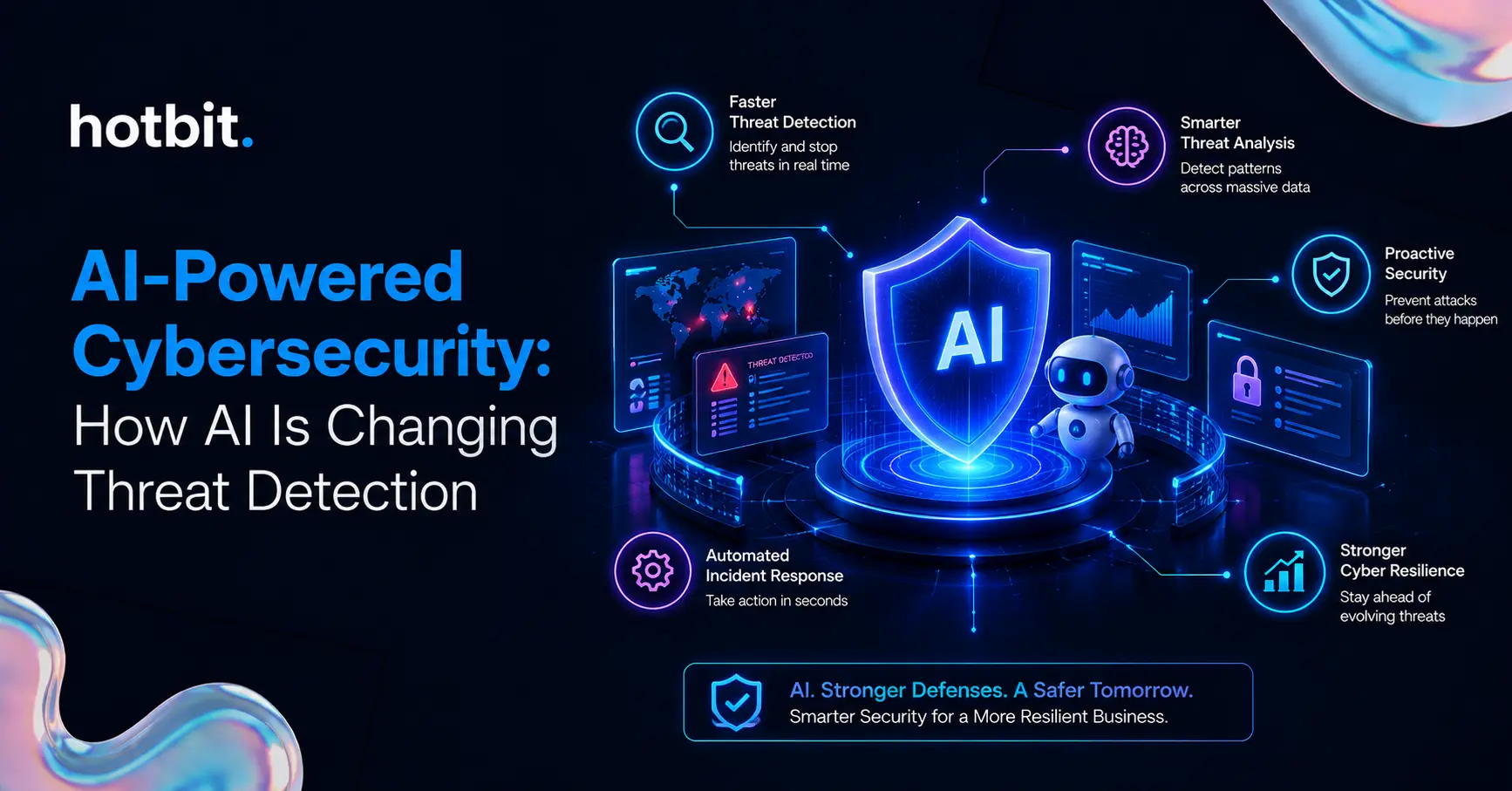
AI-Powered Cybersecurity: How AI Is Changing Threat Detection

AI-powered cybersecurity is closing the gap between attack speed and defense speed faster than most security teams expected. Gartner projects that more than 75% of enterprises will rely on AI-amplified cybersecurity platforms for most of their security use cases by 2028, up from less than 25% in 2025. As organizations adopt these technologies, access to specialized cybersecurity teams can also help businesses strengthen their technical capabilities and respond to evolving security needs

This shows why organizations are increasingly augmenting manual security processes with AI rather than relying on manual triage alone. The technology pairs static, rule-based defense with systems that learn what normal looks like across your network, identities, and endpoints, then flag anything that breaks that pattern.
For CTOs and IT Directors deciding where to invest next, this is the line between security teams that lead and security teams still catching up.

What Is AI-Powered Cybersecurity?

AI-powered cybersecurity pairs machine learning with the signature-based defenses security teams already run. Instead of relying only on a fixed list of known threats, these systems also build a live picture of what normal looks like across your network, identities, and endpoints, then flag whatever breaks that pattern. As AI agents increasingly interact with enterprise systems, identity and access management for AI agents also plays an important role in controlling permissions and monitoring agent activity.

That shift matters because attackers have upgraded too. Generative AI is increasingly used for phishing campaigns, reconnaissance, and other attack activity, and a rule set that only recognizes what it already knows cannot recalibrate fast enough to keep up on its own.

According to IBM’s 2023 Cost of a Data Breach Report, organizations using AI and automation extensively cut their breach lifecycle by 108 days on average, to 214 days instead of 322. That’s the difference between catching an incident early and living through a crisis. A secure, well-designed business website with the right features can also support stronger digital security and automation.

Where AI is strengthening threat detection

Six important capabilities include:

1. Behavioral Anomaly Detection

AI builds a baseline for every user, device, and workload, then flags whatever falls outside it: an unfamiliar login location, an unusual data transfer, a process running somewhere it shouldn’t. This can help detect behavior that signature-based tools may miss, including some previously unseen attack behavior. No detection method, AI included, catches every unknown threat, but a system built to learn closes more of that gap than one built only to memorize.

2. Automated Alert Triage

Security teams are buried under false positives, and that noise is expensive. AI-driven triage helps prioritize and reduce that noise so analysts spend more of their time on alerts that actually matter, recovering hours that used to disappear into manual review. Results vary by platform and by how well it’s tuned, but the direction holds: less noise, faster judgment calls.

3. Predictive Risk Scoring

Rather than waiting for a breach to happen, AI models score risk continuously, helping security teams prioritize which users, devices, or systems carry the highest risk. That lets teams recalibrate their defenses ahead of an attack instead of only reacting once it lands.

4. Automated Incident Response

Once a threat is confirmed with high confidence, AI-driven playbooks can isolate an endpoint, revoke a session, or block malicious traffic without waiting for a human to act first. Actual response speed still depends on the platform and its integrations, but automation like this can meaningfully reduce the time between detection and containment. According to IBM’s 2024 Cost of a Data Breach Report, organizations using security AI extensively across prevention workflows cut breach costs by $2.2 million on average compared with organizations not using it in those workflows.

5. Continuous Identity Monitoring

IBM’s 2024 research identifies stolen or compromised credentials as the most common initial attack vector in the breaches it studied. AI systems track identity behavior around the clock, catching compromised accounts and lateral movement that a scheduled review would only surface after the damage is done.

6. Cloud Workload Protection

As infrastructure spreads across public cloud, private cloud, and on-premises systems, AI models watch workload behavior across all three, typically helping flag misconfigurations and unusual resource activity earlier than a periodic manual audit would. For businesses scaling fast, this is the layer that keeps growth from outrunning visibility.

Are You Ready for AI-Driven Threats?

According to the World Economic Forum’s “AI and Cyber: Empowering Defenders” report, developed in collaboration with KPMG and published in May 2026, 94% of cyber leaders identify AI as the defining force in cybersecurity, and 77% of organizations already use it in their cyber operations. AI is reshaping the field on both sides accelerating threats and defenses alike, and pushing organizations into a faster race against attackers than most were built for.For practical steps to strengthen security, organizations can also follow a cybersecurity checklist for SMEs.

McKinsey estimates the global cybersecurity addressable market could reach approximately $2 trillion, reflecting the broad potential demand for cybersecurity products and services as threats and technology continue to evolve. That scale of opportunity is a signal worth paying attention to it points to how central AI-driven security has become to enterprise planning.

Readiness comes down to three questions. Is your data clean and connected enough for a model to learn from it? Is your team set up to act on what the model finds, not just watch a dashboard? And is your incident-response process fast enough to match the detection speed you’re paying for?

AI-powered cybersecurity is most effective when the infrastructure around it is built to move as fast as the model does. A fast detection layer bolted onto a slow response process still leaves you exposed the advantage shows up most clearly when both are rebuilt together.

How Hotbit Infosoft Helps You Get There

Hotbit Infosoft, a digital-first technology company specializing in AI Automation, Product Engineering, Business Transformation, Cloud, Team-as-a-Service, and iGaming & Fantasy solutions, builds the detection and automation layer that makes AI-powered cybersecurity work in practice, not just on a roadmap. Our AI Automation team designs behavior-based detection and response workflows that plug into the systems you already run, so you’re not tearing out infrastructure to get there.

We connect the data pipelines these models depend on, tune them to your actual environment, and build the automation around them so detection speed turns into response speed not just a faster alert. That’s the work of becoming future-ready: not a single tool, but a system that keeps learning as the threats do.
Ready to move from reactive to future-ready security? Talk to an expert on Hotbit’s AI Automation team and find out what your first move should be.

Frequently Asked Questions (FAQs)

What is AI-powered cybersecurity?

AI-powered cybersecurity uses artificial intelligence and machine learning to detect unusual behavior, identify potential threats, prioritize alerts, and automate parts of the security response process.
AI analyzes large volumes of security data, learns normal behavior, identifies anomalies, and detects suspicious activity that traditional rule-based security tools may overlook.
AI can help identify previously unseen threats by detecting unusual behavior and patterns rather than relying only on known attack signatures. However, no AI system can detect every unknown threat.
Yes. Depending on the platform and integrations, AI-powered security systems can automate actions such as isolating endpoints, blocking suspicious traffic, or revoking compromised sessions.
No. AI is designed to support security teams by analyzing data, prioritizing alerts, and automating repetitive tasks. Human analysts remain important for investigation, decision-making, and complex security incidents.

Disclaimer:

The information provided in this article is for general educational and informational purposes only. Cybersecurity technologies, AI capabilities, statistics, and threat landscapes change over time, and results may vary based on the tools, data, infrastructure, and security processes used by each organization. This article should not be considered a substitute for professional cybersecurity advice, risk assessment, or security services. Organizations should evaluate their specific security requirements and consult qualified cybersecurity professionals before making technology or security decisions.