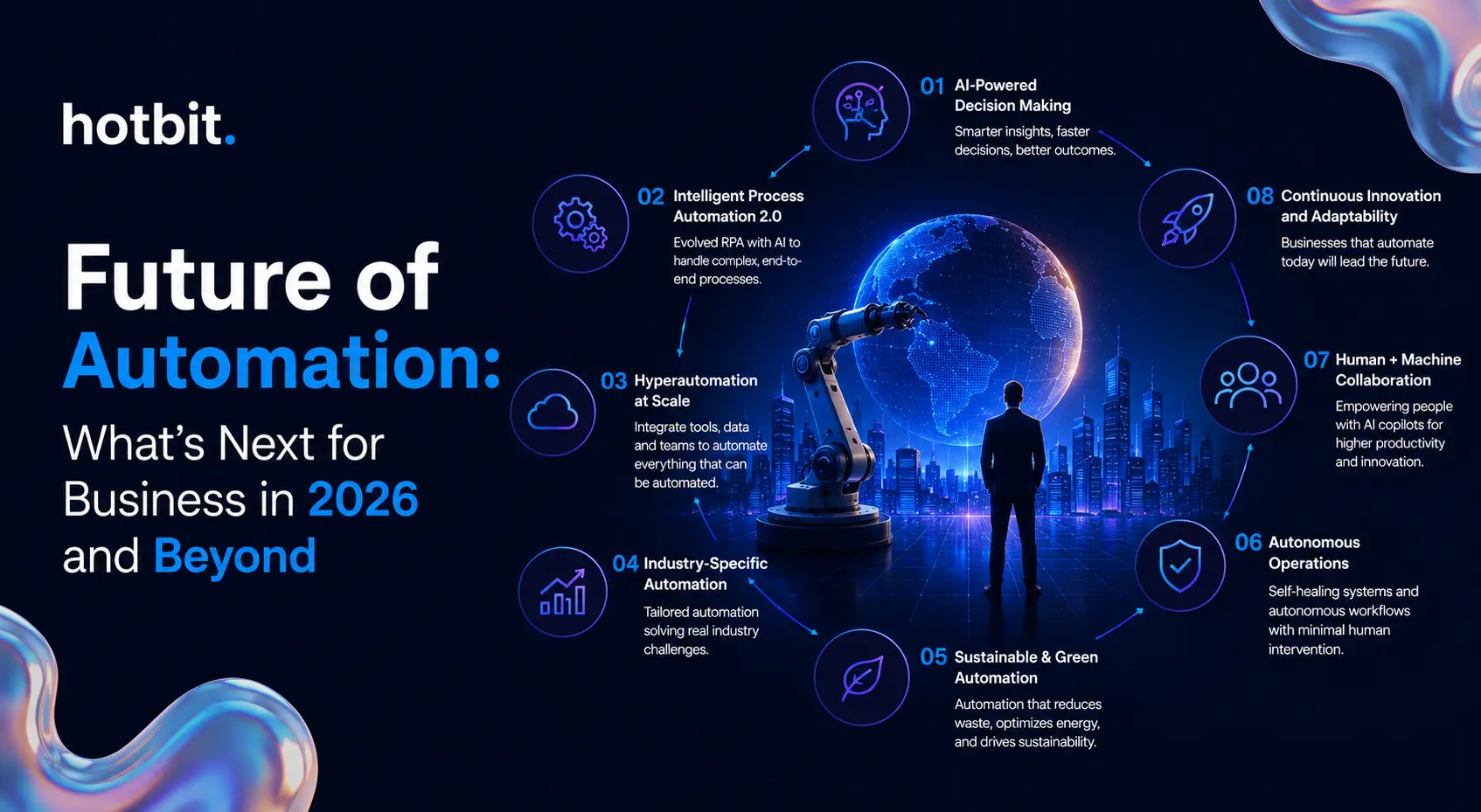
Future of Automation: What’s Next for Business in 2026 and Beyond

The future of automation is increasingly shifting from isolated, single-task bots toward AI-driven systems, including agentic AI. These systems can plan, decide, and execute multi-step business processes with less human input at each step than today’s tools require.

88% of organizations now use AI in at least one business function, up from 78% a year earlier. Most remain in the experimentation or pilot stage (McKinsey, The State of AI in 2025).

Gartner predicts that over 40% of agentic AI projects will be canceled by the end of 2027. The reasons include escalating costs, unclear business value, and inadequate risk controls.

That gap between enthusiasm and execution matters. The future of automation isn’t just about adopting new tools. It’s about deploying them in a way that holds up in production.

This piece from Hotbit Infosoft looks at that gap directly. Hotbit Infosoft is a digital-first technology company specializing in AI Automation, Product Engineering, Business Transformation, Cloud, Team-as-a-Service, and iGaming & Fantasy solutions. The sections below separate the automation trends worth building around from the ones likely to stall in pilot mode.

What Is the Future of Automation?

The future of automation refers to the next phase of business process automation. AI agents, robotic process automation (RPA), and machine learning models work together to handle entire workflows, not just isolated tasks, with reduced human oversight of each step.
Traditional automation followed fixed, rule-based scripts. The emerging model uses AI to interpret unstructured data, assist with context-aware decisions, and adapt when a process changes.

McKinsey estimates that current generative AI and other technologies have the technical potential to automate activities accounting for 60–70% of employees’ time, not 60–70% of jobs. The acceleration is largely driven by generative AI’s improved ability to understand natural language, which is involved in work activities accounting for about 25% of total work time.

That distinction between automatable tasks and automatable occupations matters. It’s central to understanding where automation is actually headed next.

Trends Shaping Automation Through 2026

Automation is evolving on several fronts at once. Businesses evaluating a 2026 roadmap should weigh these trends together rather than picking one in isolation. Governance, data readiness, and process redesign matter just as much, and this article covers them below.
Agentic AI is expanding automation beyond single-purpose bots. Instead of a script that performs one fixed task, agentic AI systems can break a goal into steps, call other tools or APIs, and adjust their approach based on results.
This capability sits behind orchestration frameworks such as LangChain, an open-source framework for building and coordinating AI agent workflows. LangGraph is a related orchestration framework built for more controllable, long-running agent processes.
Hyperautomation coordinates tools rather than replacing them. Gartner, the technology research and advisory firm that popularized the term, defines hyperautomation as the coordinated use of RPA, AI, process mining, and low-code platforms. The goal is to automate as much of a business process as is technically feasible.
Hyperautomation programs increasingly incorporate agentic AI as one of the technologies they coordinate. It’s a strategy for combining tools, not a separate rung on a maturity ladder.
Regulated, data-heavy sectors find automation especially attractive. Healthcare claims processing and financial compliance checks are examples. High volumes of repetitive, rules-based decisions make the business case for automation easier to build first.
Online gaming platforms also contain automation opportunities in areas such as backend operations, monitoring, data processing, and workflow orchestration. Requirements vary considerably by jurisdiction, and actual adoption pace varies by organization.
Governance is becoming a first-class part of the automation conversation. Gartner predicts that by 2027, 40% of enterprises will demote or decommission autonomous AI agents due to governance gaps identified only after production incidents occur.
Gartner argues that applying the same oversight rules to a low-risk summarization agent and a high-autonomy agent taking real actions in production is a root cause of these failures. That distinction supports building governance in from the start, with oversight calibrated to each agent’s level of autonomy, rather than retrofitting it after deployment.
The broader automation future includes process mining and workflow orchestration, intelligent document processing, API-level automation, and data-quality and process-redesign work. This less visible groundwork determines whether any of the above actually scales.

Automation Models Compared: RPA, AI Automation, Hyperautomation & Agentic AI

These four terms are often used interchangeably. They describe different, and sometimes overlapping, approaches rather than a strict sequence from basic to advanced.
Choosing the wrong approach for a given process can cause automation projects to stall.

Benefits of Automation for Businesses

Next-generation automation compresses the distance between a business decision and its execution. It closes that gap across an entire workflow, not just one task.

Bain’s 2024 survey found that automation leaders, meaning organizations investing at least 20% of their IT budget in automation, reported average cost savings of 22%. Organizations investing less than 5% reported savings of just under 8%.

This is survey data, not a controlled causal study. Treat the figures as directional rather than a guaranteed return.
Separately, 59% of information workers surveyed by Smartsheet estimated they could save six or more hours per week if repetitive tasks were automated. That time can shift toward strategy, customer relationships, and product work.
For B2B teams specifically, this can translate into faster quote-to-cash cycles and fewer manual handoffs between departments. It can also mean systems that flag anomalies, such as a fraud pattern, a compliance gap, or a supply delay, before they become costly.

Challenges to Scaling Automation

Technology isn’t the biggest obstacle to the future of automation. Execution is.

McKinsey’s 2025 State of AI survey found that 23% of respondents say their organizations are scaling an agentic AI system somewhere in the enterprise. Another 39% are experimenting.

In any individual business function, though, no more than 10% report scaling agents rather than piloting them.
Common failure modes include unclear ownership of the automated process and integration debt with legacy systems. They also include governance applied too uniformly across agents with different risk levels, and treating automation as a one-time IT project instead of an ongoing operating model.
A commonly recommended starting strategy is to scope a single, high-volume workflow and prove ROI before expanding. Results vary by organization, so treat this as a starting point rather than a guarantee.

How Hotbit Infosoft Supports Automation Programs

Automation initiatives often struggle for a specific reason. A promising pilot never makes it into production with the governance and integration work it needs.

Hotbit Infosoft, a digital-first technology company specializing in AI Automation, Product Engineering, Business Transformation, Cloud, Team-as-a-Service, and iGaming & Fantasy solutions, works with founders, CTOs, and operations leaders to close that gap. The approach starts with scoping one workflow.

Hotbit builds the automation with the appropriate level of human oversight for its risk profile. It integrates the automation with the client’s existing systems rather than replacing them.

That approach spans document and data processing automation through to multi-step agentic workflows. Product Engineering and Cloud infrastructure support the automation once it’s running.

For regulated environments such as online gaming platforms, the same principles apply within jurisdiction-specific compliance requirements. Hotbit’s iGaming & Fantasy practice handles this work.

Businesses staffing up for an automation initiative can also draw on Team-as-a-Service (TaaS) to bring in relevant technical skill sets without a lengthy hiring cycle.

If you’re scoping where automation fits in a 2026 roadmap, talk to an expert at Hotbit Infosoft about your specific workflow.

The Bottom Line

The future of automation isn’t a single technology. It’s the combination of RPA, AI automation, hyperautomation, and agentic AI, applied to workflows that used to require constant human coordination.

The businesses that benefit most likely won’t be the ones that adopt fastest. They’ll be the ones that scope automation carefully, build governance in from the start, and prove value on one workflow before expanding.

If you’re evaluating where automation fits in your 2026 roadmap, talk to an expert at Hotbit Infosoft to scope a workflow-specific automation plan.

Frequently Asked Questions (FAQs)

What is the future of automation in the workplace?

The future of automation centers on agentic AI systems that plan and execute multi-step workflows rather than single tasks. Adoption is already broad: 88% of organizations use AI in at least one function, per McKinsey. Production-scale deployment of agents specifically still lags well behind pilots and experiments across most business functions.
Automation reshapes jobs more than it eliminates them outright. An earlier McKinsey analysis estimated that fewer than 5% of occupations could be fully automated with technologies then available, an older estimate rather than a current 2026 measurement.
The World Economic Forum’s 2025 Future of Jobs report considers technology alongside demographic, economic, and other macrotrends, not automation alone. It projects a net gain of 78 million jobs by 2030 alongside 92 million displaced roles, a significant skills shift rather than simple job loss.
Industries with high volumes of structured or repetitive work, including financial services, healthcare administration, logistics, and some online gaming operations, can be particularly well suited to automation. That kind of work tends to make automation’s return on investment easier to demonstrate.
Actual adoption rates vary by organization, use case, regulation, and technology maturity. McKinsey’s 2025 agent-specific research found reported agent use is currently most widespread in technology, media and telecom, and healthcare.
RPA follows fixed, rule-based scripts on structured data and typically needs to be reconfigured when the underlying process changes. AI automation adds AI capabilities, such as machine learning, natural language processing, or large language models, letting the system interpret unstructured data and handle exceptions.
A commonly recommended approach is to start with one high-volume, well-defined workflow rather than an enterprise-wide rollout. Prove measurable ROI on that process, and address integration with existing systems early before expanding automation incrementally. Results vary by organization, industry, and how much groundwork is done before scaling.
Not exactly. Generative AI creates content, such as text, images, or code, in response to a prompt. Agentic AI goes further: it plans and executes multi-step actions toward a goal, often using a generative AI model as its reasoning or interface layer while also calling other tools or systems along the way.