
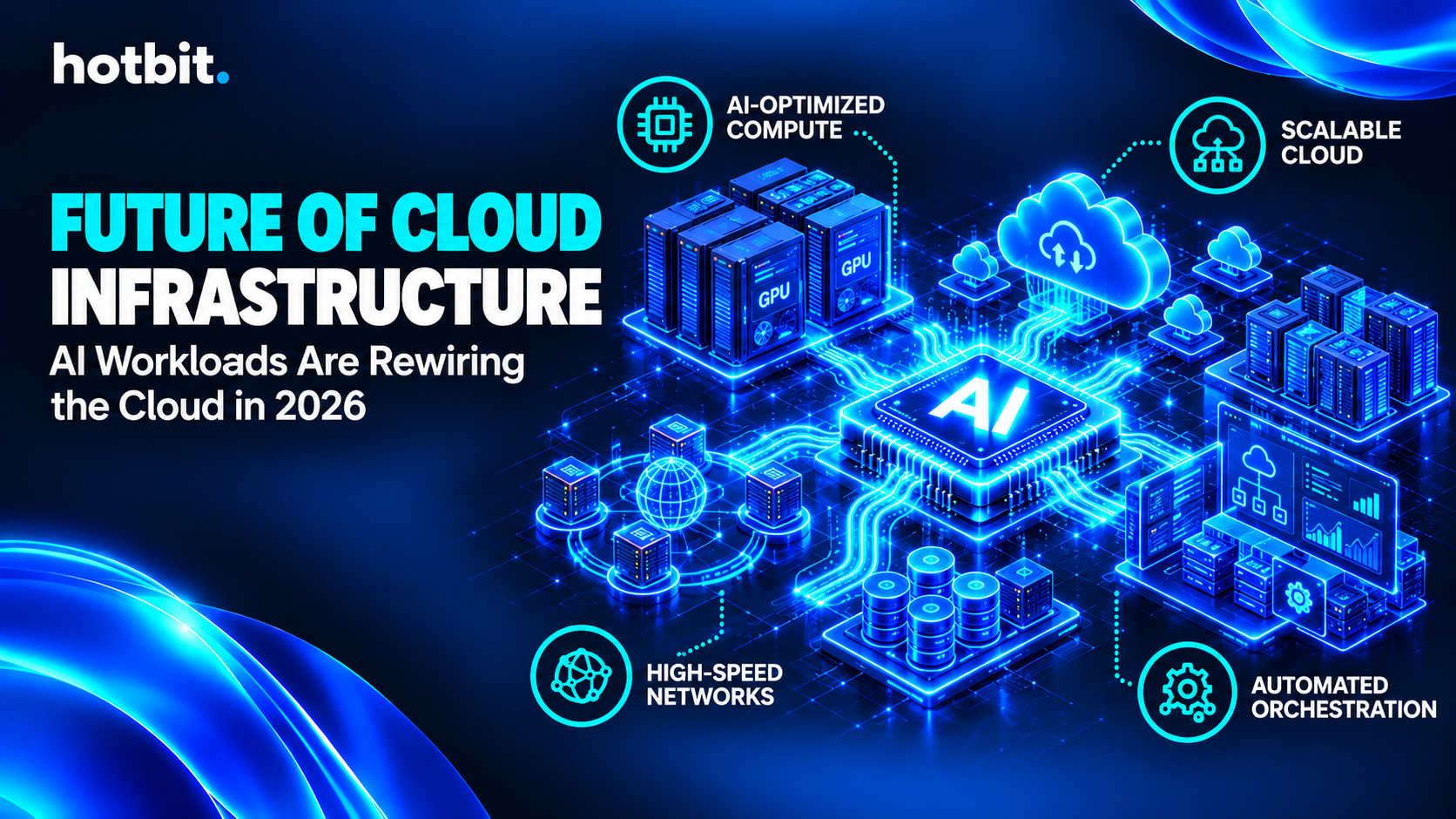
The future of cloud infrastructure runs on accelerator-based platforms built to train, serve, and govern AI workloads at scale. According to Gartner, the global research and advisory firm, worldwide spending on AI-optimized infrastructure as a service (IaaS) will reach $42.3 billion in 2026, a 96% jump over 2025. AI workloads increasingly influence compute, networking, storage, and operations across major cloud platforms, alongside the continuing needs of conventional enterprise applications.
Hotbit Infosoft, a digital-first technology company specializing in AI Automation, Product Engineering, Business Transformation, Cloud, Team-as-a-Service, and iGaming & Fantasy solutions, helps founders, CTOs, and IT directors navigate this shift. This guide explains what is changing, why inference is overtaking training in AI-optimized IaaS, and how to prepare. It draws on forecasts from three of the industry’s most cited analyst sources.
Planning around the future of cloud infrastructure helps manage budget risk in both directions. Overbuilding strands capital in idle accelerators. Underbuilding leaves AI products waiting for capacity.
What Is the Future of Cloud Infrastructure?
The future of cloud infrastructure is a cloud model designed around AI workloads as well as conventional web and enterprise applications. It combines GPU and accelerator compute, high-bandwidth networking, vector-ready data platforms, and automated orchestration into a single stack.
Gartner defines AI-optimized IaaS as cloud infrastructure built specifically for training and running AI models, including accelerator instances and purpose-built networking and storage. Major cloud providers such as Amazon Web Services, Microsoft Azure, and Google Cloud are expanding infrastructure options for AI training and inference alongside their general-purpose cloud services.
The last era ran on virtual machines. The next adds accelerators, while CPUs and virtual machines remain essential. For businesses, the practical result is a cloud that scales by model throughput and response latency, and capacity planning shifts from sizing servers to sizing AI demand. Integrating AI agents in identity and access management can also help businesses explore how AI-driven systems support access control and identity-related workflows.
Why AI Workloads Are Reshaping the Future of Cloud Infrastructure
AI workloads are reshaping cloud infrastructure because many AI applications demand far more compute, power, and bandwidth than traditional software, although requirements vary by model, workload, and deployment scale. Four data points show the scale of the change:
- According to IDC, the global market intelligence firm, AI infrastructure spending will reach $497 billion in 2026, about 56% above 2025.
- According to IDC, AI infrastructure spending hit $89.7 billion in the first quarter of 2026 alone, up 33% year over year.
- According to McKinsey & Company, the global management consulting firm, AI-related data center capacity demand will grow from 44 gigawatts in 2025 to 156 gigawatts by 2030.
- According to McKinsey & Company, about 70% of total data center capacity demand by 2030 will be for data centers equipped to host advanced AI workloads.
McKinsey also estimates that meeting global compute demand could require $6.7 trillion in data center investment by 2030, including about $5.2 trillion tied to AI-related demand. These are forecasts, not guaranteed spending totals.
The growth gap between AI and conventional cloud is just as telling. According to Gartner, total IaaS spending will grow 29.3% in 2026 to $287 billion, while AI-optimized IaaS spending will grow 96.4%. IDC attributes its upward forecast revision to hyperscaler capital spending and emerging non-GPU AI demand.
Hotbit Infosoft designs its Cloud practice around this reality.
Training vs. Inference: Where AI Cloud Demand Is Heading
Inference is becoming the larger share of spending within AI-optimized IaaS. Gartner forecasts that inference spending on AI-optimized infrastructure as a service will surpass training spending in 2026, reaching $23.3 billion compared with $19 billion. Inference will account for 55% of AI-optimized IaaS spending in 2026 and 59% in 2027, reflecting growing demand to run AI models in production.
Training builds a model through periodic, GPU-intensive runs. Inference uses a trained model to generate predictions or responses for new inputs. It may run continuously in production systems, although request volume, latency requirements, and serving patterns vary by application. Gartner also identifies agentic AI, where software agents execute multi-step tasks, as a driver of sustained demand.
This shift changes four infrastructure decisions:
- Capacity planning: Steady request volume replaces bursty training schedules.
- Latency: Inference serving moves closer to users and data sources.
- Cost model: Teams track cost per request, not cost per training run.
- Reliability: Production inference needs uptime targets similar to any customer-facing service.
Businesses that deploy AI Automation at scale feel this shift first, because AI-powered automation can increase inference demand as more workflows use models to classify information, generate responses, or make predictions. Our guide to AI agents in the workplace covers how that demand builds.
Traditional vs. AI-Optimized Cloud Infrastructure: A Comparison
AI-optimized cloud infrastructure differs from traditional cloud infrastructure in compute type, network design, data layer, scaling unit, and cost driver. The table below compares both models across the dimensions that matter most to infrastructure planning.
Dimension | Traditional Cloud Infrastructure | AI-Optimized Cloud Infrastructure |
Primary compute | General-purpose CPUs | GPUs and other accelerators, on both Arm-based and x86 servers |
Typical workload | Web apps, databases, ERP, batch jobs | Model training, inference, agentic workflows, retrieval |
Networking | Standard data center networking | High-bandwidth, low-latency fabrics for parallel processing |
Data layer | Relational and object storage | Often adds vector databases, feature stores, real-time pipelines |
Scaling unit | Virtual machines and containers | GPU clusters, inference endpoints, model throughput |
Main cost driver | Compute hours and storage | Accelerator utilization, power, and per-request inference |
2026 growth (Gartner) | Total IaaS: +29.3% to $287 billion | AI-optimized IaaS: +96.4% to $42.3 billion |
Table 1: Traditional vs. AI-optimized cloud infrastructure. Growth figures from Gartner, August 2026.
Note: Gartner’s AI-optimized IaaS forecast measures a specific cloud infrastructure segment. IDC’s AI infrastructure forecast covers a broader market of servers, storage, and networking. For more context on how AI agents are changing business operations in 2026, readers should understand that these forecasts cover different market segments and should not be compared as equivalent market totals.
Traditional cloud remains essential for databases, ERP, and web applications. AI-optimized infrastructure adds a second layer on top, and the two must work together.
Five Architecture Shifts Defining the Future of Cloud Infrastructure
Five architecture shifts define the future of cloud infrastructure: accelerator-first compute, Arm-based servers, AI-ready data layers, dynamic orchestration, and power-aware design. Each one changes how engineering teams build and operate cloud platforms.
1. Accelerator-first compute
GPUs, such as those from NVIDIA, the leading GPU maker, now anchor AI cloud capacity. Accelerators process thousands of operations in parallel, which suits neural network math.
Gartner describes AI-optimized IaaS as built around GPU and accelerator instances for exactly this reason. Teams must now plan accelerator supply, scheduling, and utilization as carefully as they once planned CPU capacity.
2. Arm overtakes x86 in accelerated servers
IDC reported that non-x86, primarily Arm-based, accelerated server spending exceeded x86 spending in the first quarter of 2026: $53.0 billion versus $34.6 billion. This applies to the accelerated-server segment IDC measures, not to all servers.
x86 remains relevant, and future platform leadership is uncertain. Engineering teams should build container images and pipelines that support multiple CPU architectures.
3. AI-ready data layers
Many AI architectures retrieve context from vector databases, feature stores, and real-time data pipelines, though not every AI application needs all three. These components must sit close to compute, because moving large datasets across regions adds latency and cost.
4. Dynamic orchestration
Kubernetes, the open-source container orchestration platform, increasingly manages model-serving gateways, inference routers, and autoscaling layers. Infrastructure as code keeps these environments reproducible across clouds.
For workloads with rapidly changing demand, static configurations can be less efficient than automated scaling and dynamic resource allocation. Product Engineering teams must treat orchestration as part of the product, not a back-office task.
5. Power-aware design
Power availability is becoming a significant constraint on AI data center expansion in some markets. McKinsey & Company estimates that, even if all announced plans are delivered on time, the United States could face a data center supply deficit of more than 15 gigawatts by 2030.
Efficient models, right-sized instances, and region selection based on power availability all become architecture choices.
Hybrid, Multi-Cloud, and Edge: Where AI Workloads Will Run
AI workloads will run across public cloud, private infrastructure, and edge locations, with placement decided by data sensitivity, latency, and cost. No single environment fits every workload.
- Public cloud: A common fit for elastic training runs, experimentation, and variable inference demand.
- Private or on-premises infrastructure: A common fit for regulated data and steady, high-utilization inference. Compliance needs and workload economics decide each case.
- Edge: Can reduce network latency for applications that need rapid local responses, including industrial systems, retail operations, connected vehicles, and some real-time platforms such as iGaming & Fantasy projects.
- Multi-cloud: Can widen access to accelerator capacity and reduce provider lock-in. Differences in hardware, quotas, pricing, and architecture can limit portability, and consistent security and policy controls are required.
Data residency rules differ by country, so global businesses must map each AI workload to the regions where its data may legally live. Infrastructure as code keeps security and configuration consistent across every environment.
Placement decisions belong in the wider Business Transformation roadmap, because they affect cost structure, compliance posture, and product speed at the same time.
Cost, Power, and Governance Risks: Are You Ready for AI Cloud Infrastructure?
AI cloud infrastructure introduces three risks that traditional cloud programs rarely faced at this scale: runaway cost, power constraints, and governance gaps.
Cost. McKinsey & Company projects that capital investment to support AI-related data center capacity could range from about $3.7 trillion in a constrained-demand scenario to $7.9 trillion in an accelerated-demand scenario by 2030, with about $5.2 trillion in its continued-momentum case. These are scenario forecasts, not committed spending.
Enterprises feel that uncertainty through volatile accelerator pricing and long-term capacity commitments. AI agents in the workplace can add another dimension to infrastructure planning, making it important to evaluate workloads and resource requirements carefully. FinOps, the discipline of managing cloud spend, should track GPU utilization, idle capacity, and cost per inference request.
Power. Power availability now limits where and how fast providers can expand. Teams that choose smaller, efficient models and optimize accelerator usage reduce both cost and energy demand.
Governance. AI services expand the attack surface and the compliance workload. Zero-trust access, audit logging, model and data lineage, and clear ownership of every endpoint help reduce that exposure.
Governance and cost controls work best when built into the platform from the start. Retrofitting them after launch is slower and more expensive.
McKinsey & Company also warns that overbuilding is a real risk. Companies that overinvest risk stranding assets, while companies that underinvest fall behind competitors.
Buying long-term accelerator capacity before demand is proven locks in cost, while relying only on on-demand capacity exposes products to shortages. A balanced plan reserves capacity for steady inference traffic and uses on-demand capacity for experiments and spikes.
How to Prepare Your Cloud Strategy for AI Workloads
Preparing a cloud strategy for AI workloads takes six steps: audit current workloads, classify AI use cases, choose placement, modernize the data layer, automate operations, and govern cost and risk.
- Audit current workloads. Measure utilization, dependencies, and data locations across existing applications.
- Classify AI use cases. Label each as training, fine-tuning, or inference, and estimate request volume and latency needs.
- Choose placement. Assign each workload to public cloud, private infrastructure, or edge based on data sensitivity and response time.
- Modernize the data layer. Add vector search, streaming pipelines, and clean, governed datasets close to compute.
- Automate operations. Use infrastructure as code, Kubernetes, and autoscaling to remove manual provisioning.
- Govern cost and risk. Set FinOps targets, access policies, and monitoring before production launch.
Measure progress against business outcomes, not infrastructure milestones. Useful indicators include inference latency, cost per request, accelerator utilization, and time to deploy a new model.
Some AI infrastructure projects struggle to find professionals with the required cloud, machine-learning, and platform-engineering skills. Teams can weigh targeted hiring, training, or external specialists, including Hotbit’s Team-as-a-Service model of pre-vetted, skilled professionals. For a deeper checklist, read our guide on how businesses can prepare their infrastructure for AI.
How Hotbit Infosoft Can Help Build AI-Ready Cloud Infrastructure
Hotbit Infosoft, a digital-first technology company, builds Cloud platforms that carry AI workloads from pilot to production. The company brings 15+ years of experience, 100+ delivered success stories, 200+ global brands served, and work across 12+ industries, with teams in India, Singapore, Mauritius, and Saudi Arabia.
Hotbit’s Cloud, AI Automation, and Product Engineering practices work as one team. Cloud engineers design the platform, AI specialists tune model serving, and product engineers integrate AI features into customer-facing software. Explore the full range of Hotbit services, or read how AI is changing the role of software developers.
Book a consultation to discuss your AI infrastructure requirements with our team.
Future of Cloud Infrastructure: Your Questions Answered
What is the future of cloud infrastructure?
The future of cloud infrastructure is an increasingly AI-centric model that runs alongside conventional workloads. Providers are adding GPU and accelerator platforms, high-bandwidth networks, and automated orchestration to general-purpose capacity. According to Gartner, AI-optimized infrastructure as a service will grow 96% in 2026 to $42.3 billion, far outpacing the 29.3% growth of overall IaaS.
How is AI changing cloud infrastructure?
AI is changing cloud infrastructure by shifting demand from CPUs to GPUs, raising power and networking requirements, and making inference a growing share of AI cloud spending. According to McKinsey & Company, about 70% of global data center capacity demand by 2030 will be for data centers equipped to host advanced AI workloads. Providers are redesigning compute, storage, and orchestration around that demand.
What is AI-optimized infrastructure as a service?
AI-optimized infrastructure as a service (IaaS) is cloud infrastructure built specifically to train and run AI models. It includes GPU and accelerator instances plus purpose-built networking and storage. Gartner, the global research and advisory firm, forecasts this segment at $42.3 billion in 2026. Businesses rent it on demand instead of buying accelerators.
What is the difference between AI training and inference?
Training teaches a model by processing large datasets in periodic, GPU-intensive runs. Inference applies the trained model to live requests and runs continuously. According to Gartner, inference will take 55% of AI-optimized IaaS spending in 2026, surpassing training: $23.3 billion versus $19 billion.
What are the biggest challenges of AI cloud infrastructure?
The biggest challenges are cost, power, and governance. Accelerator capacity is expensive. AI data centers draw significantly more power than traditional facilities. According to McKinsey & Company, AI-related data center investment could range from roughly $3.7 trillion to $7.9 trillion by 2030, depending on the scenario. Teams also need strict access controls and audit trails.
Disclaimer
This article is for informational purposes only and reflects industry forecasts and technology trends available at the time of writing. Market projections are estimates, not guarantees. Cloud infrastructure requirements, costs, performance, and compliance obligations vary by business and workload. Consult qualified cloud and technology professionals before making infrastructure or investment decisions.