
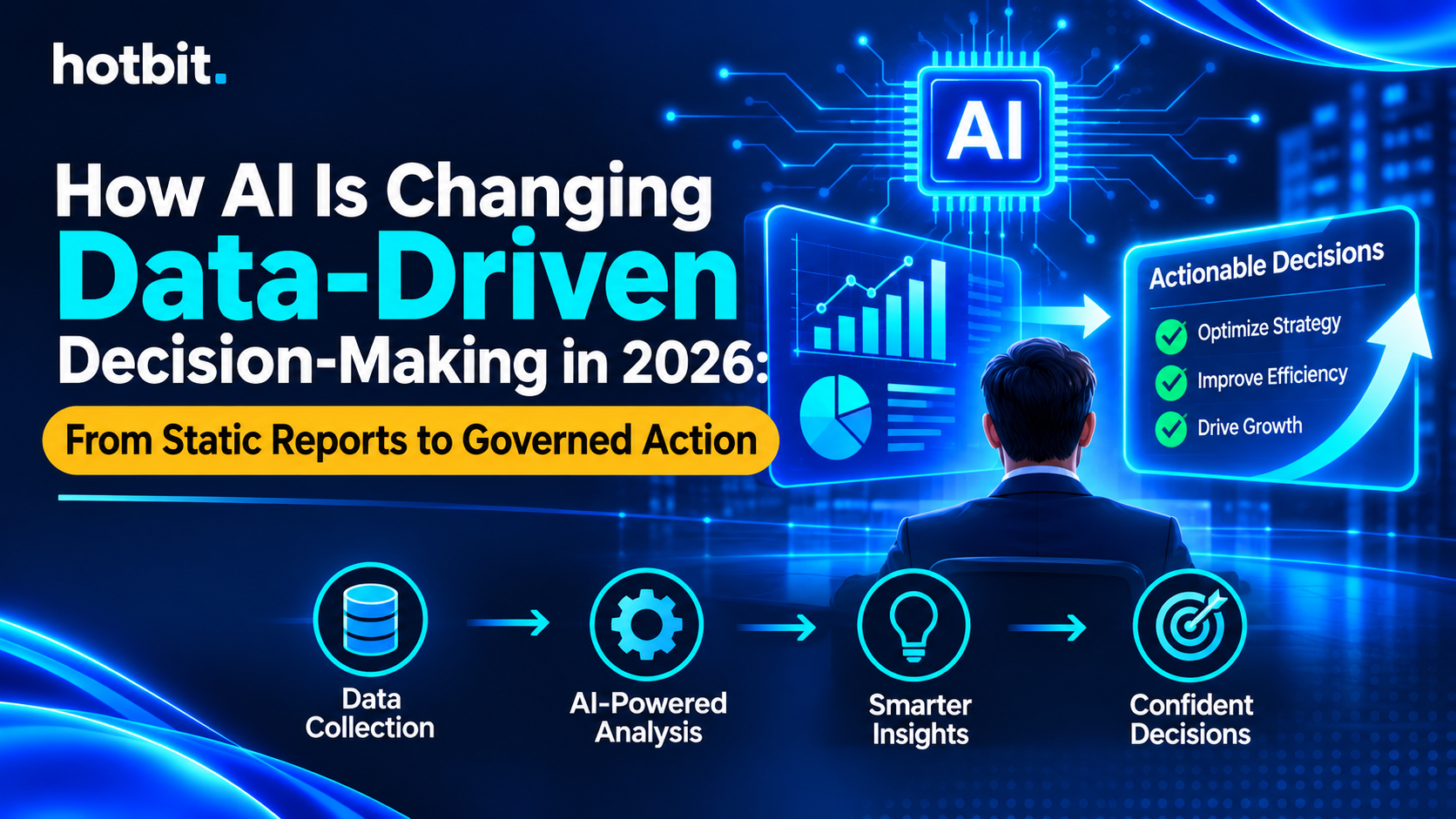
How AI is changing data-driven decision-making: machine learning now analyzes data continuously, predicts outcomes, and acts within governed limits. The shift moves your team from interpreting static reports to directing systems that recommend actions and execute routine choices within set limits.
According to McKinsey & Company, the global management consulting firm, 50 percent of survey respondents say AI helps them make better decisions, yet only 37 percent report that AI has contributed to enterprise EBIT (earnings before interest and taxes). That gap decides who leads the race and who stalls. For businesses developing AI-powered products, making informed decisions early also means validating a mobile app idea before development to assess market demand, understand user needs, and reduce the risk of investing in an idea that may not succeed.
AI improves decision processes when systems are appropriately designed, tested, and integrated into business workflows. The value depends on data quality, model reliability, governance, and how you connect AI outputs to real decisions.
This guide maps what changes at each stage of the decision cycle and how AI-powered decisions compare with traditional analytics. Expect a clear view of where organizations stall and how to implement AI responsibly while addressing emerging security challenges through a comparison of traditional cybersecurity and AI-driven security approaches. Hotbit Infosoft, a digital-first technology company specializing in AI Automation, Product Engineering, Business Transformation, Cloud, Team-as-a-Service, and iGaming & Fantasy solutions, prepared this guide.
How AI Is Changing Data-Driven Decision Making: What It Means
Machine learning models detect patterns across large datasets, forecast likely outcomes, and suggest the next best action, often in real time. Gartner, a technology research and advisory firm, defines decision intelligence platforms as software that blends decision modeling, analytics, and AI to support, enhance, or fully automate decisions. As businesses increasingly rely on AI-driven systems and sensitive data, they must also consider long-term security risks and explore post-quantum cryptography for businesses to protect their data against potential quantum computing threats.
The payoff can be a faster decision cycle that processes more data and uses monitored outcomes to improve future recommendations. Leaders still set goals, define limits, and own accountability, while AI Automation handles the volume and speed that manual analysis cannot match.
Three levels of AI involvement in decision-making
AI plays one of three roles in a decision: it supports the decision maker, augments the decision maker, or automates the decision entirely. Matching the role to the risk of the decision is the most important design choice. For example, local large language models (LLMs) and AI coding assistants can support developers by providing AI-powered recommendations while keeping data processing and control within their local environment.
- Decision support: AI provides analysis and dashboards, and a person decides. This suits strategic, high-stakes, or low-frequency decisions.
- Decision augmentation: AI recommends an action and explains why, and a person approves or overrides it. This suits pricing, credit, and hiring shortlists, where fairness testing, regulatory compliance, and meaningful human review are also required.
- Decision automation: AI acts on its own within defined limits and escalates exceptions. This suits high-volume, low-risk decisions such as ticket routing or stock reordering.
Most organizations use all three levels at once, assigning each decision type to the level that balances speed with risk.
How AI Is Changing Data-Driven Decision Making at Every Stage
AI changes data-driven decision making at five stages: data preparation, pattern detection, prediction, recommendation, and execution.
1. Data preparation
AI-powered tools can help clean, integrate, and validate data across multiple systems, flagging anomalies and missing values before analysis begins. Organizations still need defined data-quality rules and human oversight to keep the information accurate and reliable.
2. Pattern detection
Machine learning can identify complex patterns and relationships across large datasets, helping analysts investigate trends that conventional analysis may struggle to detect. Natural language interfaces let non-technical managers ask questions in plain words and receive answers drawn from connected data.
That widens access to insight well beyond the data team.
3. Prediction
Predictive models forecast demand, churn, risk, and equipment failure from historical and live data. Teams act on likely outcomes instead of reacting to last month’s results, which turns planning from a periodic review into a continuous process.
4. Recommendation
AI evaluates scenarios and ranks options by expected outcome, cost, and risk. Leaders compare “what if” paths side by side rather than debating a single forecast.
5. Execution
AI agents can trigger routine actions within defined permissions, such as reordering stock, routing support tickets, or flagging suspicious transactions for review. What an agent can do independently depends on its permissions, integrations, reliability, and safeguards.
According to Gartner, the technology research and advisory firm, 32 percent of CEOs expect their organizations to deploy self-learning, adaptable AI tools to assist human decision making by the end of 2028, and 80 percent expect AI to force a high to medium degree of change in their operational capabilities. These figures describe CEO expectations, not current deployment. As organizations adapt to these changes, understanding the future of business intelligence can help businesses explore how AI, predictive analytics, and data-driven insights are shaping strategic decision-making.
AI-Powered vs. Traditional Data-Driven Decision Making: Eight Dimensions Compared
The key difference is that traditional analytics mainly describes what happened, while AI-powered decision making adds prediction, recommendation, and action at scale. Predictive and prescriptive analytics existed before modern AI, so the shift is one of scale and automation. The table below compares the two approaches across eight dimensions.
Dimension | Traditional Data-Driven Decisions | AI-Powered Data-Driven Decisions |
Primary question | Mostly descriptive: what happened, and why? | Predictive and prescriptive: what will happen, and what should we do? |
Data handled | Structured data from a few systems | Structured and unstructured data from many sources |
Speed | Daily, weekly, or monthly reporting cycles | Continuous or near real-time analysis, where infrastructure allows |
Analysis method | Manual queries, dashboards, spreadsheets | Machine learning, natural language queries, anomaly detection |
Who gets insights | Analysts and data teams | Authorized team members, depending on data permissions and system access |
Action | People interpret and act | AI recommends or acts within set limits |
Learning | Rules updated manually | Models monitored and periodically retrained using validated data |
Main risk | Slow cycles and selective reporting | Poor data quality, opaque models, over-automation |
Table 1: Traditional and AI-powered data-driven decision making compared.
AI-powered decisions do not replace traditional analytics. They depend on the same clean data, clear metrics, and accountable owners, which is why Business Transformation programs often start with data foundations before models.
Business Benefits of AI-Driven Decision Making: Speed, Accuracy, Scale, and Consistency
AI-driven decision making can deliver four potential benefits when supported by reliable data and appropriate governance:
- Speed: AI can analyze data far faster than manual methods, depending on infrastructure, dataset size, and task, so teams respond while opportunities are still open.
- Accuracy: Models can improve predictive performance by detecting subtle patterns, but they can also produce incorrect predictions.
- Scale: A well-architected system can evaluate thousands of products, customers, or transactions at the same time.
- Consistency: Models apply the same learned logic to similar inputs, which can reduce variation between teams, though they can also embed systematic bias.
According to McKinsey & Company, the global management consulting firm, 80 percent of respondents report that AI has improved their individual productivity. These figures reflect respondents’ own reported experience, not independently measured results.
Investment forecasts point the same way, though they project spending rather than record it. International Data Corporation (IDC), the global market intelligence firm, expects that AI spending will grow 31.9 percent year over year between 2025 and 2029 and reach $1.3 trillion in 2029.
These benefits are not automatic: they depend on data quality, model performance, and implementation. They grow when you pair them with Cloud data platforms that give models fast, governed access to current data.
Scaling AI Decision Making: Why Most Organizations Stall
Most organizations stall because they adopt AI faster than they redesign the decisions it should improve. According to Gartner, the technology research and advisory firm, only 22 percent of organizations have scaled AI across multiple business units or adopted an AI-first approach, even though 85 percent of functional leaders plan to increase AI spending in 2026.
That survey covered 1,303 respondents from organizations with at least $50 million in annual revenue.
The decision-quality gap is visible too. A Gartner survey of 204 finance leaders found that only 20 percent of finance AI projects lean toward decision quality, while 45 percent lean toward productivity. McKinsey & Company also reports that the share of respondents seeing AI contribute to EBIT is essentially flat at 37 percent.
Three causes recur:
- Fragmented data: Models cannot recommend well when inputs sit in disconnected systems.
- Productivity bias: Teams automate tasks instead of improving the decisions behind them.
- Unclear ownership: No one is accountable for an AI-assisted decision, so no one tunes it.
Go deeper on enterprise AI in Hotbit’s insights library.
Use Cases: How AI Improves Data-Driven Decisions Across Industries
AI supports decision making across industries that generate large volumes of data, including finance, retail, manufacturing, healthcare operations, and digital platforms:
- Finance: Credit risk scoring, fraud detection, and cash-flow forecasting.
- Retail and e-commerce: Demand forecasting, dynamic pricing, and inventory planning.
- Manufacturing: Predictive maintenance, quality inspection, and supply chain planning.
- Healthcare operations: Capacity planning, staff scheduling, and claims review, which are administrative and operational decisions rather than clinical diagnosis or treatment.
- Digital products: Feature-usage analytics that guide roadmap priorities, a core input for Product Engineering teams.
- iGaming & Fantasy platforms: Engagement analytics and platform performance monitoring for operators and studios building on iGaming & Fantasy solutions.
Each use case follows the same pattern: a clearly defined decision, a reliable data feed, and a model whose output reaches the person or system that acts on it. Where any of those three is missing, the model produces insight that nobody uses.
Start with the decision, not the dataset or the algorithm. That choice separates working deployments from stalled pilots.
How to Implement AI-Driven Decision Making in Six Steps
Implementing AI-driven decision making takes six steps: choose a decision, prepare the data, build the model, embed it in the workflow, set governance, and measure outcomes.
- Choose one high-value decision. Pick a frequent, measurable decision, such as demand planning or lead scoring, and define what a better outcome means.
- Prepare the data. Consolidate sources, fix quality issues, and set up governed access on a scalable Cloud architecture.
- Build and test the model. Train on historical data, validate against held-out cases, and compare results with current human decisions.
- Embed it in the workflow. Connect outputs to the tools people already use through AI Automation services, so recommendations trigger frictionless action instead of waiting in a dashboard.
- Set governance. Assign an owner, define human review for high-stakes cases, and log every automated decision.
- Measure and expand. Track decision speed, accuracy, and business impact, then extend the approach to the next decision.
Teams can complement internal capabilities with vetted specialists through Team-as-a-Service, while decision ownership and data governance stay with the organization.
Measuring AI Decision Quality: Four Metrics That Prove Impact
Measuring AI decision quality requires tracking four metrics: decision speed, prediction accuracy, human override rate, and business outcome. Baseline each metric before launch so that improvement is provable rather than assumed.
- Decision speed: Time from data arrival to completed action.
- Prediction accuracy: How often forecasts match actual results, such as demand or churn.
- Override rate: How often people reject AI recommendations, helping identify model limitations, governance issues, or situations where human judgment adds value.
- Business outcome: Revenue, cost, risk, or customer results linked directly to the decision.
Review these metrics on a schedule that matches the decision’s risk and the model’s behavior, and retrain after validation when accuracy drifts. Pair each override with its reason, since a high rate does not automatically mean a model is failing. Measurement also keeps AI investment tied to decision quality instead of activity.
Risks and Governance in AI-Assisted Decision Making: Five Controls
AI-assisted decisions need governance because models can inherit bias, hide their reasoning, and fail when data changes. Five controls address these risks:
- Data validation: Check accuracy, completeness, and freshness before data reaches a model.
- Explainable AI (XAI): Use models whose reasoning people can inspect and challenge.
- Human-in-the-loop review: Require human approval for high-stakes or irreversible decisions.
- Bias and performance monitoring: Test outputs regularly and retrain after validation when accuracy drifts.
- Audit trails: Record inputs, outputs, and approvers for every automated decision.
Explainability and human oversight are widely recommended governance practices because they keep decision logic inspectable and open to challenge. They matter in private enterprises too, where trust determines whether people act on AI recommendations.
How Hotbit Infosoft Supports AI-Driven Decision Making: From Pilot to Production
Hotbit Infosoft helps organizations move AI from pilot to production decisions. With 15+ years of experience, 100+ delivered success stories, 200+ global brands, 12+ industries served, and listed locations in India, Singapore, Mauritius, and Saudi Arabia, Hotbit builds the purpose-built foundations that decision-ready AI requires.
- AI Automation: Decision workflows, predictive models, and AI agents that act on insights.
- Cloud: Governed data platforms and scalable infrastructure for analytics.
- Product Engineering: AI features embedded in web and mobile products.
- Business Transformation: Operating models and change management around data-driven decisions.
- Team-as-a-Service (TaaS): Pre-vetted data and AI engineers who join existing teams.
Explore all six pillars on the What We Do page, or read more practical guidance in Hotbit’s latest technology articles.
Lasting value comes from redesigning decisions, not adding tools. Organizations that start with one decision, build on governed data, embed models in daily workflows, and keep people accountable move AI from experiment to repeatable value, so Talk to an Expert and let’s make it happen.
Frequently Asked Questions About AI and Data-Driven Decision Making
How does AI help in data-driven decision making?
AI helps by analyzing large datasets faster than people can. Machine learning detects patterns, predicts outcomes, and recommends actions, while AI also assists with data cleaning and answers questions in plain language. Leaders receive timely, evidence-based options instead of waiting for manual reports.
What is AI-driven decision making?
AI-driven decision making is the use of machine learning and related technologies to analyze data, predict results, and recommend or take actions. Humans set goals and limits, and AI handles analysis at scale. Gartner, the technology research and advisory firm, groups these capabilities under decision intelligence, which combines decision modeling, analytics, and AI.
How is AI used in decision making in business?
Businesses use AI to forecast demand, score credit risk, detect fraud, optimize pricing, and plan maintenance. Models analyze historical and live data, then rank options by expected outcome, and some tasks run automatically within set limits. According to McKinsey & Company, 50 percent of surveyed respondents say AI helps them make better decisions.
What are the benefits of AI in decision making?
AI can improve decision making through speed, predictive accuracy, scalability, and consistency when data and governance are sound. It can analyze more data in less time and surface patterns people may miss. According to McKinsey & Company, 80 percent of respondents report that AI improved their individual productivity.
What are the risks of using AI in decision making?
The main risks are poor data quality, biased models, opaque reasoning, and over-automation. A model trained on flawed data produces flawed recommendations, so organizations reduce these risks with data validation, explainable AI, human review of high-stakes decisions, and regular model monitoring. Clear ownership for each automated decision is essential.
Disclaimer
This article is intended for informational and educational purposes only. The information provided reflects general perspectives on artificial intelligence, data-driven decision-making, and emerging technology trends. AI capabilities, performance, and implementation outcomes may vary depending on data quality, infrastructure, model design, and organizational requirements. Statistics and industry forecasts are based on cited third-party sources and may change over time. Readers should independently verify information and consult qualified technology, legal, and compliance professionals before making business or technology decisions. Hotbit Infosoft does not guarantee specific business outcomes from AI implementation.