
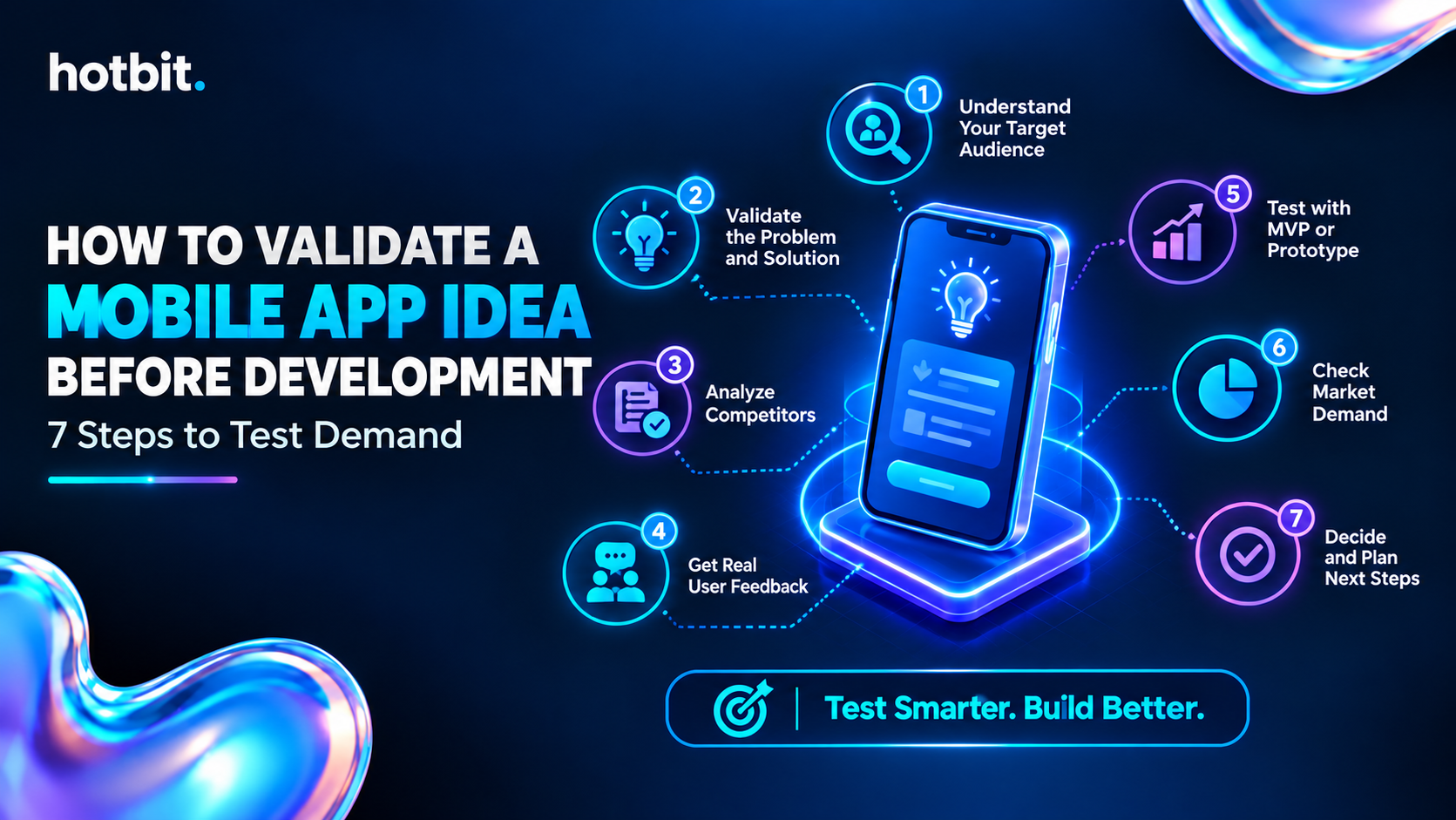
How to validate a mobile app idea before development comes down to seven evidence-led steps that help assess demand, usability, and willingness to pay before development begins. Skip them, and you fund a build on assumptions. The data points to weak demand, not weak engineering, as the real risk.
CB Insights, the venture-capital data and research firm, analyzed 101 startup post-mortems in 2018 and found that 42% cited a lack of market need, ahead of running out of cash at 29%. It is a historical sample, not a current industry-wide failure rate, but it shows why testing demand first pays off. One way startups can accelerate this validation process is by exploring AI-assisted development approaches. Understanding the differences between vibe coding and traditional software development can help businesses choose an approach that fits their product goals, resources, and development requirements.
How to Validate a Mobile App Idea Before Development: The Core Principle
Validation replaces assumptions about demand with measurable user behavior. Validation can provide evidence of demand, but it cannot guarantee success. Proceed to full development only when real users, not friends or family, show commitment. As AI continues to change software development workflows, understanding how AI is changing the role of software developers can also help businesses make more informed decisions about their product development approach.
Commitment comes in levels. A waitlist sign-up is the weakest signal, repeated prototype engagement is stronger, and a completed payment is the strongest. Compliments are not validation. Behavior is. However, understanding customer behavior requires reliable data. An effective AI-first data strategy helps businesses organize, analyze, and use data to make better product and business decisions.
Understanding the seven-step framework
- Define the problem and target user. Write one sentence: “[Specific user] struggles with [specific problem] and currently uses [existing workaround].” If it needs the word “everyone,” the idea is not ready.
- Research the market and competitors. List the top five competing apps on the Apple App Store and Google Play, then read their one-star and two-star reviews. Existing competitors can indicate that customers already recognize the problem and may pay for a solution, so examine their pricing, reviews, and user demand. An empty market is not automatically evidence of no demand; investigate whether the opportunity is underserved or the problem is too minor to support a product.
- Interview real users. Plan roughly 8 to 15 interviews and ask about past behavior, not hypotheticals like “Would you use this?” Listen for unprompted pain, existing workarounds, and emotional intensity.
- Test demand with a landing page. Publish one page with a clear headline, three benefits, a mockup, and a single call to action. Judge sign-ups from targeted traffic against a goal set before launch, and treat conversion rates as directional, not universal benchmarks.
- Build a clickable prototype. Use Figma to design only the core journey, then run moderated tests with five to eight target users. Record where they hesitate and measure task completion.
- Test willingness to pay. Use pre-orders, a pricing page test, or letters of intent for B2B apps. Each shows a different strength of evidence, and only completed payments prove revenue.
- Launch a limited MVP. Release one core feature loop through TestFlight or Google Play’s closed testing track to a pilot group of 50 to 200 users. That range is a practical suggestion, not a statistically universal sample size.
Steps one to six happen before any production code. Step seven is a deliberately small build that caps your investment before the full product. Before moving toward production, businesses should also evaluate the computing resources, scalability, security, and deployment requirements needed to support their AI solutions. A well-planned AI infrastructure for businesses can help establish that foundation.
Are You Ready for the Retention Reality?
The market leaves little room for guesswork. Sensor Tower, the mobile app intelligence firm, reported in its State of Mobile 2026 report that people spent about 3.6 hours per day in apps across iOS and Google Play in 2025. Attention is plentiful but already allocated, so your app must displace an existing habit. To make that experience valuable and consistent, businesses also need to prioritize data quality and AI, ensuring AI-powered features rely on accurate, reliable, and well-managed data.
Retention sharpens the stakes. According to Business of Apps, 2026 estimates put average day-one retention near 25% and day-30 retention near 4%. Figures vary by app category, platform, and how retention is calculated, and other providers publish different numbers, but all show steep drop-off.
Track activation rate, day-1, day-7, and day-30 retention, repeat usage, and qualitative feedback during the MVP. Industry averages give context, not product-market-fit thresholds. A small cohort can mislead, so weigh retention alongside acquisition cost, revenue, and sample uncertainty. Generative AI vs. Traditional Business Intelligence can also help businesses understand how AI-powered insights differ from traditional analytics when evaluating product performance and making data-driven decisions.
Common Validation Mistakes That Corrupt Your Results
Each mistake below can produce false positives that make an app idea look more promising than it is, increasing the risk of building a product without sufficient market demand. If you need help evaluating your product idea, validating its market potential, or planning the next steps, contact our team to discuss your project and development goals.
- Asking hypothetical questions: “Would you use this?” invites a polite yes, so ask about past behavior instead.
- Validating with the wrong audience: feedback from non-users is noise, so screen every participant against your target user definition.
- Skipping the money test: interest without payment is a common false positive.
- Ignoring negative results: a failed test is the process working, and it saves the budget you would have spent on the wrong build.
Combine at least three methods. Convergent evidence protects you from any single misleading result.
How Hotbit Infosoft Helps You Validate and Build
Hotbit Infosoft brings 15+ years of experience, 100+ delivered success stories, and 200+ global brands served across 12+ industries. Our Product Engineering teams run discovery workshops, Prototype design and MVP builds to help ensure validation evidence feeds directly into your roadmap. Ready to test your idea with a team that builds as well as validates? Learn more about Hotbit Infosoft and our expertise, then talk to an expert, and let’s make it happen..
Frequently Asked Questions About Validating a Mobile App Idea
1. How do you validate a mobile app idea before development?
Start by identifying the problem your app will solve and defining its target audience. Research competing apps, interview potential users, test demand with a landing page, and create a clickable prototype. You should also assess willingness to pay before investing in a full product build.
2. How much does it cost to validate a mobile app idea?
The cost depends on the validation methods you choose. User interviews, competitor research, and simple landing-page tests can often be conducted with a relatively small budget. A clickable prototype or limited MVP requires more resources. Starting with low-cost experiments helps you identify weak ideas before committing to expensive development.
3. How many people should you interview to validate an app idea?
Around 8 to 15 interviews can provide useful early insights into user problems, existing workarounds, and expectations. Focus on interviewing people who match your target audience rather than collecting responses from a large but unrelated group. You may need additional interviews if important patterns remain unclear.
4. How do I know if my mobile app idea has market demand?
Look for evidence of real user behavior rather than relying on compliments or hypothetical interest. Useful signals include existing solutions, recurring user problems, waitlist registrations from targeted visitors, prototype engagement, pre-orders, and completed payments. No single signal guarantees success, so combine multiple validation methods.
5. Do I need to build an MVP to validate my app idea?
No. You can complete several important validation steps before writing production code. Problem research, competitor analysis, user interviews, landing-page experiments, and clickable prototypes can help assess an idea first. Build a limited MVP when you have enough evidence to test the core feature with real users.
Disclaimer
The information in this article is intended for general educational and informational purposes only. The validation methods, interview counts, pilot group sizes, and industry statistics are provided as general guidance and may vary depending on the app category, target audience, market conditions, and business objectives. Results from early testing do not guarantee market success or profitability. Businesses should conduct their own research and evaluate their specific requirements before making development or investment decisions.