The bar keeps rising. Gartner reported in July 2026 that customers are now roughly three times more likely to reach for a third-party generative AI tool than a company’s own chatbot when they have a service issue.
This piece breaks down what generative AI actually does inside a support workflow, how it differs from the rule-based chatbots most teams already run, what the productivity numbers look like, and how to start using it without disrupting the support experience customers already trust.
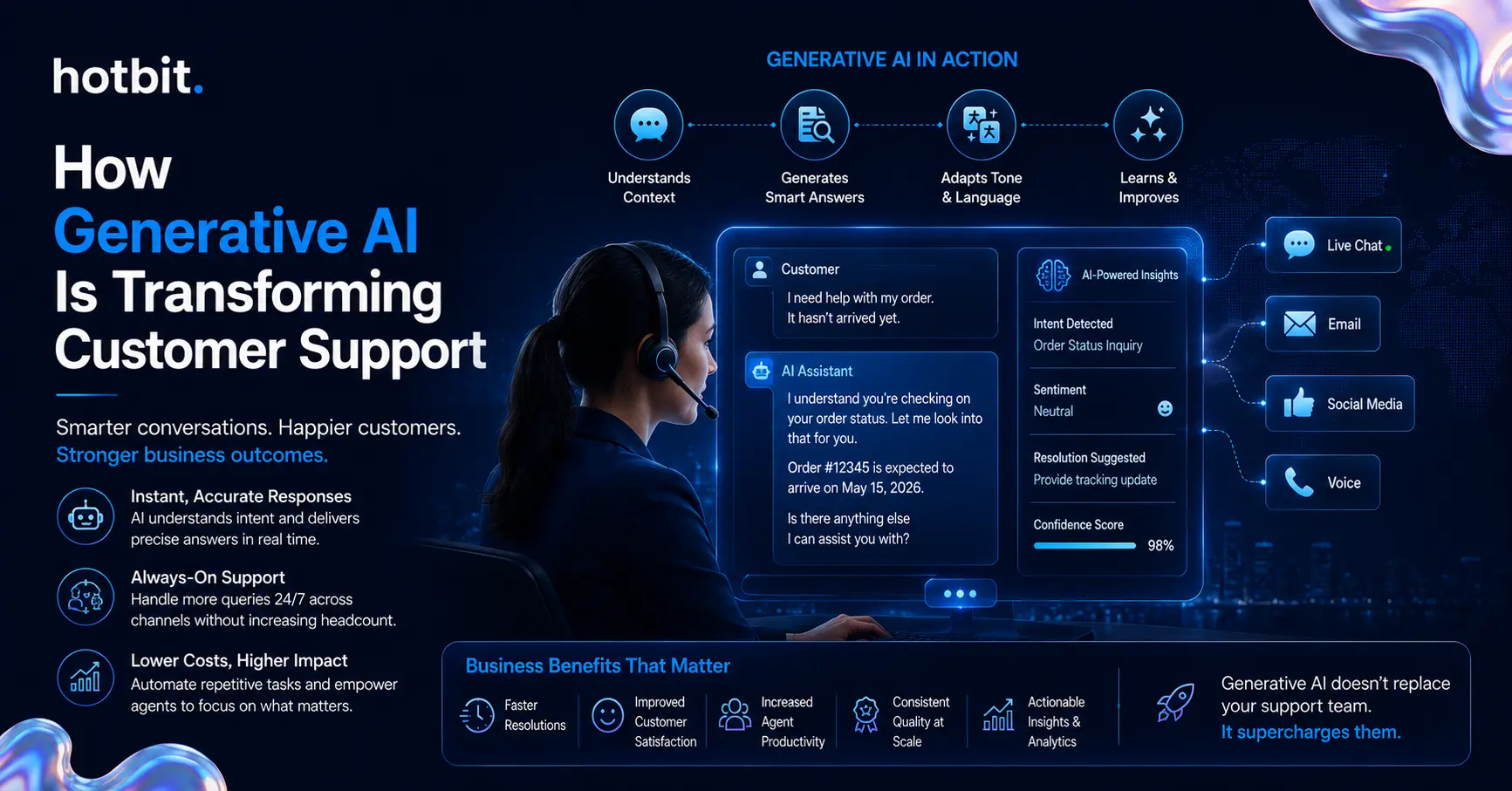
Generative AI in customer support refers to systems built on large language models that read a customer’s message, pull relevant information from a company’s knowledge base or systems, and generate a new, contextually accurate response rather than selecting from a pre-written script.
Generative AI reshapes daily support work in three concrete ways:
1. Drafts first-response replies for agents to edit rather than write from scratch.
2. Resolves high-volume, repetitive tickets password resets, order status, billing FAQs without human involvement.
3. Summarizes long customer histories into a short brief an agent can read in seconds..
McKinsey documented a case involving 5,000 customer service agents in which generative AI increased issue resolution by 14% per hour and reduced time spent handling an issue by 9%. Agents don’t disappear. They spend less time on repetitive lookups and more time on the smaller share of conversations that genuinely need judgment.
The core difference is flexibility. Rule-based chatbots follow fixed decision trees and fail outside their scripted paths. Generative AI understands intent and responds to phrasing it has never seen before.
The numbers show why this shift is accelerating and why the size of the gain depends on how deeply the system is integrated, rather than whether it is run as a standalone pilot. McKinsey estimates that generative AI could create productivity value equal to 30% to 45% of current customer care function costs. This represents potential value, not a guaranteed reduction in operating expenses.
The potential for automation is also reflected in Gartner’s forecasts. Gartner predicts that agentic AI will resolve 80% of common customer service issues without human intervention by 2029, compared with a negligible share today. This suggests that AI could increasingly handle routine and predictable support requests while human agents focus on more complex cases.
The main risks are inaccurate or fabricated responses and weak handling of emotionally sensitive cases. A model that isn’t properly grounded in verified company data can generate a confident but incorrect answer, which can be more damaging in customer support than a chatbot simply saying it doesn’t know.
Over-automation can also strip away the human escalation paths customers still need. Gartner reports that 85% of service and support leaders are expanding human agents’ responsibilities as AI takes on routine volume, while only 31% have implemented or planned frontline workforce reductions through early 2027. This suggests that most organizations are redesigning the human role around AI rather than eliminating it. This shift is part of broader AI trends in 2026, as businesses increasingly combine AI capabilities with human expertise rather than relying on automation alone.
That expectation is becoming measurable from the customer side too. Gartner reported in August 2026 that 87% of customers say it’s essential for companies to provide an option to reach a human agent when using GenAI for customer service. The right balance depends on the use case because the level of nuance and empathy required varies by ticket. Generative AI should therefore be treated as an augmentation layer for agents, not a full replacement, with a fast and clear path to a human whenever a request falls outside the model’s confidence range.
Rolling out generative AI in support starts with an audit: which ticket types are highest-volume and lowest-complexity, and therefore the safest to automate first. From there, a phased rollout can reduce risk: start with agent assistance, move to supervised automation, and expand toward autonomous resolution as accuracy and business results justify it. Connecting a language model to real support data, CRM records, and ticketing systems is as much a build challenge as an AI one, which is a common obstacle when organizations try to move AI pilots into production.
Generative AI is no longer an experimental layer on top of customer support. It’s already handling high-volume queries, drafting agent replies, and surfacing relevant context before a conversation even starts.
Businesses can achieve more sustainable productivity gains when they treat the rollout as a data and integration project rather than simply purchasing a chatbot. The goal should be to identify where AI can improve efficiency while maintaining the human support customers still need.