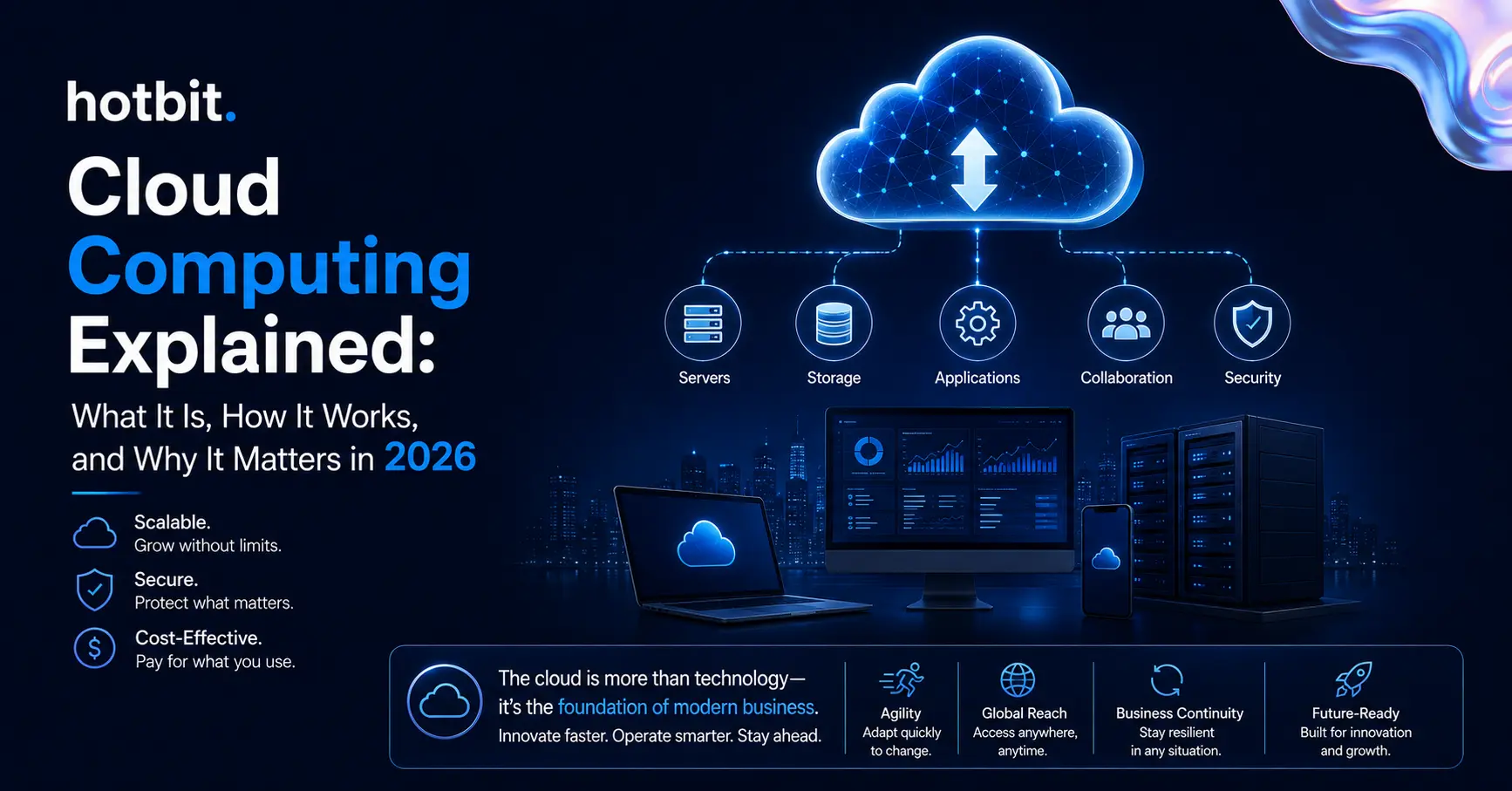
Cloud Computing Explained: What It Is, How It Works, and Why It Matters in 2026

Every growing business eventually hits the same wall: the servers it owns can’t keep pace with the demands it’s placing on them. A product launch spikes traffic tenfold overnight. A new market requires infrastructure on another continent by next quarter. Cloud computing changed how businesses handle that problem, replacing fixed hardware with capacity that can often be provisioned in minutes instead of months.
As businesses increasingly combine cloud infrastructure with artificial intelligence adoption, the ability to scale computing resources efficiently has become even more important. Global public cloud end-user spending is forecast to reach $850 billion in 2026, up 21.3% from 2025, according to Gartner. For founders, CTOs, and operations leaders, the question is whether the current infrastructure can scale efficiently and whether cloud adoption would improve that position.

What Is Cloud Computing?

Cloud computing delivers computing power, storage, and applications over the internet from a remote provider, replacing owned, on-site servers. A business provisions capacity from a provider such as Amazon Web Services, Microsoft Azure, or Google Cloud Platform and adjusts it as needs change, instead of buying fixed hardware upfront. Pricing runs on consumption, subscriptions, or committed-use arrangements rather than a single hardware purchase, which shifts spending from capital expenditure toward operating expenditure.

This flexibility has helped cloud adoption move from a niche IT strategy to a mainstream approach across many industries, while also providing the infrastructure businesses increasingly rely on for the future of artificial intelligence adoption.

Underneath this sits virtualization: physical servers are divided into isolated, software-defined environments so multiple businesses share the same infrastructure without interference. This is the mechanical difference between cloud computing and traditional hosting capacity can expand or contract with demand instead of being fixed by whatever hardware a company originally purchased. With autoscaling configured correctly, that capacity adjusts automatically as demand shifts, though some workloads still need manual tuning to take full advantage of it.

Understanding the Framework: Deployment and Service Models

Cloud computing breaks down into two decisions: where it runs, and how much of the stack a provider manages for you.
Deployment models determine ownership and control:
Service models determine how much you manage versus the provider:
  • IaaS (Infrastructure as a Service) — virtual servers and networking; you manage the operating system and applications. AWS EC2 is a common example.
  • PaaS (Platform as a Service) — a managed runtime for building and deploying applications. Google App Engine is a common example.
  • SaaS (Software as a Service) — a complete, ready-to-use application with everything underneath managed for you. Salesforce and Slack are common examples.
Moving from IaaS toward SaaS trades infrastructure control for less operational overhead.

Are You Ready for the Shift?

Hybrid cloud isn’t an emerging trend anymore it’s a mainstream approach. 73% of organizations now operate hybrid cloud estates, according to the Flexera 2026 State of the Cloud Report. As hybrid cloud becomes part of the broader technology trends shaping businesses in 2026, organizations relying entirely on owned hardware often face different scalability and infrastructure-management constraints than cloud-enabled businesses and that gap tends to widen fast once competitors start shipping features on infrastructure that scales in minutes rather than months.

The advantages are real, but they depend on how the migration is built: lower upfront costs, faster scalability with the right autoscaling in place, stronger availability through redundant regions, and access from anywhere on the team. The risks are just as real when the move is rushed. Cost overruns come from unused or oversized resources running unchecked the fix is ongoing cost monitoring, not a one-time budget review. Depending on the service model, customers are typically responsible for areas such as access controls, configuration, and data, while the provider secures the underlying infrastructure. Vendor lock-in can be reduced by designing for portability from day one, not retrofitting it later once switching costs have already piled up.

How Hotbit Infosoft Helps You Move to the Cloud

Hotbit Infosoft, a digital-first technology company specializing in AI Automation, Product Engineering, Business Transformation, Cloud, Team-as-a-Service, and iGaming & Fantasy solutions, builds cloud environments sized to where your business is actually headed. Our Cloud practice handles right-sized infrastructure, migration planning, and ongoing cost governance, so the shift strengthens your operation instead of straining it. Ready to see what a properly planned migration looks like for your business? Talk to an expert and let’s map it out.

Frequently Asked Questions (FAQs)

How do I know if my business is ready to move to the cloud?

You’re ready when your current infrastructure can’t scale fast enough, maintenance costs keep climbing, or your team needs remote, always-on access. A cost and architecture assessment before migrating can help identify risks and reduce the likelihood of expensive mistakes that follow a rushed move.
Cloud storage is one type of cloud service, focused on storing and accessing data remotely. Cloud computing is the broader category storage plus processing power, networking, and full application hosting.
It can be, when properly configured and monitored. Security follows a shared responsibility model: the provider secures the infrastructure, and your team controls access, configuration, and data handling.
Costs scale with usage, from a few dollars a month for storage to significant enterprise infrastructure spend. Businesses without cost monitoring commonly see wasted spend, which is why governance matters as much as the initial pricing plan.
Gmail and Microsoft 365 run on SaaS. AWS EC2 and Google Compute Engine run on IaaS. Even Netflix and Dropbox run on cloud infrastructure behind the scenes.