
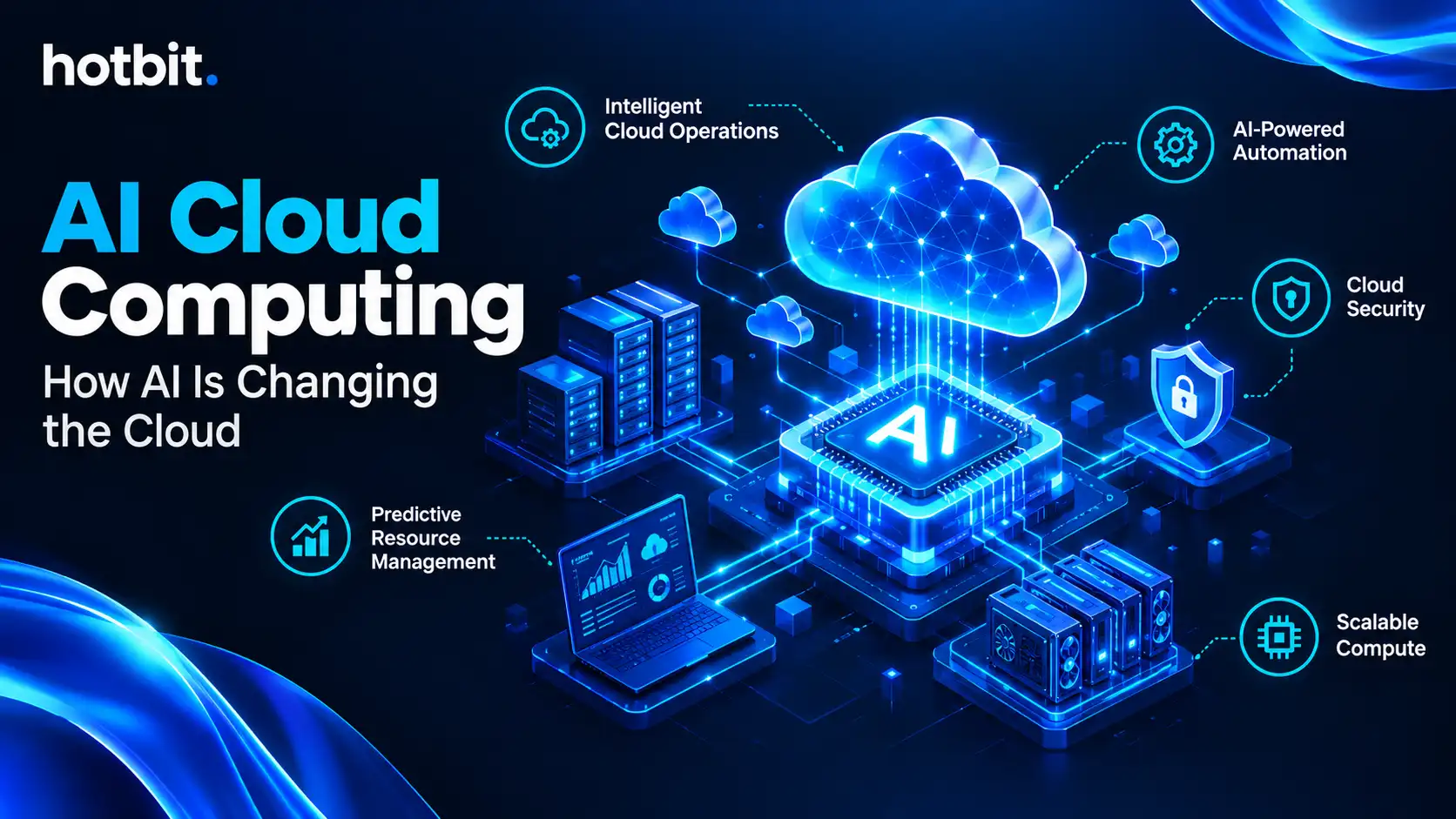
AI cloud computing is rewiring how businesses build, run, and secure technology. It adds AI-driven intelligence to how cloud infrastructure is built, operated, secured, and optimized.
According to Gartner, the global research and advisory firm, worldwide IT spending is expected to reach $6.37 trillion in 2026, up 14.2% from 2025 (Gartner, July 2026). Data center systems and infrastructure as a service (IaaS) lead that growth as organizations invest in AI infrastructure and cloud platforms.
AI cloud computing is the delivery of artificial intelligence capabilities, such as model training, inference, and analytics, through cloud platforms, combined with AI-assisted capabilities that can help scale, secure, monitor, and optimize cloud environments. This guide covers what it is, the six shifts driving it, how it compares with traditional cloud, and how you adopt it. It comes from Hotbit Infosoft, a digital-first technology company specializing in AI Automation, Product Engineering, Business Transformation, Cloud, Team-as-a-Service, and iGaming & Fantasy solutions.
What Is AI Cloud Computing?
AI cloud computing combines artificial intelligence and cloud infrastructure in two directions. First, cloud platforms deliver AI as a service: on-demand GPUs, managed machine learning platforms, pretrained models, and inference endpoints that you rent instead of build. Second, AI helps run the cloud itself, supporting resource allocation, cost control, monitoring, and threat detection.
The first direction widens access to AI. The second makes cloud environments more responsive, efficient, and resilient when you pair it with governance and monitoring. Together, they add AI-driven intelligence to the AI infrastructure you already run.
In both cases, businesses gain access to scalable compute, managed AI services, and global infrastructure without owning physical servers. Results still depend on cost, data residency, latency, compliance, and workload type.
How AI Is Changing the Cloud: Six Major Shifts
AI is changing the cloud in six ways: infrastructure design, autonomous operations, cost control, security, managed platforms, and distributed architectures. Together, these shifts are making cloud environments more AI-driven, automated, and adaptive.
1. AI-driven infrastructure design
AI is an increasingly important driver of cloud infrastructure design, from compute and networking to accelerator hardware. Major hyperscale cloud providers, including Amazon Web Services, Microsoft Azure, and Google Cloud, offer GPU clusters and custom AI accelerators for training and inference.
Gartner notes that hyperscalers and enterprises are rapidly scaling next-generation data center capacity for AI workloads and high-performance computing. General-purpose infrastructure remains essential for workloads that do not require specialized AI accelerators.
2. Autonomous cloud operations (AIOps)
AIOps, artificial intelligence for IT operations, applies machine learning to monitor systems, correlate alerts, and support incident response. Models learn normal behavior from your logs and metrics, then flag anomalies and can trigger predefined fixes.
When trained and configured appropriately, AIOps can reduce alert noise, accelerate diagnosis, and help engineers focus on higher-value infrastructure work. Hotbit Infosoft supports this approach through its Cloud practice.
3. Smarter cost management
FinOps, the discipline of managing cloud spend through shared financial accountability, is increasingly being enhanced by machine learning. Models forecast demand, recommend right-sized instances, and surface idle resources.
Control matters here. A poorly designed AI workload raises infrastructure costs instead of cutting them.
4. Predictive security
AI adds continuous anomaly detection and risk prioritization on top of your existing security controls. Models can flag unusual access patterns, network traffic, and configuration changes that may be difficult to detect with static rules alone.
5. Managed AI platforms and foundation models
Providers now package foundation models, vector databases, and machine learning pipelines as managed services. You add language, vision, and prediction features through APIs and shorten the path from idea to production.
AI Automation builds on these services to automate business workflows. See how AI agents are changing business operations for a live example.
6. Distributed, multicloud architectures
AI workloads increasingly span more than one provider. Gartner predicts that by 2030, over 60% of enterprises will run intensive AI model activity in one cloud while using it with their data in another, up from less than 10% today (Gartner, June 2026).
Governance across hybrid and multicloud environments becomes a core design requirement, not an afterthought.
Traditional Cloud vs. AI Cloud Computing
AI cloud computing is not a separate type of cloud infrastructure. It generally refers to cloud environments that combine conventional infrastructure with AI workloads and AI-assisted management capabilities. The table below shows where the two approaches differ in practice.
Dimension | Traditional Cloud Computing | AI Cloud Computing |
Resource scaling | Configured autoscaling policies | Predictive or model-assisted scaling |
Operations | Conventional monitoring and automated alerts | AIOps-assisted detection and partly automated remediation |
Cost management | Periodic reviews and manual right-sizing | Continuous, model-assisted FinOps recommendations |
Security | Signature and rule-based detection | Rule-based controls plus behavioral anomaly detection |
Core workloads | Web apps, databases, storage, backups | Model training, inference, analytics, generative AI |
Hardware | General-purpose CPUs | GPUs and AI accelerators alongside CPUs |
Skills required | Cloud administration and DevOps | DevOps plus data engineering and MLOps |
Caption: Traditional cloud vs. AI cloud computing across seven operating dimensions.
Business Benefits of AI Cloud Computing
AI cloud computing can deliver faster releases, less waste, stronger security, and direct access to advanced AI. Results depend on implementation quality and governance.
- Speed to market: Managed AI services reduce the amount of model infrastructure your teams need to build and maintain, so they ship AI features sooner.
- Lower waste: Predictive scaling and automated shutdowns can reduce idle capacity and unnecessary spend.
- Higher reliability: Predictive monitoring can identify some signs of degradation before they develop into customer-facing incidents.
- Stronger security: Continuous anomaly detection can help surface suspicious activity earlier for investigation.
- Elastic experimentation: You rent GPU capacity for a training run and release it afterward, with no large upfront hardware purchase.
Are You Ready for the AI Cloud Shift?
You can organize a practical AI governance framework around seven components: an AI inventory, risk classification, named ownership, data and model controls, human oversight rules, continuous monitoring, and incident response.
Residency rules add pressure. Gartner forecasts worldwide sovereign cloud IaaS spending at $80 billion in 2026, a 35.6% increase (Gartner, February 2026). Building a governed, AI-ready foundation early can reduce the need for costly architectural changes later.
AI Cloud Challenges: Four Risks and How You Solve Them
The main challenges are cost control, data governance, skills gaps, and vendor lock-in. Each can be reduced through early architectural planning and governance.
1. GPU and workload costs
GPU capacity can be expensive and, for some accelerator types and regions, constrained. Set budgets and alerts per project, use reserved or spot capacity for predictable training jobs, and run a FinOps review before any AI workload scales.
2. Data privacy and residency
AI applications may process large volumes of sensitive or business-critical data. Classify data before it reaches a model, encrypt it in transit and at rest, and choose regions that meet local rules.
3. Skills shortages
AI cloud projects need cloud engineers, data engineers, and MLOps specialists working as one team. Hotbit’s Team-as-a-Service model provides access to additional engineering specialists without requiring permanent hiring.
4. Vendor lock-in
Proprietary AI services make migration harder. Use containers, Kubernetes (the open-source container orchestration platform), open model formats, and abstraction layers where practical to improve workload portability.
How to Adopt AI Cloud Computing: Five Steps
Adopt AI cloud computing in five steps: assess, prioritize, build a foundation, pilot, and scale. This order helps address two common adoption risks: unmanaged costs and pilots that struggle to reach production.
- Assess your cloud maturity. Audit workloads, data quality, security posture, and spending to find where AI adds value.
- Prioritize high-impact use cases. Pick two or three with clear metrics, such as forecasting, support automation, or fraud detection.
- Build a governed foundation. Set up data pipelines, identity controls, cost tagging, and a hybrid or multicloud plan that fits your compliance needs.
- Run a focused pilot. Deploy one use case on managed AI services, measure results against a baseline, and document what worked.
- Scale with governance. Add AIOps and FinOps automation, then extend proven patterns to more teams.
Tie this roadmap to your Business Transformation goals so every workload maps to a business outcome. The What We Do page shows the full service range.
AI Cloud Computing Across Industries
AI cloud computing applies across sectors that generate and analyze significant volumes of data. Financial services use it for fraud detection, healthcare providers for imaging analysis and scheduling, retailers for demand forecasting, and manufacturers for predictive maintenance.
Software teams embed cloud-hosted models directly into applications through Product Engineering. Platform builders in iGaming & Fantasy use the same elastic infrastructure for real-time analytics at scale.
A practical approach is to govern agents according to their autonomy, permissions, and potential impact. Read-only agents may require less operational control than agents that can change records or execute transactions, depending on the data and decisions involved.
How We Can Help: Build an AI-Ready Cloud
Hotbit Infosoft, a digital-first technology company specializing in AI Automation, Product Engineering, Business Transformation, Cloud, Team-as-a-Service, and iGaming & Fantasy solutions, designs and runs AI-ready cloud environments. With 15+ years of experience and 200+ global brands served, our engineers cover architecture, migration, cost governance, and security. Ready to plan your first AI workload? Talk to an Expert on our Cloud team, or book a consultation to get started.
AI Cloud Computing FAQs
1. What is AI cloud computing?
AI cloud computing is the delivery of artificial intelligence capabilities, such as machine learning training, inference, and analytics, through cloud platforms. Businesses can access scalable computing resources and managed AI services on demand instead of building and maintaining all the required infrastructure themselves.
2. How is AI used in cloud computing?
AI is used in cloud computing to forecast demand, allocate resources, detect security threats, automate monitoring, and optimize cloud spending. Cloud providers also offer managed AI services, including pretrained models, vector databases, and machine learning platforms.
3. What is the difference between cloud computing and AI?
Cloud computing provides on-demand computing resources such as servers, storage, and networking. AI refers to technologies that enable software to learn from data, recognize patterns, and perform tasks that typically require human intelligence. They are complementary because AI workloads often rely on cloud infrastructure for scalable compute and storage.
4. What are the benefits of AI in cloud computing?
AI in cloud computing can improve scalability, automation, security, performance, and cost management. Predictive monitoring can identify potential issues earlier, while automated resource allocation can help reduce unused capacity. Managed AI services can also make it easier for businesses to develop and deploy AI-powered applications.
5. What are the challenges of AI in cloud computing?
Common challenges include high GPU and infrastructure costs, data privacy and residency requirements, skill shortages, security risks, and vendor lock-in. Organizations can address these challenges through cloud cost management, strong data governance, security controls, workload optimization, and carefully planned cloud architecture.
Disclaimer
This article is for general informational and educational purposes only. It does not constitute technical, financial, legal, cybersecurity, or professional advice. Cloud architecture, AI implementation, security, compliance, and costs vary by organization and workload. Any examples or recommendations should be evaluated based on your specific requirements. Hotbit Infosoft does not guarantee specific performance, cost savings, security outcomes, or business results from adopting AI cloud computing.