
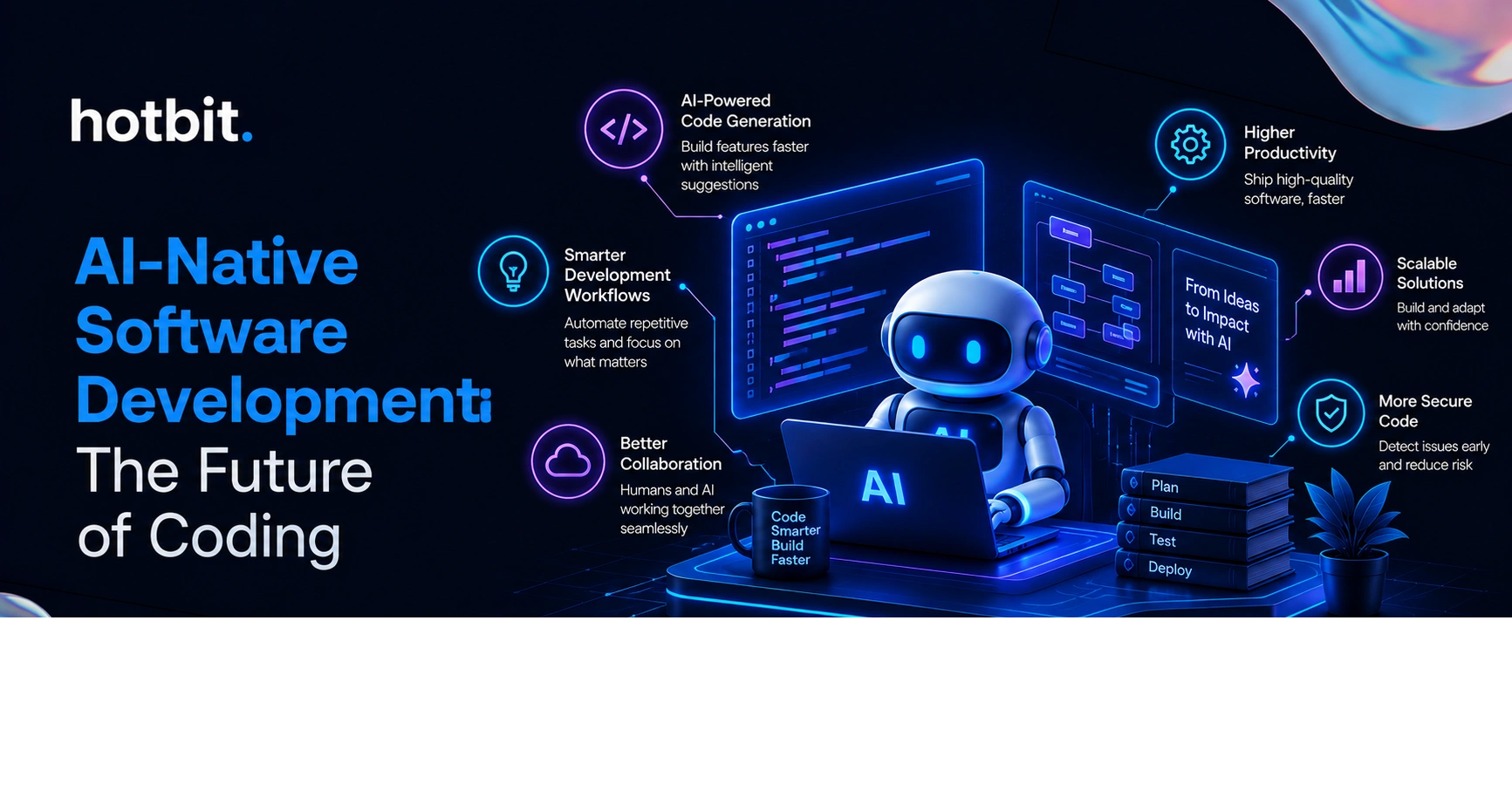
Software engineering is being rewired at the core. AI is no longer a plug-in developers reach for occasionally; it’s becoming the foundation the entire development lifecycle runs on. Businesses that treat this as a minor tooling upgrade may struggle to capture the full potential of AI in software development. Understanding the differences between vibe coding and traditional software development can help businesses determine how AI fits into their development workflows.
What Is AI-Native Software Development?
AI-native software development means designing your engineering workflow around AI from the start, not bolting it onto an existing process. AI can participate in requirements analysis, code generation, testing, review, and monitoring, while your engineers focus on architecture, judgment, and the decisions AI can’t make for you. This approach is especially relevant when businesses are modernizing core systems, where choosing the right ERP can determine how effectively AI integrates with business processes and data.
This is a sharp break from AI-assisted coding, where a tool suggests autocomplete inside an IDE and the rest of the process stays untouched. AI-native teams rebuild the process itself: review gates, delivery pipelines, and team structure all shift to make room for AI as a working participant, not a convenience. Recognizing these changes is also part of identifying the digital transformation warning signs that businesses need to address as technology reshapes their operations.
Understanding the AI-native development framework
- Specification layer. Product requirements start as natural-language input, not a technical spec written from scratch.
- Code-generation layer. Large language models such as Claude or GPT-class systems turn those specs into working code.
- Test-generation layer. AI generates and helps maintain unit, integration, and end-to-end test coverage, reducing manual test-writing effort.
- Governance layer. Security, compliance, and architecture checks run before and after every deployment.
Forrester’s 2026 predictions for software development point to widespread adoption of observability-as-code and governance-as-code as generative AI lowers the barrier to writing this kind of declarative code. That governance layer is what separates a serious AI-native rebuild from a team that simply handed developers a coding assistant and called it done. Understanding the software development life cycle is also essential for building structured processes around AI-assisted development, from planning and development through testing, deployment, and maintenance.
Are You Ready for the Shift to AI-Native Development?
AI use in the software development lifecycle is already widespread, not theoretical. Coding and testing are the top two AI use cases today, at 48% and 47% of teams respectively, according to Forrester’s Developer Survey. As software becomes more connected to AI tools, cloud platforms, and business systems, APIs have become essential for connecting applications and supporting business growth.
Developers using generative AI can complete certain coding tasks up to twice as fast, according to McKinsey. In McKinsey’s study of more than forty developers, code generation ran 35 to 45% faster, documentation time dropped by close to half, and refactoring time fell by 20 to 30%. Results depend heavily on the task and the developer: highly complex work saw far smaller gains, and inexperienced developers sometimes moved slower with the tools than without them. That’s the real signal here: AI-native development rewards teams that pair the tooling with real training and workflow redesign, not teams that treat it as a plug-and-play upgrade.
How Hotbit Infosoft Helps You Go AI-Native
Hotbit Infosoft, a digital-first technology company specializing in AI Automation, Product Engineering, Business Transformation, Cloud, Team-as-a-Service, and iGaming & Fantasy solutions, builds this shift directly into how it delivers work. Our AI Automation practice includes a dedicated AI Native Product Architecture offering, designed to evolve with changing user needs rather than requiring a rebuild every cycle. Trusted by 200-plus global brands across India, Singapore, Mauritius, and Saudi Arabia, we help engineering leaders move from AI-assisted to AI-native.
Ready to see what an AI-native rebuild looks like for your team? Talk to an Expert and let’s map it out together.