
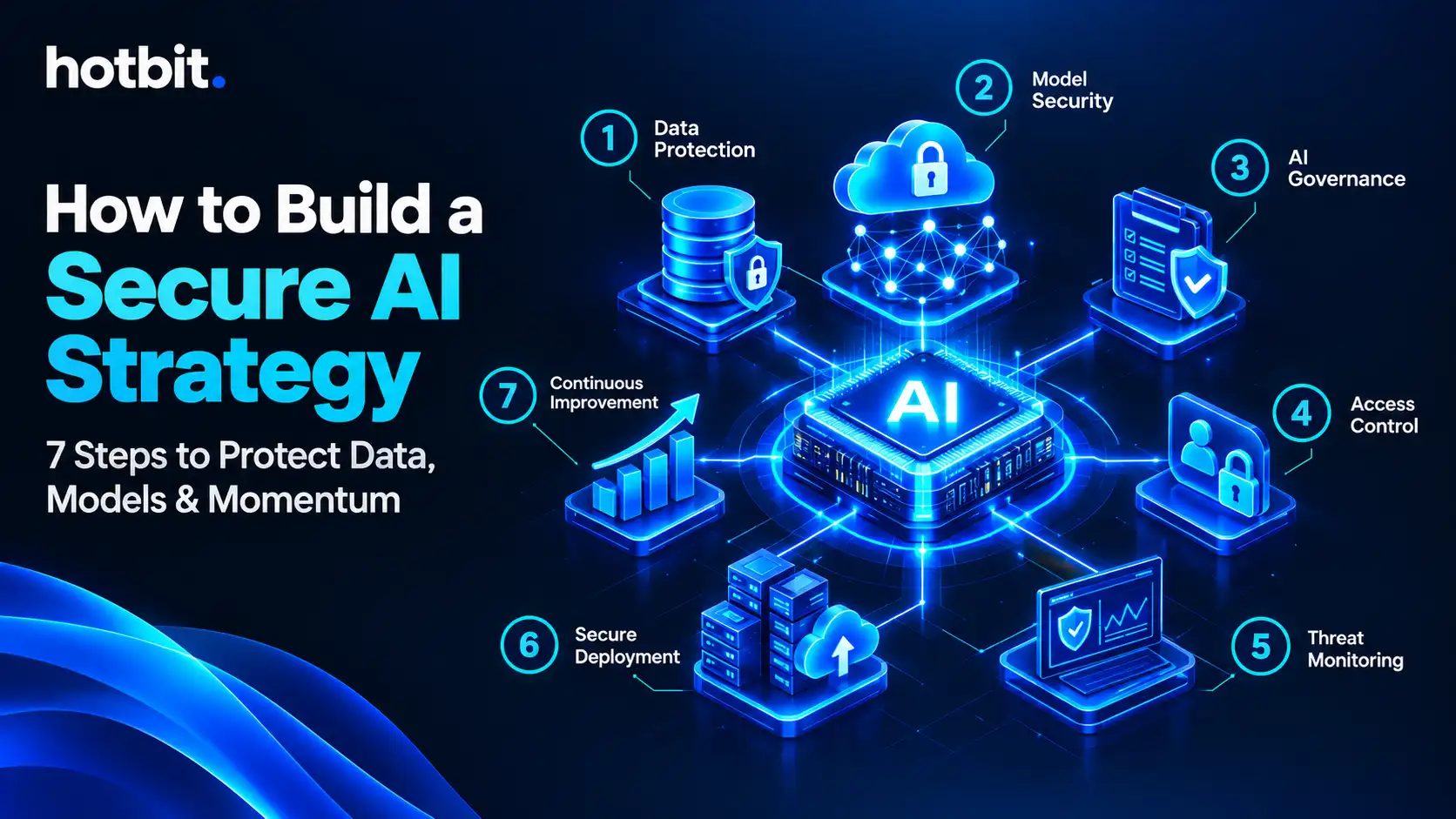
How to build a secure AI strategy for your business starts with one discipline: govern, protect, and monitor every AI system before it touches sensitive data. A secure AI strategy is a documented plan that governs how AI systems are selected, built, deployed, and monitored, so value scales while risk stays contained. A strong AI governance framework can help organizations establish the policies, accountability, risk controls, and monitoring practices needed to manage AI responsibly.
According to IBM’s 2026 Cost of a Data Breach Report, more than one in five organizations reported a breach targeting their AI models or applications. Among those organizations, 92% lacked proper AI access controls. Hotbit Infosoft, a digital-first technology company specializing in AI Automation, Product Engineering, Business Transformation, Cloud, Team-as-a-Service, and iGaming & Fantasy solutions, lays out the seven-step framework below for business leaders seeking to scale AI while maintaining appropriate security and governance controls.
What Is a Secure AI Strategy?
A secure AI strategy treats security as a design input, not a patch. It names an owner for every AI system, sets rules for data and access, and maps controls to the frameworks and laws that apply. This is especially important as businesses adopt AI agents that can plan and execute multi-step business workflows, where permissions, audit trails, and human oversight need to be built into the system from the start.
Adoption moves fast. Control has to keep pace.
Dimension | Ad Hoc AI Adoption | Secure AI Strategy |
Ownership | Individual teams decide | Named executive sponsor and governance committee |
Data handling | Staff paste data into any tool | Classified tiers with approved-tool rules |
Risk visibility | Shadow AI goes unseen | Live AI inventory and risk register |
Incident response | Generic or absent | AI-specific playbooks and logging |
Compliance | Reactive, audit by audit | Controls mapped to applicable frameworks |
Actual outcomes still depend on how well each control is implemented.
How to Build a Secure AI Strategy for Your Business: The Seven-Step Framework
Each step produces a deliverable that feeds the next. Scale the depth to your risk profile, and explore how generative AI is transforming customer support as a practical example of AI implementation before working through the steps in order.
- Inventory and risk-score every AI use case. Include third-party tools with embedded AI. Rank each by data sensitivity, business impact, autonomy, and regulatory exposure.
- Classify your data. Define which tiers (public, internal, confidential, restricted) each AI system may touch. Apply masking and minimization before data reaches a model, and judge every AI service on retention terms, model-training use, and contractual protections.
- Establish governance. Form a cross-functional committee with an executive sponsor. Add an acceptable-use policy, an approval workflow for new use cases, and an AI-specific incident response plan.
- Design for zero trust. Choose private cloud, VPC isolation, or on-premises hosting by risk. Route model traffic through a gateway that enforces authentication, rate limiting, and logging, because no hosting model is secure by default.
- Layer technical safeguards. Apply least-privilege access and multi-factor authentication to users, services, agents, and non-human identities such as API keys. Filtering alone cannot stop prompt injection, so also restrict agent permissions, separate untrusted content from system instructions, and require human approval for sensitive actions.
- Train people and vet vendors. Teach staff approved tools, data rules, and how to spot AI-enabled phishing. Request security questionnaires and data processing agreements. SOC 2 and ISO/IEC 27001 are useful signals, not guarantees.
- Monitor, audit, and improve. Log model interactions, watch for drift and anomalies, and audit on a schedule matched to risk and regulation. Minimize what logs capture, mask sensitive fields, and restrict who can read them.
Frameworks and Regulations: Mapping NIST, ISO/IEC 42001, and the EU AI Act
These instruments serve different purposes, so treat them as complementary. The NIST AI Risk Management Framework is voluntary guidance built around Govern, Map, Measure, and Manage.
ISO/IEC 42001 is an international standard specifying AI management system requirements, and organizations can certify against it. The EU AI Act is binding law with obligations for providers and deployers within its scope, including certain organizations outside the EU whose AI systems or outputs fall under its territorial rules. GDPR applies wherever its conditions for processing personal data are met. Understanding the difference between AI agents and chatbots is also important when assessing the systems, risks, and controls that an organization needs to govern.
Under the EU AI Act, violations of prohibited AI practices can result in fines of up to €35 million or 7% of worldwide annual turnover, whichever is higher. Other specified violations can carry fines of up to €15 million or 3% of worldwide annual turnover, subject to the Act’s applicable rules. The European Commission states that rules for Annex III high-risk AI systems apply from 2 December 2027, and rules for high-risk AI embedded in regulated products from 2 August 2028. Which requirements apply depends on your role and your system’s classification, so confirm with legal counsel.
Are You Ready for AI at Scale? The Data Says Control Is Lagging
McKinsey’s 2026 State of AI survey found that nearly nine in ten respondents use AI regularly in at least one business function, and 44% say it is scaling across the enterprise. As AI adoption expands, organizations are also relying more heavily on cloud infrastructure to support AI workloads and applications. Yet IBM reports that only 40% of organizations use access controls on AI models and data.
The cost side is climbing. IBM’s 2026 study of 602 organizations that experienced data breaches found that the global average breach cost rose 12% to a record USD 4.99 million. The most common causes of AI-related breaches were compromised APIs, applications, or plug-ins (27%) and cloud misconfigurations affecting AI workloads (27%). These are ordinary weaknesses, not exotic model attacks.
Gartner predicted in 2025 that by 2027, more than 40% of AI-related data breaches will stem from improper cross-border use of generative AI. It is a prediction, not a measured result, and it underscores the weight Gartner places on cross-border AI governance. Understanding how AI-native platforms differ from traditional SaaS can also help businesses identify where additional security and governance considerations may apply. Traditional SaaS vs. AI-Native SaaS
The risks your strategy must contain
- Data leakage: sensitive information exposed through prompts, outputs, or logs.
- Prompt injection: malicious instructions that hijack model behavior. IBM reports an average cost of USD 5.89 million for incidents of this type.
- Model inversion: attackers reconstruct training data from model outputs. IBM reports an average cost of USD 6.07 million for these incidents.
- Training data poisoning: corrupted datasets that skew model behavior.
- Insecure integrations: over-permissioned agents and plugins.
- Shadow AI: unapproved tools that create unmanaged data flows.
How Hotbit Infosoft Can Help
Hotbit Infosoft supports businesses in turning this framework into working systems, from AI risk assessment to secure deployment. Our AI Automation and Cloud teams build access controls, audit logging, and governance into AI systems from day one. Ready to put this framework to work? Book a consultation and let us guide you further.
Frequently Asked Questions
1. What is a secure AI strategy?
A secure AI strategy is a documented approach to managing AI systems safely, covering data protection, access controls, governance, risk management, monitoring, and compliance.
2. How do you build a secure AI strategy for a business?
Build a secure AI strategy by inventorying AI use cases, classifying data, establishing governance, applying zero-trust controls, securing AI integrations, training employees, and continuously monitoring and auditing AI systems.
3. What are the biggest security risks of using AI?
Common AI security risks include data leakage, prompt injection, model inversion, training data poisoning, insecure integrations, excessive agent permissions, and unauthorized or shadow AI tools.
4. Which frameworks can help organizations manage AI security and risk?
Organizations can use frameworks and standards such as the NIST AI Risk Management Framework and ISO/IEC 42001. Depending on the organization and use case, regulations such as the EU AI Act and GDPR may also apply.
5. How can businesses protect sensitive data when using AI?
Businesses can protect sensitive data by classifying information, applying data minimization and masking, enforcing least-privilege access, using approved AI services, reviewing vendor data practices, and monitoring AI-related data flows.
Disclaimer
This article provides general information about AI security, governance, risk management, and regulatory considerations. It is not legal, cybersecurity, or compliance advice. AI regulations, security practices, and industry requirements can change, so organizations should assess their specific circumstances and consult qualified legal, cybersecurity, and compliance professionals before implementing an AI strategy.