
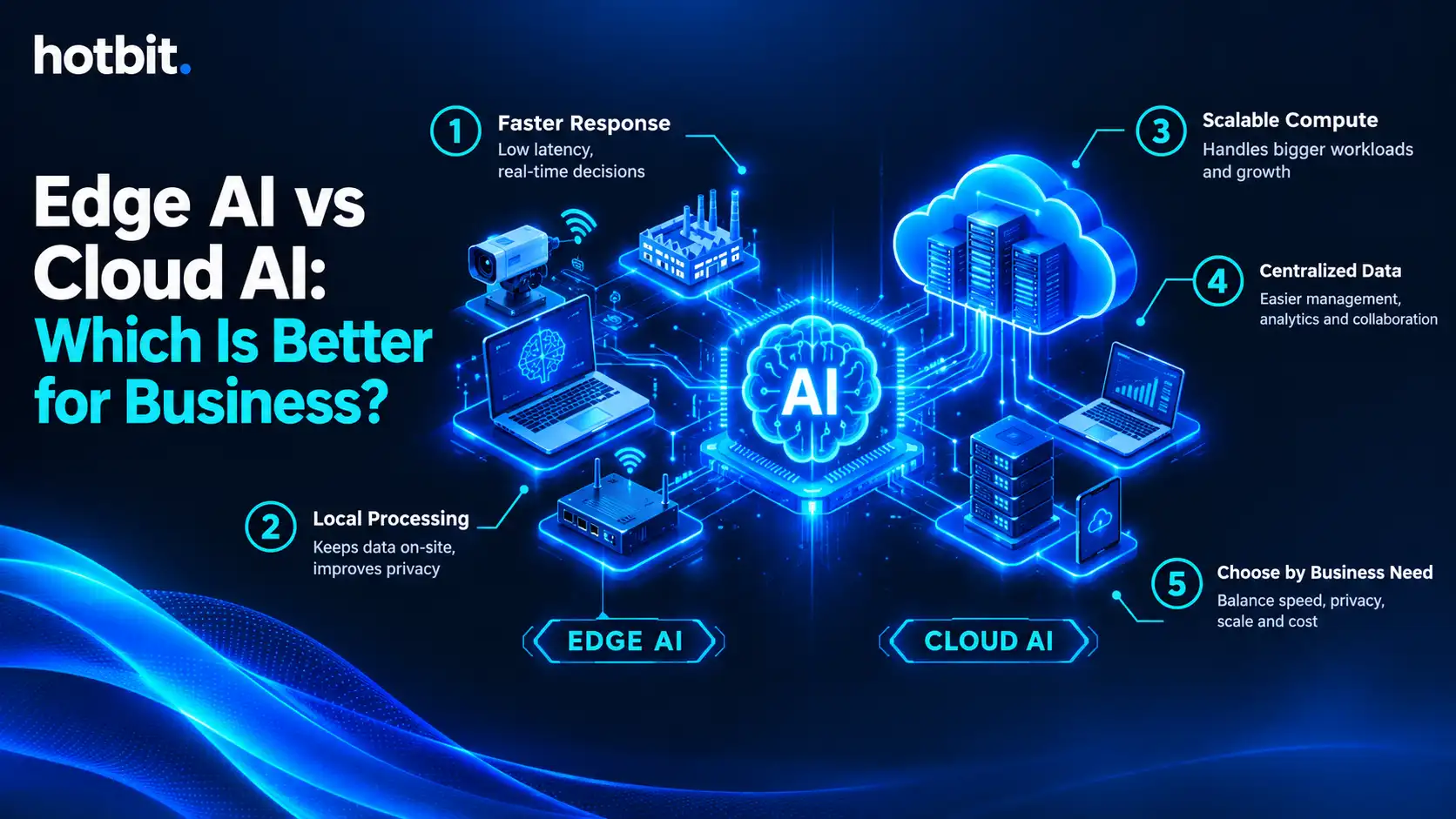
Edge AI vs Cloud AI is the choice between running AI models on local devices or in cloud infrastructure, and it shapes your speed, cost, and risk exposure. The right answer depends on the workload, not the trend. Get the placement wrong and you pay for it in latency, bandwidth, or compliance risk.
According to the International Data Corporation (IDC), the global market intelligence firm, worldwide spending on edge computing reached $265 billion in 2025 and is forecast to grow at roughly 15% to $450 billion by 2029. (IDC press release, February 2026) Businesses are moving intelligence closer to the data, while cloud platforms are commonly used for training and scalable workloads.
What Is Edge AI vs Cloud AI?
Edge AI runs trained models on devices near the data source, such as cameras, sensors, smartphones, industrial controllers, and gateways. The device analyzes data locally and responds with very low latency, without requiring a network round trip for inference.
Cloud AI runs models in centralized or regional cloud infrastructure, such as services offered by Amazon Web Services (AWS), Microsoft Azure, and Google Cloud. Depending on the architecture, data may be sent to the cloud for inference and the output returned to the application. Edge AI tends to optimize for real-time response and data locality. Cloud AI tends to optimize for compute capacity, central management, and scale.
The two are deployment approaches, not mutually exclusive technologies. Many production systems run inference at the edge and handle training, orchestration, and model management in the cloud.
Understanding the framework
Here’s a simple breakdown
Factor | Edge AI | Cloud AI |
Latency | Low; avoids a network round trip for inference | Higher; depends on network quality |
Connectivity | Can continue operating with limited or intermittent connectivity | Typically needs a connection for inference |
Compute capacity | Limited by device hardware | Elastic, far above typical edge devices |
Data handling | Can keep raw data local, depending on architecture | Processed in centralized infrastructure |
Upfront cost | Often higher (hardware) | Typically lower (usage-based) |
Ongoing cost | Less bandwidth; adds device maintenance | Grows with usage and data transfer |
Scalability | Scales by adding devices | Can scale rapidly with demand |
Best for | Real-time, local, or remote use | Training, analytics, large-scale services |
When Edge AI Is the Stronger Choice
Edge AI leads where milliseconds, data movement, or connectivity set the rules. Four conditions point your way. When AI agents need to interact with enterprise applications and data sources, understanding how AI agents connect to business systems can also help determine whether processing should happen at the edge or through cloud infrastructure.
- Real-time decisions: inspection lines, autonomous machinery, and safety monitoring benefit from avoiding a network round trip.
- Sensitive data: local processing can reduce how much personal data travels to central systems, though compliance still depends on your data, jurisdiction, and architecture.
- Limited connectivity: oil rigs, farms, ships, and mines can benefit from local processing when connectivity is limited.
- Heavy data streams: analyzing video locally and sending only results can cut bandwidth costs.
When Cloud AI Is the Stronger Choice
Cloud AI leads where capacity and flexibility matter more than millisecond response. Four conditions point your way.
- Model training: GPU clusters can be rented or provisioned on demand instead of bought outright.
- Large-scale analytics: sales, behavior, and supply chain data sit in one place.
- Variable demand: capacity can follow campaign spikes and seasonal peaks.
- Central management: centralized deployment, monitoring, and auditing of models.
Hybrid Edge-Cloud AI: Train in the Cloud, Run at the Edge
Hybrid architecture splits the work by what each layer does best. The cloud trains and manages models. Edge devices run inference close to the data and send selected results back for retraining.
IDC’s Dave McCarthy, research vice president for cloud and edge services, has pointed to the shift in AI focus from model training to inference as a driver of edge computing’s growing importance for latency and privacy needs. In a smart factory, edge cameras can catch defects on the line while the cloud learns from patterns across plants.
Hybrid adds integration work across data pipelines, versioning, and security. A strong Cloud foundation and clear ownership keep that complexity under control.
Are You Ready for the Shift?
According to IDC, service providers, through multi-access edge computing, content delivery networks, and virtualized network functions, are forecast to account for nearly a third of the edge market by 2029. Carriers and platforms are building the low-latency networks that edge AI runs on. Appropriate workload placement can reduce latency and unnecessary bandwidth use.
Cost and security shape the decision too. Edge often carries higher upfront hardware spend and needs encrypted storage, secure boot, and signed updates on every device. Cloud shifts spend toward ongoing usage and data transfer, and it demands strong identity management, access controls, and storage configuration.
Map every data flow in either model, and confirm GDPR and India’s Digital Personal Data Protection Act, 2023 obligations with legal counsel. Then start with four questions: how fast must the system respond, how sensitive is the data, how reliable is the connection, and which technology approach best fits your business priorities?
How We Can Help: Edge, Cloud, and Hybrid AI Built to Lead
Hotbit Infosoft, a digital-first technology company specializing in AI Automation, Product Engineering, Business Transformation, Cloud, Team-as-a-Service, and iGaming & Fantasy solutions, helps businesses plan and build edge, cloud, and hybrid AI systems. Our AI Automation team works to place each workload where it performs best. Have a workload to place? Talk to an Expert and let’s design it together.
Frequently Asked Questions - Edge AI vs Cloud AI
What is the difference between edge AI and cloud AI?
Edge AI runs models on local devices near the data source, so inference happens without a network round trip. Cloud AI runs models in centralized or regional cloud infrastructure, so data typically travels to remote servers. Edge AI favors low latency and data locality. Cloud AI favors compute capacity and scale.
Is edge AI better than cloud AI?
Edge AI is generally better for real-time, low-connectivity, and data-sensitive workloads. Cloud AI is generally better for model training, large-scale analytics, and variable demand. Neither wins universally. Latency needs, data sensitivity, connectivity, and cost decide, and many businesses combine both approaches in one architecture.
What are the disadvantages of edge AI?
Edge AI is limited by device memory, processing power, and energy, so models must be smaller and optimized. Hardware often costs more upfront. Teams must update and secure many distributed devices, which adds operational work and exposes physical theft and tampering risks.
Can edge AI and cloud AI work together?
Yes. Hybrid edge-cloud AI trains models in the cloud and runs them on edge devices. Devices send selected data back so the cloud can retrain and improve the models. This combines cloud scale with edge speed for workloads with mixed requirements.
How do you choose between edge AI and cloud AI?
Choose by testing four factors: required response speed, data sensitivity, connectivity reliability, and data volume. Fast responses, sensitive data, weak connections, or heavy video streams point toward edge. Training, large-scale analytics, and variable demand point toward cloud. Mixed requirements point toward a hybrid architecture.
Disclaimer
This article provides general informational guidance on edge AI, cloud AI, and hybrid architectures. Specific technology, security, privacy, compliance, and infrastructure decisions depend on your business requirements, data, jurisdiction, and technical environment. Consult qualified technical, legal, or compliance professionals before making implementation decisions