
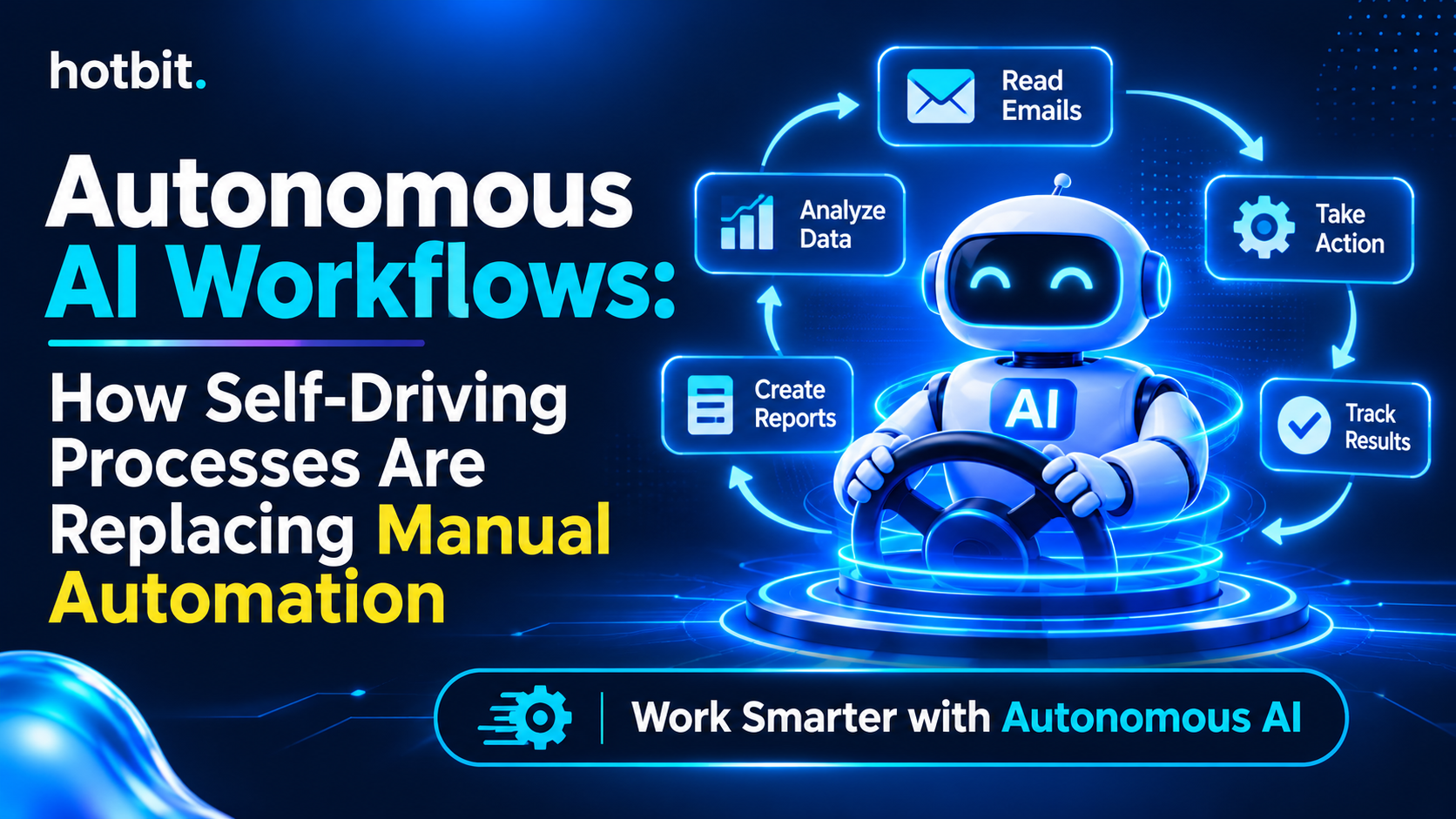
Autonomous AI Workflows are business processes where AI agents plan steps, use software tools, and make bounded decisions without a human triggering each step. The last era automated tasks with scripts. The next automates outcomes.
According to Gartner, the global research and advisory firm, in a June 2025 forecast, at least 15% of day-to-day work decisions will be made autonomously through agentic AI by 2028, up from 0% in 2024. As organizations explore this shift, understanding how AI agents in the workplace can automate tasks and support business operations becomes increasingly important. The race to rewire operations around agents has already started.
What Are Autonomous AI Workflows?
Autonomous AI Workflows are business processes run by AI agents that decide, act, and adapt toward a defined goal with minimal human intervention. Unlike rule-based automation, which follows fixed if-then scripts, they use a large language model (LLM), the reasoning engine behind modern AI agents, to interpret a goal, break it into tasks, call tools such as APIs and databases, and review their own output. A human sets the objective, the guardrails, and the approval points. The agent handles everything between them. However, successful implementation also depends on having the right technology foundation, including scalable systems, reliable data pipelines, and secure integrations. Businesses should first understand how to prepare their business infrastructure for AI before deploying autonomous workflows.
They differ from chatbots because they take action inside business systems instead of only generating text.
Understanding the framework: five stages
Every autonomous AI workflow runs in five stages, and each stage should produce an auditable log entry.
- Goal intake: A trigger such as an email, ticket, webhook, or schedule starts the workflow and hands the agent its goal and limits of authority.
- Planning: The agent breaks the goal into ordered tasks, such as verifying an order, checking policy, and calculating a refund.
- Tool execution: The agent acts through CRMs, ERPs, and internal APIs, with permissions that follow the principle of least privilege.
- Verification: Rules, data, or a second model check the result. A second model adds a check but does not guarantee correctness.
- Escalation or completion: The agent finishes the task or hands it to a human at a defined limit, such as a high transaction value or low confidence.
These stages can run on cloud, on-premises, or hybrid infrastructure, with an orchestration layer that manages memory, retries, and permissions. As AI becomes more integrated into software development workflows, developers must also adapt to new responsibilities involving AI integration, system orchestration, and application management. Learn more about how AI is changing the role of software developers.
Autonomous AI Workflows vs Traditional Automation: Reasoning Replaces Scripting
Robotic process automation (RPA) copies repetitive human clicks and can become unreliable when an interface or input format changes. Autonomous AI Workflows reason toward a goal, replan when conditions change, and escalate whatever falls outside their authority. Businesses looking to implement more adaptive automation solutions can contact our team to discuss their AI automation requirements.
Stable, repetitive tasks stay on RPA. Variable, judgment-heavy processes move to agents.
Where Autonomous AI Workflows Deliver Value: Three High-Volume Starting Points
Autonomous AI Workflows perform best in high-volume processes with clear rules, measurable outcomes, and frequent exceptions. According to McKinsey’s 2025 State of AI survey, agent use is most common in IT and knowledge management functions. As organizations expand these AI-driven processes, understanding the future of cloud infrastructure can help them evaluate the scalability, computing resources, and infrastructure needed to support autonomous workflows.
- Customer operations: Agents triage tickets, draft replies, and process refunds within policy limits, while humans review escalations and sensitive cases.
- Finance and back-office: Agents match invoices to purchase orders and flag discrepancies for approval.
- IT operations: Agents triage incidents, collect logs, and propose fixes for human review.
Are You Ready for Autonomous AI Workflows?
The shift is moving through enterprise software fast. According to Gartner’s June 2025 forecast, 33% of enterprise software applications will include agentic AI by 2028, up from less than 1% in 2024.
Adoption is broad, but scale is rare. According to McKinsey’s 2025 State of AI survey, 39% of respondents’ organizations were experimenting with AI agents, while 23% were scaling an agentic AI system in at least one business function.
The cost of a stalled pilot is real. Gartner predicts that over 40% of agentic AI projects will be canceled by the end of 2027, citing escalating costs, unclear business value, or inadequate risk controls.
The gap between pilot and production is a process-design problem. Organizations that scale agents redesign the process, enforce guardrails, and measure results against business metrics. Guardrails reduce risk but cannot eliminate it, so assign named owners, cap irreversible actions, and log every decision. Building the right team with the skills to develop, manage, and oversee these systems is equally important. Explore career opportunities at Hotbit Infosoft to learn more.
How We Can Help
Hotbit Infosoft, a digital-first technology company specializing in AI Automation, Product Engineering, Business Transformation, Cloud, Team-as-a-Service, and iGaming & Fantasy solutions, builds Autonomous AI Workflows for production use. Our AI Automation practice maps your process, integrates agents with your existing ERPs, CRMs, and data stores, and builds monitoring, logging, and rollback into the first release. Ready to move an agent pilot into production? Talk to an Expert and let’s make it happen.
FAQs: Autonomous AI Workflows
1. What are Autonomous AI Workflows?
Autonomous AI Workflows are business processes managed by AI agents that can plan tasks, use software tools, make bounded decisions, and work toward a defined goal with minimal human intervention.
2. How do Autonomous AI Workflows differ from traditional automation?
Traditional automation follows predefined rules and scripts to complete repetitive tasks. Autonomous AI Workflows use AI agents to interpret goals, adapt to changing conditions, choose actions, and escalate exceptions when human input is needed.
3. How do AI agents work in an autonomous workflow?
AI agents receive a goal, break it into smaller tasks, interact with tools such as APIs, CRMs, and databases, and verify the results. They operate within defined permissions and hand off tasks to humans when approval or additional judgment is required.
4. What are the common business applications of Autonomous AI Workflows?
Businesses can use them for customer support ticket handling, invoice matching, finance operations, IT incident triage, data processing, and other high-volume processes with clear rules and measurable outcomes.
5. Can Autonomous AI Workflows replace human employees?
Autonomous AI Workflows can reduce repetitive manual work, but they do not eliminate the need for human oversight. Employees remain important for complex decisions, sensitive cases, approvals, exception handling, and monitoring AI-generated actions.
Disclaimer
Disclaimer: This article is for informational and educational purposes only. Business intelligence trends, AI capabilities, and industry predictions may change over time. Gartner forecasts and statistics are based on its published research and should not be considered guaranteed outcomes. Businesses should evaluate their specific requirements, data quality, security, and compliance needs before adopting AI-driven business intelligence solutions.