
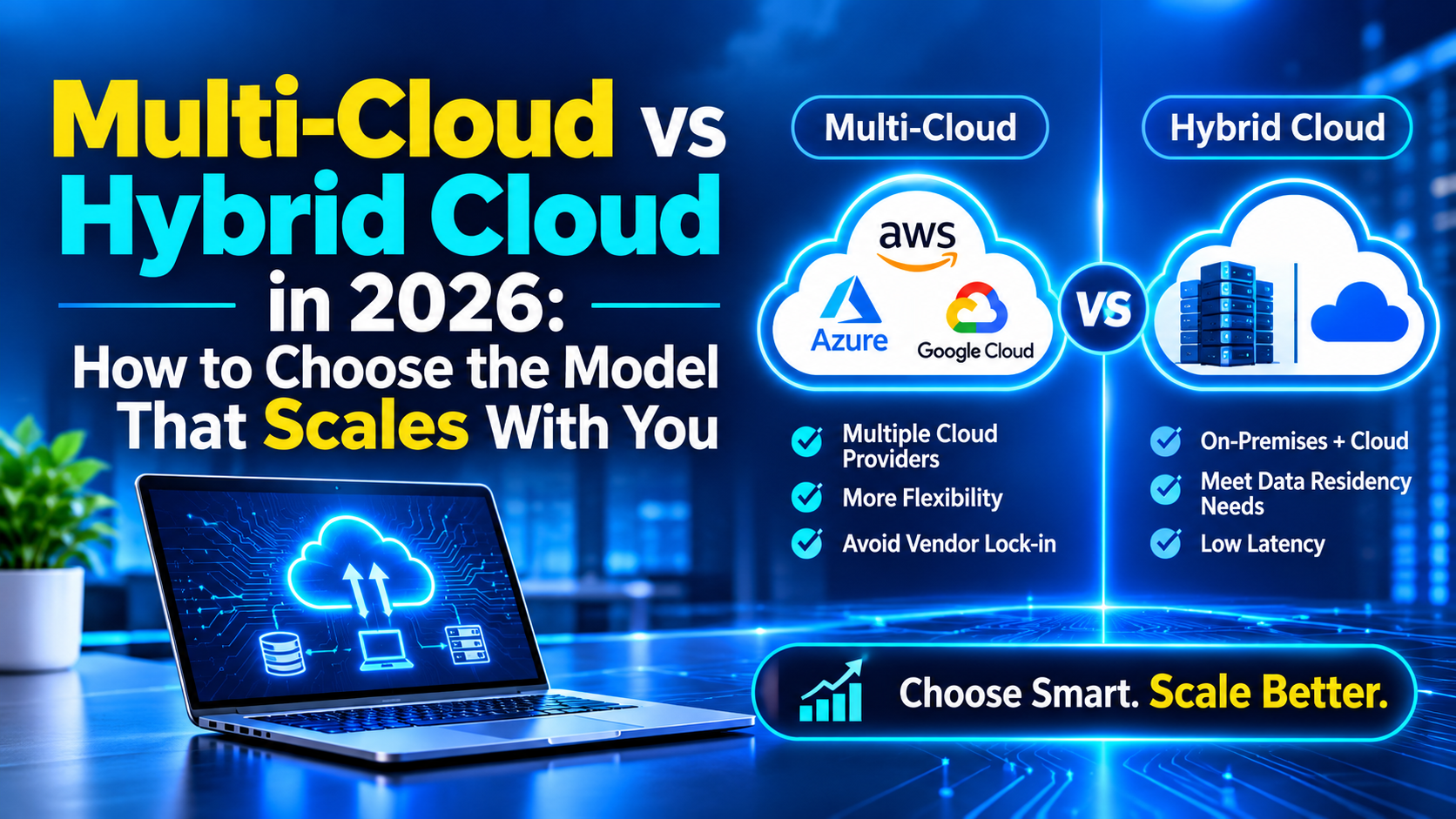
Multi-cloud vs hybrid cloud in 2026 comes down to one choice: spread workloads across public providers, or tie private infrastructure to public cloud. Hybrid keeps your data close. Multi-cloud keeps your options open.
According to Flexera, the IT management software company behind the State of the Cloud Report, 73% of organizations now run hybrid cloud environments. That choice shapes your cost, risk, and speed for years to come. Choosing the right development approach also matters, as businesses evaluate vibe coding vs. traditional software development to balance development speed, code quality, and long-term scalability.
What Is Multi-Cloud vs Hybrid Cloud in 2026?
Multi-cloud uses services from two or more public cloud providers, such as Amazon Web Services (AWS), Microsoft Azure, and Google Cloud, and places each workload on the platform that fits it best hybrid cloud links private or on-premises infrastructure to a public cloud under one management layer.
Multi-cloud decides which provider runs each workload. Hybrid cloud decides where each workload lives. Both can run together as a hybrid multi-cloud environment, and neither automatically removes vendor lock-in.
According to Flexera, 33% of organizations use multiple public and multiple private clouds at the same time.
How hybrid cloud works
Hybrid cloud runs sensitive or latency-critical workloads on infrastructure you control and bursts into public cloud for scale. Kubernetes, the open-source container orchestration platform, helps teams deploy consistently across both, though portability still depends on application design. Regulated, legacy-heavy enterprises gain the most. For organizations running AI workloads across these environments, domain-specific AI models for business can help align AI capabilities with industry requirements and specific operational needs.
How multi-cloud works
Multi-cloud assigns each workload to its best-fit provider and manages them all through shared tooling. Terraform, HashiCorp’s infrastructure-as-code tool, provisions resources across providers from one codebase. Cloud-native teams gain resilience and specialized services, provided failover is designed and tested. As cloud environments continue to evolve, understanding the future of cloud infrastructure in 2026 can help businesses prepare for emerging architectures and infrastructure strategies.
Multi-Cloud vs Hybrid Cloud: Key Differences at a Glance
Multi-cloud mixes providers.Hybrid cloud mixes environment types.
Factor | Multi-Cloud | Hybrid Cloud |
Composition | Two or more public providers | Private or on-premises plus public cloud |
Primary driver | Provider choice, resilience, specialized services | Data control, compliance, latency |
Data control | Shared with each provider | Greater direct control for workloads on organization-managed infrastructure |
Lock-in | Lower only where workloads are portable | Depends on architecture and proprietary services |
Complexity | Separate APIs, billing, and security models | Private-to-public integration |
Cost profile | Operating expense; savings depend on usage, egress, and licensing | Capital plus operating expense |
Best fit | Cloud-native teams, SaaS, global products | Regulated industries, legacy-heavy enterprises |
Cost, Security, and Compliance: What Is at Stake
Complexity is where cloud budgets bleed. According to Flexera, wasted IaaS and PaaS spend rose to 29% in 2026, the first increase in five years. The report ties rising waste to growing complexity and AI workloads.
According to Flexera, 71% of organizations now have a cloud center of excellence or equivalent, and 63% run a FinOps team, the practice of managing cloud spend through shared financial accountability.
Multi-cloud raises the execution bar. According to Gartner, the global technology research and advisory firm, more than 50% of organizations will not get the expected results from their multi-cloud implementations by 2029, largely because providers interoperate poorly.
Security follows the same pattern. Hybrid cloud concentrates controls around infrastructure you own, while multi-cloud multiplies identity systems, APIs, and policy settings. Consistent policy and centralized identity matter more than the model itself.
Regulation raises the bar further. Gartner also reports that more than 50% of multinational organizations will have digital sovereignty strategies by 2029, up from less than 10% at the time of its 2025 forecast. Hybrid cloud can support data residency by keeping regulated workloads on approved infrastructure, but you must still assess data access, processing locations, and cross-border transfers.
Multi-Cloud vs Hybrid Cloud for AI Workloads in 2026
Hybrid cloud leads AI deployment. According to Foundry, multi-cloud assigns each workload to its best-fit provider and manages them all through shared tooling. Terraform, HashiCorp’s infrastructure-as-code tool, provisions resources across providers from one codebase. Cloud-native teams gain resilience and specialized services, provided failover is designed and tested. To manage security, compliance, and accountability across these environments, businesses should also follow a structured AI Governance Framework for 2026.
echnology media and research company behind CIO, 38% of organizations in its 2026 study of 527 IT decision-makers choose hybrid cloud for AI, up from 29% in 2022. Private cloud follows at 28%, multi-cloud at 14%, and public cloud at 13%.
Only 6% of respondents do not plan to deploy hybrid or multi-cloud architecture, down from 18% in 2022. Decide data location and compute placement before you commit to a model, especially when you plan AI Automation workloads.
How to Choose Between Multi-Cloud and Hybrid Cloud
Six steps settle the decision:
- Audit workloads for latency, scaling, and dependencies.
- Classify data by sensitivity and residency needs.
- Map regulations in every country where you operate.
- Assess skills. A Team-as-a-Service (TaaS) model adds pre-vetted engineers without long hiring cycles.
- Model three-year total cost, including egress, tooling, and staffing.
- Pilot one non-critical workload, then scale what works.
How We Can Help You Choose the Right Cloud Model
Hotbit Infosoft, a digital-first technology company specializing in AI Automation, Product Engineering, Business Transformation, Cloud, Team-as-a-Service, and iGaming & Fantasy solutions, helps businesses plan, build, and run cloud environments. Our Cloud team sizes integration effort before you commit budget, and our Business Transformation practice ties the model to measurable outcomes.Contact our experts to discuss your requirements and build a future-ready cloud foundation.
Frequently Asked Questions: Multi-Cloud vs Hybrid Cloud
What is the difference between multi-cloud and hybrid cloud?
Multi-cloud uses services from two or more public cloud providers, such as AWS and Microsoft Azure. Hybrid cloud connects private or on-premises infrastructure to a public cloud. The key difference is composition: multi-cloud mixes providers, while hybrid cloud mixes environment types. Many organizations run both at the same time.
Is multi-cloud better than hybrid cloud?
Neither model is better in every case. Multi-cloud suits organizations that want provider choice, resilience, and best-of-breed services. Hybrid cloud suits organizations with on-premises systems, strict data residency rules, or latency-sensitive workloads. According to Flexera, 73% of organizations operate hybrid cloud, and multi-cloud adoption continues to rise. Some combine both.
Can hybrid cloud and multi-cloud be used together?
Yes. A hybrid multi-cloud environment combines private or on-premises infrastructure with two or more public cloud providers. According to Flexera, 33% of organizations use multiple public and multiple private clouds. Teams manage these setups with shared tooling such as Kubernetes and Terraform, plus consistent identity, security, and cost policies.
Which is more secure, hybrid cloud or multi-cloud?
Neither architecture is inherently more secure. Hybrid cloud can keep sensitive data on infrastructure you control, which can simplify data residency. Multi-cloud multiplies security models, APIs, and identity systems, which raises configuration risk. Security depends on consistent policy, centralized identity management, and continuous monitoring across every environment you run.
What are the disadvantages of multi-cloud?
Multi-cloud adds management complexity, skill requirements, and integration cost. Teams must learn separate APIs, billing models, and security controls for each provider. Data egress fees add further cost. According to Gartner, more than 50% of organizations will not get expected results from multicloud implementations by 2029.
Disclaimer
This article is for informational purposes only and does not constitute technical, financial, or legal advice. Cloud strategies, costs, security requirements, and regulatory obligations vary by organization and may change over time. Businesses should assess their specific infrastructure, compliance needs, and operational requirements before choosing or implementing a cloud model.