
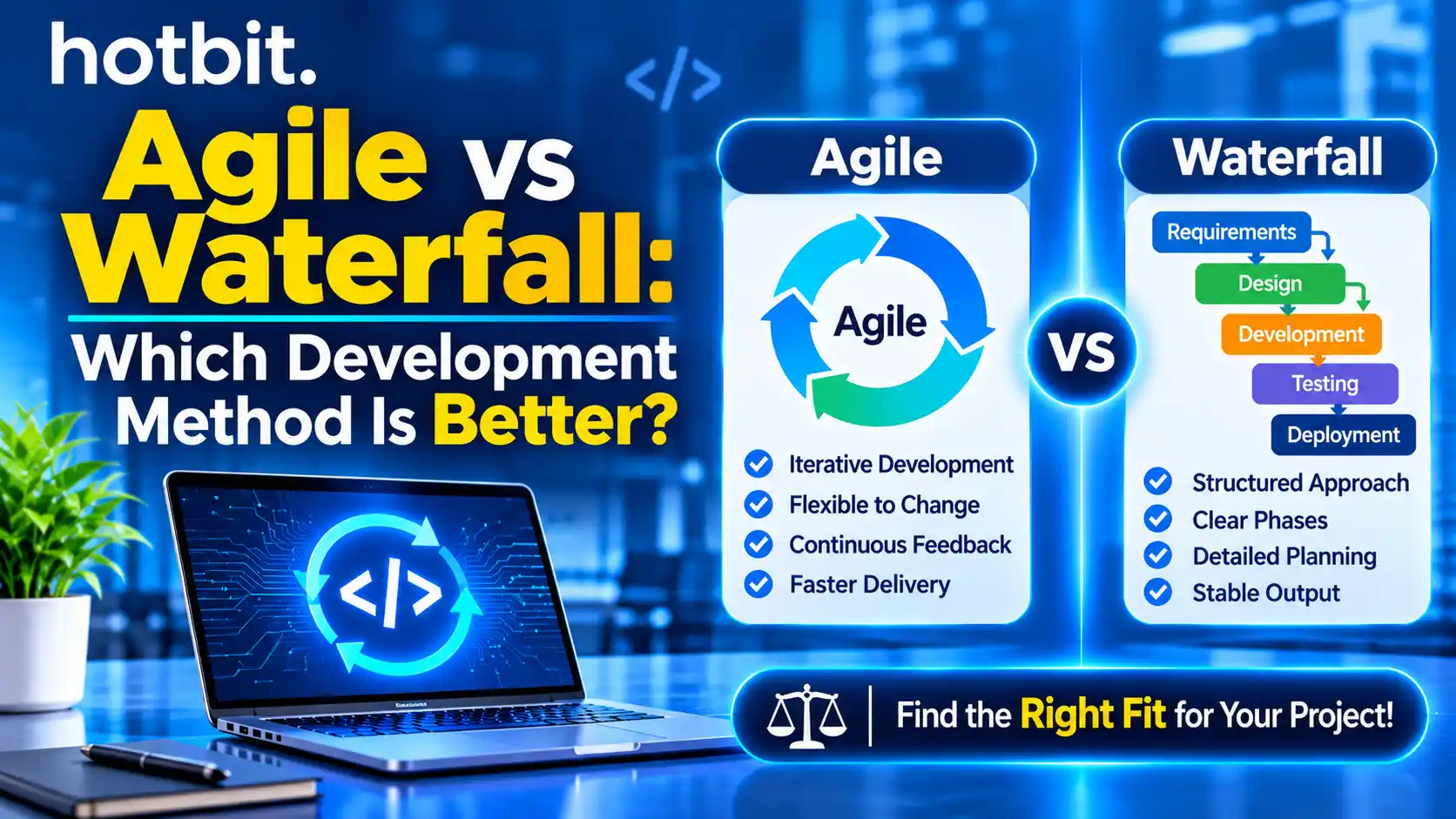
Agile vs Waterfall is the choice between building software in short feedback cycles or in fixed sequential phases, and your requirements decide which wins. Choose wrong, and you ship software nobody wanted, or lose control of a build that needed discipline.
According to the Standish Group, Agile projects succeeded 39% of the time versus 11% for Waterfall in its 2011 to 2015 CHAOS data. That is historical research, not a current benchmark, and it reflects project size and research method as well as methodology. Understanding the differences between traditional software development and modern development approaches can help put these findings into context.
What Is Agile vs Waterfall?
Agile vs Waterfall is the comparison between two software development approaches. Waterfall generally completes project phases in sequence, with each phase largely finished before the next begins. Agile delivers small, working increments in short cycles, often lasting one to four weeks, and adjusts the plan after each cycle based on feedback.
Waterfall is commonly traced to Winston Royce’s 1970 paper, although Royce himself warned of the risks of a purely sequential approach. The Agile Manifesto, published in 2001 by 17 software practitioners, formalized Agile’s four values. Today, these approaches also provide useful context for understanding AI-native software development, where adaptability and continuous improvement play an important role. The difference comes down to change: Agile expects it, and Waterfall controls it.
Understanding the framework: Agile vs Waterfall at a glance
Factor | Agile | Waterfall |
Structure | Iterative cycles, often one to four weeks | Sequential phases |
Requirements | Evolve during the project | Largely fixed before development starts |
Customer feedback | Continuous, every cycle | Typically at the start and at final delivery |
Delivery | Working software released incrementally | Typically one release after verification |
Change handling | Built into the process | Generally managed through formal change control |
Best fit | Uncertain scope, fast-moving markets | Stable scope, strong governance needs |
When each method wins
Agile fits when:
- Requirements are uncertain and users can give feedback every cycle.
- The market moves faster than a long planning cycle can track.
- Early correction matters more than a fixed upfront estimate.
Waterfall fits when:
- Requirements are complete, stable, and agreed before development starts.
- Hardware dependencies or fixed endpoints, such as a defined Cloud migration, limit change.
- Formal documentation, approvals, and audit trails drive delivery.
Neither method owns regulated or fixed-price work. Agile also works there when compliance controls, change controls, and acceptance criteria are built into every cycle. Before selecting a development approach, teams should also consider how to validate a mobile app idea before development to assess user needs, market demand, and project feasibility. Hybrid models pair Waterfall governance with Agile building, and PMI’s framework-neutral Agile Practice Guide helps teams choose among predictive, agile, and hybrid life cycles without prescribing one model.
Are You Ready to Choose the Right Delivery Model?
The stakes are higher than a process preference. The Digital.ai 2025 State of Agile Report found that 76% of respondents feel pressure to demonstrate the return on investment of Agile, and only half feel they can deliver reliably and with accountability. Agile wins when teams apply it with discipline, not when they adopt its vocabulary. Waterfall wins when the scope truly holds.
Teams planning a Business Transformation program should settle the delivery model before the first sprint or the first specification, when a change of approach costs the least.
How We Can Help: Match the Delivery Model to the Project
Hotbit Infosoft, a digital-first technology company specializing in AI Automation, Product Engineering, Business Transformation, Cloud, Team-as-a-Service, and iGaming & Fantasy solutions, matches the delivery method to the project, not the reverse. With 15+ years of experience and 100+ delivered success stories, our Product Engineering teams run Agile for product builds and Waterfall-style planning where formal approvals or fixed scope call for it.
Not sure which fits your next build? Talk to an Expert and we will identify the right approach for your project.
Frequently Asked Questions: Agile vs Waterfall
What is the main difference between Agile and Waterfall?
The main difference is how each method handles change. Agile delivers software in short iterations and welcomes new requirements between cycles. Waterfall generally completes requirements, design, build, and testing in sequence and controls change after approval. Agile optimizes for adaptability; Waterfall optimizes for predictability.
Which is better, Agile or Waterfall?
Agile usually fits projects with evolving requirements, frequent feedback, and uncertain scope. Waterfall usually fits projects with stable requirements and formal approval needs. Historical Standish Group data from 2011 to 2015 reported Agile projects succeeding 39% of the time versus 11% for Waterfall. These figures do not predict outcomes for current projects.
When should you use Waterfall instead of Agile?
Use Waterfall when requirements are complete, stable, and agreed upfront. Typical cases include hardware-dependent builds, infrastructure migrations, and projects with strict approval gates or fixed-scope contracts. Waterfall works well there because each phase has clear deliverables, formal approvals, and documentation that auditors and procurement teams can verify.
What is a hybrid of Agile and Waterfall?
A hybrid model combines Waterfall’s upfront planning with Agile’s iterative delivery. Teams commonly fix scope, budget, and governance at the start, then build in short iterations, though implementations vary. Hybrid approaches suit enterprises that need predictable milestones and compliance sign-off while still responding to user feedback during development.
Is Agile faster than Waterfall?
Agile typically delivers usable software sooner because it releases working increments every few weeks, while Waterfall typically releases once, after verification ends. Total project duration is not always shorter. Agile’s advantage is earlier value and earlier feedback, not guaranteed faster completion of the full scope.
Disclaimer
This article is for informational and educational purposes only. The comparison of Agile and Waterfall reflects general software development practices and may not apply equally to every project. Historical statistics cited from the Standish Group and other reports are based on their respective research periods and methodologies; they should not be treated as guarantees of future project outcomes. The best development approach depends on your project requirements, budget, timeline, team capabilities, and business objectives.