
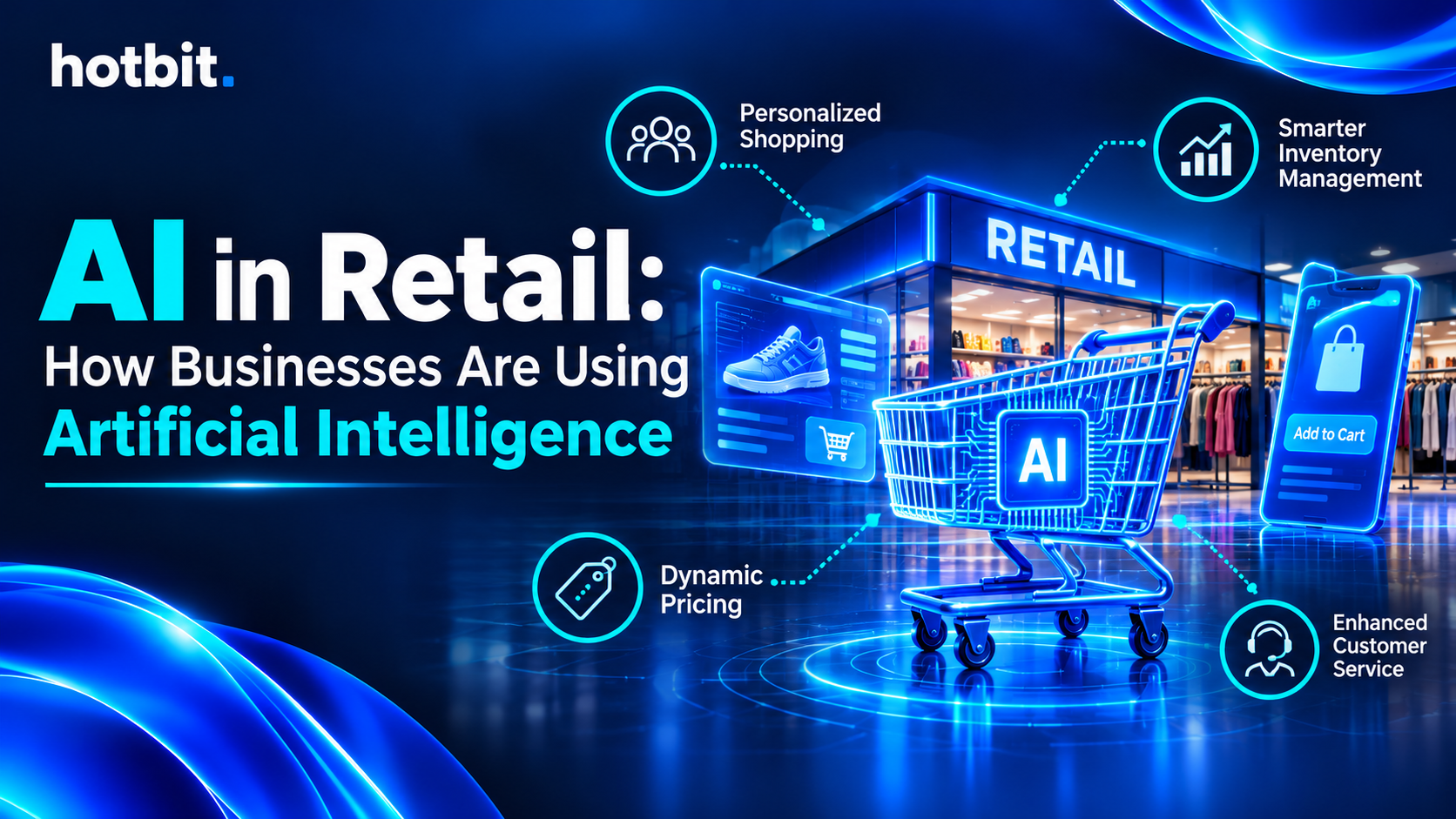
Artificial Intelligence in Retail is already rewriting how businesses forecast demand, price products, and serve customers. According to McKinsey & Company, generative AI alone could unlock an estimated $240 billion to $390 billion in economic value for the retail industry, per its 2024 analysis. That is sector-wide potential, not a guaranteed gain for any single retailer. As businesses explore practical applications, AI agents are changing business operations by helping automate workflows, coordinate tasks, and support operational decisions. The retailers that scale AI first will set the pace of the market.
What Is Artificial Intelligence in Retail?
Artificial intelligence in retail is the use of machine learning, generative AI, and computer vision to automate retail tasks and sharpen retail decisions. Machine learning predicts demand and recommends products from sales, inventory, and customer data. Generative AI powers shopping assistants and content automation, while computer vision reads camera and shelf images to track stock and flag potential loss. As retailers adopt these capabilities, understanding the differences between traditional and AI-native software architectures becomes increasingly important. This is where Traditional SaaS vs. AI-Native SaaS provides useful context for evaluating AI-driven business applications.
Seven core use cases across the retail value chain
Each use case targets a specific cost or revenue lever. Seven areas carry most of the value—
- Demand forecasting: Machine learning predicts units sold by product, location, and week from sales history, seasonality, promotions, weather, and local events. Accurate forecasts cut stockouts and the overstock that forces markdowns, and retailers can measure the change directly.
- Personalization: Engines rank products, offers, and content using browsing history, purchase patterns, and similar customers’ choices. The payoff is higher conversion, larger baskets, and stronger repeat purchase rates.
- Dynamic pricing and promotion optimization: Algorithms recommend or adjust prices based on demand, inventory levels, and competitor activity, within guardrails the retailer defines. Separate models test which discounts lift sales without destroying margin.
- Inventory and supply chain optimization: Algorithms recommend replenishment quantities, transfer stock between locations, and flag supply chain risks early. The result is lower carrying costs, less waste in perishables, and faster delivery.
- Conversational commerce: AI assistants answer questions, recommend products, and handle order tracking, returns, and loyalty inquiries, subject to escalation rules. Human agents take the complex cases, and McKinsey notes the smart-shopping assistant could become a primary shopping channel over time.
- Computer vision: Cameras and image-recognition models detect empty shelves, verify planogram compliance, and support cashierless checkout. Deployment demands privacy-by-design safeguards, customer notification, and a clear line between shelf monitoring and biometric identification.
- Fraud detection and loss prevention: Models score transactions, returns, and account activity in real time to flag suspicious behavior that fixed rules miss. Fewer chargebacks and less return fraud depend on data quality and ongoing monitoring.
Most of these use cases run on AI Automation workflows that route recommendations and flagged cases to the right human reviewer.
Where Retail AI Value Concentrates: Margin, Cost, and Revenue
Retailers capture value through margin growth, cost reduction, and revenue lift. McKinsey estimates that generative AI’s potential is equivalent to a margin increase of roughly 1.2 to 1.9 percentage points across the retail industry. Achieving these gains often depends on scalable infrastructure, making AI and cloud computing important considerations for retailers deploying AI-powered solutions.
The gains differ by segment. According to the McKinsey and EuroCommerce report “Rewiring retail in Europe: The AI imperative,” end-to-end AI transformation could unlock about €240 billion to €320 billion in economic value across Europe’s retail sector over the next five years. McKinsey’s analysis estimates that grocery retailers could see EBITDA improvement of 4 to 6 percentage points, driven by supply chain efficiency, waste reduction, and targeted promotions. Softline retailers, which sell clothing, footwear, and beauty products, could see about 8 to 10 percentage points.
These are estimated potentials, not guaranteed results. Outcomes vary by retailer, business model, and implementation maturity. Grocers win through many small operational gains, while fashion and beauty retailers win through pricing, assortment, and personalization. However, as retailers adopt more AI-powered tools, protecting customer information and business systems becomes increasingly important. Implementing safeguards to prevent AI-driven phishing attacks can help reduce security risks associated with AI-enabled business environments.
Are You Ready for the Shift? Why Retail AI Stalls Before It Scales
According to McKinsey, most retailers have started testing generative AI across the value chain, yet few have realized its full potential at scale. The EuroCommerce and McKinsey report reaches the same conclusion: AI value grows when successful applications are integrated into broader business operations. Choosing the right infrastructure is also important, and understanding the differences between Edge AI and Cloud AI can help retailers evaluate deployment options based on latency, scalability, data processing, and operational requirements. Four barriers explain most stalled programs.
- Fragmented data: Sales, inventory, and customer data sit in separate systems, so models never see the full picture.
- Legacy platforms: Older commerce and ERP systems make real-time integration slow and expensive.
- Isolated pilots: Teams run experiments with no owner, no success metric, and no path to production.
- Talent gaps: Retailers lack the machine learning and data engineers needed to build and maintain production models.
Each barrier has a fix. Stronger data architecture, phased delivery, and added engineering capacity clear them, and cloud platforms unify the data that models depend on.
Six steps move a retailer from experiment to production. Define one measurable business problem, audit your data, select a focused pilot, build or integrate the solution, measure against the baseline, and scale across stores and channels on a cloud foundation.
Choose the implementation path deliberately. Buy packaged software for standard needs such as email personalization or chatbots. Build custom models where your data and processes create a competitive edge. Partner with an engineering firm that specializes in AI-native software development to integrate existing platforms and build custom layers where differentiation matters.
Govern as you scale. Follow the privacy regulations in your markets, test pricing and recommendation outputs across customer groups for bias, and keep human review on high-impact decisions such as fraud blocks.
How We Can Help: From Retail AI Pilot to Production
Hotbit Infosoft, a digital-first technology company, moves retailers from AI experiments to production systems. With 15+ years of experience, 100+ delivered success stories, and 200+ global brands served, our AI Automation team builds demand forecasting, product recommendation, and customer service automation on a scalable cloud foundation. Exploring Artificial Intelligence in Retail for your business? Book a consultation, and we will map the use cases that fit your operations.
Frequently Asked Questions About Artificial Intelligence in Retail
1. How is artificial intelligence used in the retail industry?
Artificial intelligence is used in retail to forecast product demand, personalize shopping experiences, optimize pricing, manage inventory, detect fraud, and automate customer service. Retailers use machine learning, generative AI, and computer vision to analyze data, improve operational efficiency, and support faster business decisions.
2. What are the benefits of AI in retail businesses?
AI helps retail businesses improve demand forecasting, reduce inventory waste, personalize product recommendations, optimize promotions, and streamline customer support. It can also help identify fraudulent transactions and improve supply chain visibility. Actual benefits depend on data quality, implementation costs, and how effectively AI tools are integrated into business operations.
3. How does AI improve inventory management in retail?
AI improves inventory management by analyzing historical sales, seasonal trends, customer demand, and supply chain data to recommend stock levels and replenishment quantities. Retailers can use these predictions to reduce overstocking, minimize stockouts, limit product waste, and make inventory distribution more efficient across store locations.
4. What are the challenges of implementing artificial intelligence in retail?
Common challenges include fragmented data, outdated technology systems, high implementation costs, cybersecurity risks, privacy concerns, and a shortage of skilled AI professionals. Retailers may also struggle to scale pilot projects. A clear implementation strategy, reliable data infrastructure, and appropriate human oversight can help address these challenges.
5. What is the future of artificial intelligence in retail?
The future of artificial intelligence in retail is likely to involve more advanced shopping assistants, predictive inventory systems, personalized customer experiences, automated supply chains, and computer vision applications. As AI technology develops, retailers may increasingly integrate these capabilities across online and physical stores to improve decision-making and customer experiences.
Disclaimer
This article is for informational and educational purposes only. The information about artificial intelligence in retail, including its applications, benefits, industry estimates, and potential business outcomes, is based on publicly available sources and general industry insights. Results may vary depending on business size, data quality, technology infrastructure, and implementation strategy. Statistics and projections cited in this article are estimates, not guaranteed results. Readers should independently evaluate AI solutions and consult qualified technology professionals before making business or investment decisions.