
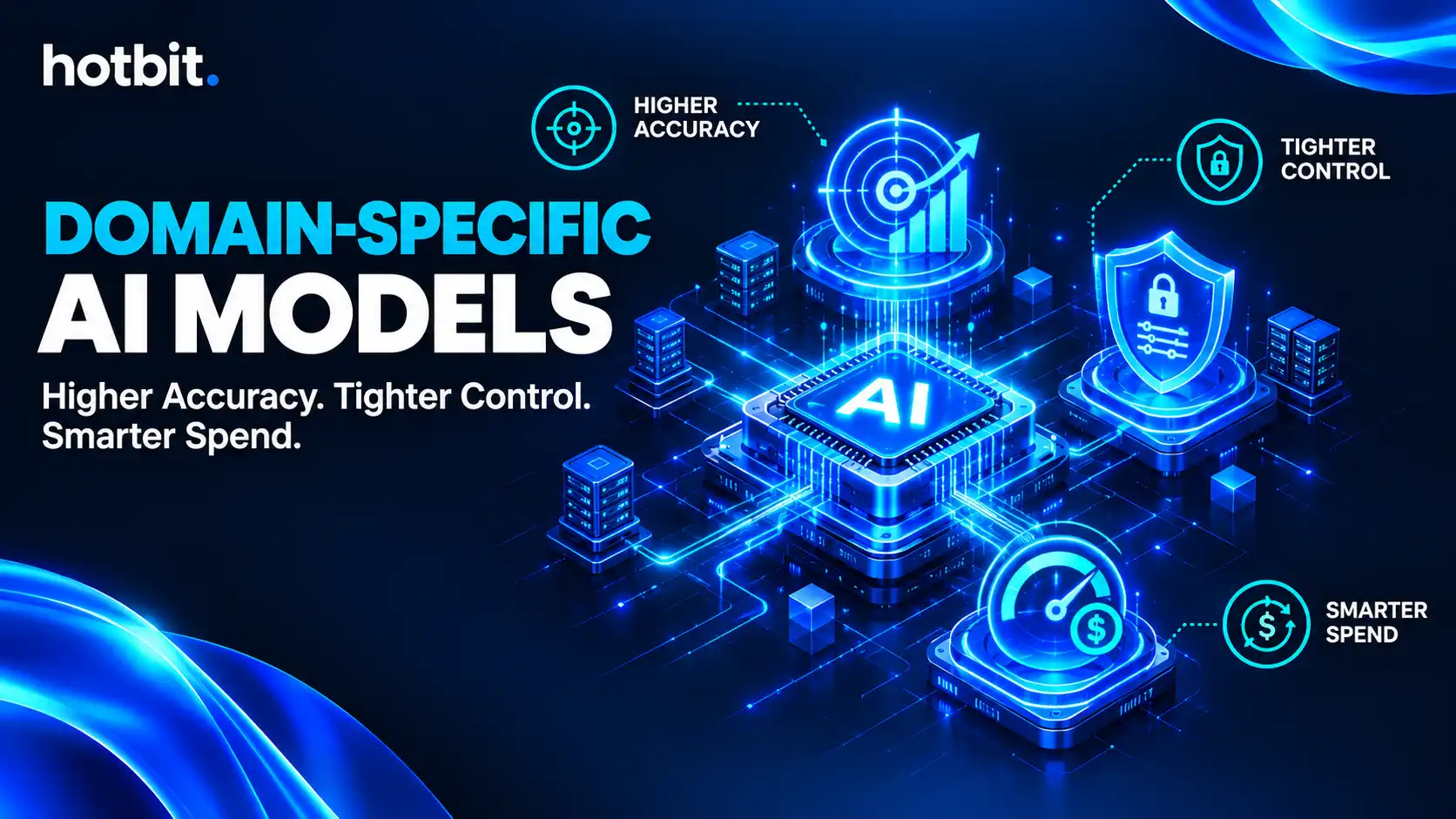
Domain-specific AI models can outperform general-purpose AI on accuracy, compliance, and cost when the task is specialized and the data is sound. Generic models deploy quickly, but they can falter when terminology is dense and errors are expensive. Gartner forecasts that more than 50% of the generative AI models enterprises use will be specific to an industry or business function by 2027, up from roughly 1% in 2023.
What Are Domain-Specific AI Models?
A domain-specific AI model is an AI system trained or adapted on data from one industry or business function, such as healthcare, finance, law, or manufacturing. It learns that field’s terminology, rules, and workflows. For practical implementation, connecting AI agents to CRM, ERP databases, and SaaS tools can help integrate AI capabilities with existing business systems. A legal model recognizes clause types, and a manufacturing model reads equipment fault codes.
Three ways to build them
- Retrieval-augmented generation (RAG): the system retrieves relevant information from company documents at query time and supplies it to a model to help generate grounded answers. It is often the most cost-effective starting point when relevant documents already exist.
- Fine-tuning: an existing foundation model is retrained on domain examples. It suits specialist tone, structured outputs, and classification.
- Training from scratch: a new model learns from a large domain corpus. It is the most expensive route and rarely necessary.
Compare total implementation and operating costs across these routes before you commit. Many teams start with RAG, then add fine-tuning where results justify it.
Domain-Specific AI Models vs General-Purpose AI: Where Each Wins
Neither approach wins everywhere. The right choice depends on task risk, data readiness, and volume.
Where specialization pays off
Domain-specific AI models fit work where accuracy and traceability carry real stakes:
- Contract review and clause extraction in legal teams
- Credit analysis, fraud detection, and compliance monitoring in financial services
- Clinical documentation support in healthcare, with clinician review
- Fault prediction from sensor and maintenance data in manufacturing
- Delay forecasting and load optimization in logistics
Where general-purpose models still lead
General-purpose models win on drafting, brainstorming, and answering broad questions. They also suit early experiments, because a team can test a use case through an API in days. However, organizations should evaluate security risks before deploying AI tools, following a practical cybersecurity checklist for SMEs to help identify common security considerations. Many organizations may benefit from using both approaches. A general model handles open-ended work, and domain-specific AI models handle regulated or high-value tasks.
How Domain-Specific AI Models Affect Accuracy, Cost, and Compliance
Specialized data can improve specialized reasoning. Bloomberg’s research team trained BloombergGPT, a 50-billion-parameter model built on a mix of financial and general data, and reported that it outperformed similarly sized general models on financial tasks. Google’s Med-PaLM 2 reported 86.5% accuracy on the MedQA benchmark of USMLE-style questions, using a configuration tuned for medical question answering. These are research results, not proof of clinical readiness, and they do not show that every specialized model beats every general one.
Results depend on the model, the data, and the evaluation. Grounding answers in verified sources can reduce fabricated output, though errors remain possible. A model trained on messy records inherits the mess, so data preparation is the first investment, not the last. Businesses can use AI-powered data analytics to turn well-prepared data into actionable insights and support more informed decisions.
Cost and compliance follow the same logic of fit and governance:
- Cost: smaller, focused models can run faster and cost less per request. Private deployment can reduce dependence on external API pricing, but total cost depends on infrastructure, utilization, staffing, and maintenance. Upfront spend is often higher because data preparation, evaluation, and monitoring all require investment.
- Compliance: domain-specific systems can support compliance efforts when paired with access controls, logging, human oversight, and legal review. Using one does not automatically satisfy privacy rules such as India’s Digital Personal Data Protection Act or the EU’s GDPR.
Why Generic AI Becomes a Liability in Production
AI is already inside the workflow. In McKinsey’s 2025 State of AI survey, 88% of respondents said their organizations used AI in at least one business function, though many were still running pilots. Once AI feeds real decisions, an approximate answer carries real cost. A wrong figure in a financial report or a wrong dosage in a clinical summary is not a minor error.
Three pressures push leaders toward specialization:
- Specialist tasks that punish approximate answers
- Auditors who expect traceable, explainable outputs
- Companies that want proprietary knowledge to stay inside their own environment
How to Adopt Domain-Specific AI Models: Six Steps From Use Case to Production
Each step lowers risk before the next begins.
- Define a narrow use case: pick one workflow with clear metrics, such as contract review time or claim error rate.
- Audit and prepare data: inventory documents, clean them, remove sensitive fields, and confirm usage rights.
- Choose an approach: select prompt engineering, RAG, fine-tuning, or full training based on budget, data volume, and control needs.
- Build and ground the model: connect it to verified company knowledge so answers cite real sources.
- Evaluate with domain experts: test against a benchmark set that specialists have reviewed, not generic prompts.
- Deploy and monitor: track accuracy, drift, and cost, and update retrieval sources or models as policies change.
Plan for the common obstacles early: scattered data, talent gaps across machine learning, data engineering, and domain expertise, ongoing maintenance, and integration with the CRMs, ERPs, and document platforms your staff already use.
How We Can Help
Hotbit Infosoft builds and deploys domain-specific AI models through its AI Automation practice, from data readiness to production. Our Cloud team designs the deployment environment around your workload and budget, and Team-as-a-Service adds AI engineers and data scientists as the project scales. Have a high-value workflow in mind? Talk to an Expert and scope your first use case.
Frequently Asked Questions
1. What are domain-specific AI models?
Domain-specific AI models are AI systems trained or adapted for a particular industry or business function, such as healthcare, finance, law, or manufacturing. They are designed to understand specialized terminology, workflows, and data to deliver more relevant results for targeted tasks.
2. How are domain-specific AI models different from general-purpose AI?
General-purpose AI handles a wide range of tasks, including writing, brainstorming, and answering general questions. Domain-specific AI focuses on specialized tasks and industry knowledge. The best choice depends on the required accuracy, data availability, compliance needs, and business goals.
3. Do domain-specific AI models provide better accuracy?
Domain-specific AI models can deliver better accuracy on specialized tasks when they use high-quality data and are properly evaluated. However, performance varies by model and application. Testing with real-world examples and expert-reviewed benchmarks is essential before deployment.
4. Are domain-specific AI models more cost-effective than general-purpose AI?
They can be more cost-effective for repetitive, high-volume, specialized tasks, particularly when smaller models can handle the workload efficiently. However, data preparation, customization, infrastructure, maintenance, and monitoring add costs. Businesses should compare total ownership costs before choosing an approach.
5. How can a business implement domain-specific AI models?
Businesses can start by identifying a specific use case, auditing and preparing relevant data, and choosing an approach such as retrieval-augmented generation (RAG) or fine-tuning. They should then evaluate performance with domain experts, deploy appropriate security controls, and continuously monitor accuracy, cost, and compliance.
Disclaimer
The information in this article is for educational and informational purposes only. AI model performance, accuracy, cost, and compliance depend on the data, implementation, and use case. Examples and research findings are not guarantees of results. Organizations should evaluate AI systems carefully and consult relevant legal, privacy, and compliance professionals before deployment.