
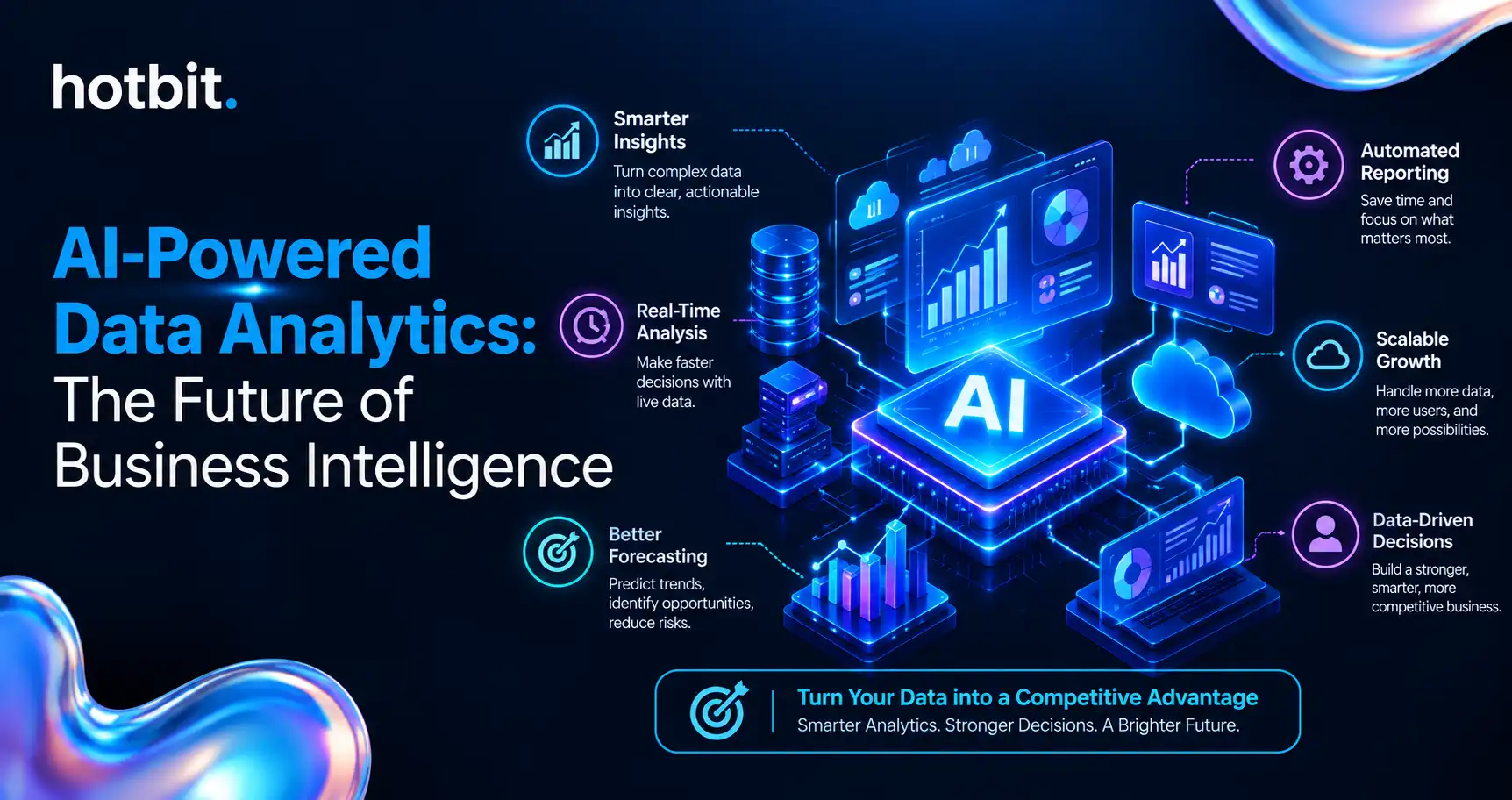
DC projects worldwide AI spending to exceed $630 billion by 2028, growing at roughly 30% a year. AI-Powered Data Analytics uses machine learning, natural language processing, and generative AI to turn raw business data into forecasts and next steps, not just reports. It’s the shift from reviewing what happened to acting on what’s coming. As businesses move toward more autonomous decision-making, how AI agents are changing business operations is becoming an important part of understanding how AI can turn insights into action.
What Is AI-Powered Data Analytics?
Traditional business intelligence is built primarily to show what happened, though many mature BI platforms also support some diagnostic and predictive analysis. AI-Powered Data Analytics pushes further: it can surface why something happened and forecast what’s likely next, often through a natural-language question instead of a query someone has to build by hand. For businesses undergoing digital transformation, these capabilities can also help identify warning signs before they become larger operational problems.
That’s the practical shift. A static dashboard shows a snapshot on a schedule. A well-built AI-powered system can keep processing new data between refreshes, flagging what’s worth attention closer to when it happens. Businesses exploring the latest AI trends in 2026 can also see how these capabilities are shaping modern operations.
The building blocks of AI-powered analytics
- Natural language processing turns a typed or spoken question into a direct answer, no query-writing required.
- Machine learning models trained on your own historical data catch patterns early: a likely stockout, a churn risk, a supply-chain delay before it hits the floor.
- Augmented analytics surfaces the insight that matters most in a dataset, instead of waiting for a scheduled report to stumble on it.
- Generative AI, the same technology behind tools like OpenAI’s ChatGPT and Microsoft Copilot, turns model output into a plain-language recommendation your team can act on.
Why AI-Powered Analytics Can't Wait
As businesses become more data-driven, their digital presence also needs to support clearer communication, better user experiences, and reliable access to information. Understanding the features every business needs on its website can help organizations build a stronger digital foundation alongside their evolving data and analytics capabilities.
The gap is widening fastest around data foundations, not algorithms. Gartner’s separate research on AI initiatives found that organizations with successful outcomes invest substantially more in data quality, governance, and change management before they scale AI. The groundwork, not the model, tends to decide whether a rollout works. Gartner predicts that by 2027, 60% of organizations that fail to address the cultural challenges associated with data and analytics governance will fail to govern AI successfully. Fragmented CRM records, inconsistent spreadsheets, and legacy databases don’t just slow a BI refresh down; they teach an AI model the wrong lessons, and it repeats them with confidence
As businesses increasingly rely on AI and analytics to make decisions, AI-powered cybersecurity threat detection can also help identify potential threats and suspicious activity across digital environments, adding an important layer of protection around the data and systems that analytics depends on.
How Hotbit Infosoft Can Help
Hotbit Infosoft, a digital-first technology company specializing in AI Automation, Product Engineering, Business Transformation, Cloud, Team-as-a-Service, and iGaming & Fantasy solutions, builds the machine learning and predictive models that turn your existing data into a forecasting engine, not just a reporting tool. Our AI Automation team handles the model-building and data integration work behind that shift. Ready to see what your data can tell you next? Talk to an Expert.