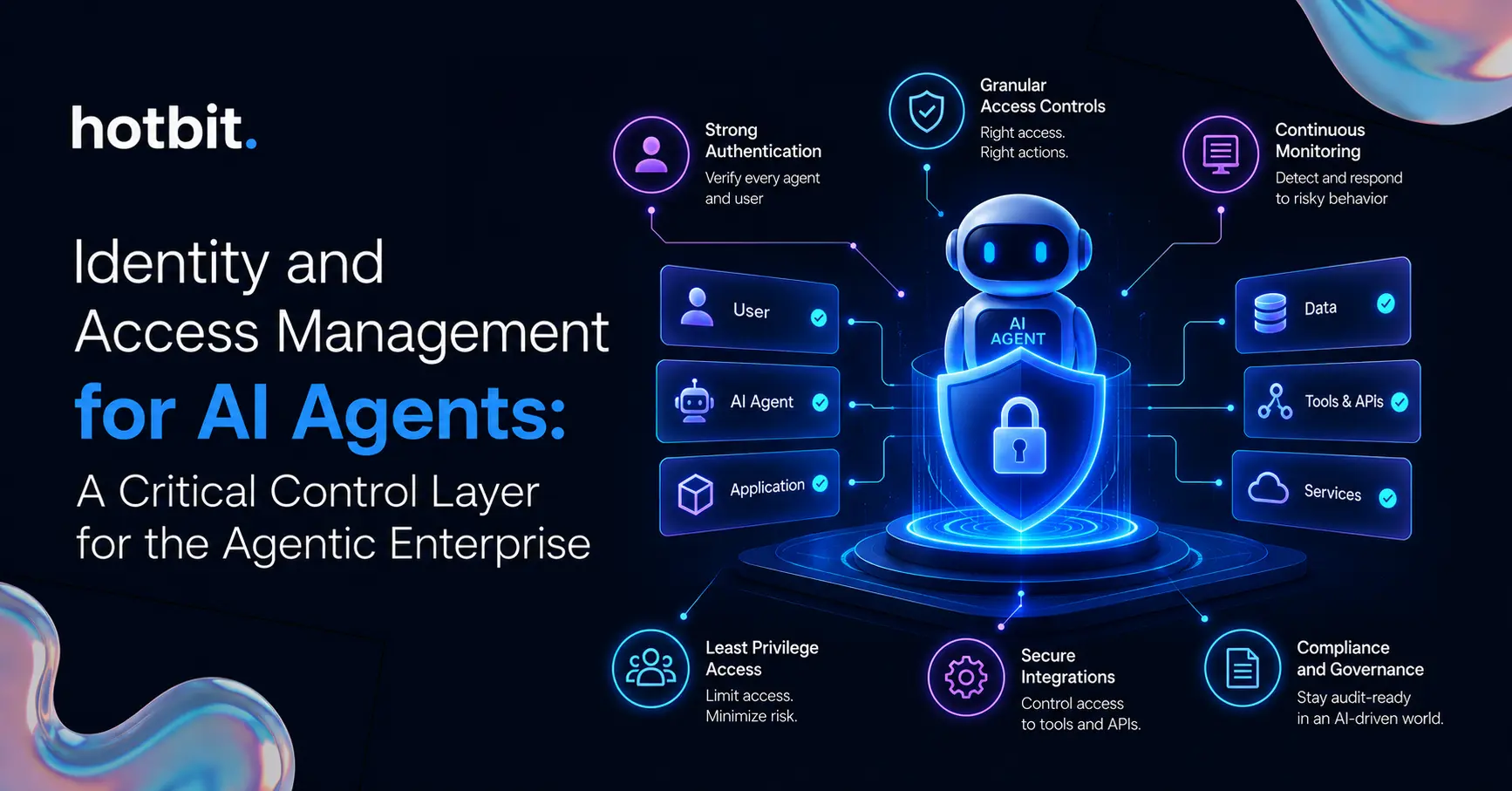
Identity and Access Management for AI Agents: A Critical Control Layer for the Agentic Enterprise

Identity and access management for AI agents governs what autonomous software can access, and it’s fast becoming a significant blind spot in enterprise security. Businesses are deploying agents faster than they can govern them, and the identity layer is where that gap turns into real risk. as generative AI continues to transform customer support and other business functions, organizations are increasingly relying on AI-powered systems that require controlled access to enterprise data and tools.

According to Gartner, the average global Fortune 500 enterprise will go from fewer than 15 AI agents in 2025 to more than 150,000 by 2028. That single projection turns agent identity from a compliance footnote into core infrastructure.

The agents are already inside the business. A critical question is whether anyone can say, with certainty, what each one is allowed to touch.

What Is Identity and Access Management for AI Agents?

Identity and access management for AI agents is the discipline of giving every autonomous or semi-autonomous agent a verifiable, auditable identity. It then governs what that identity can access, for how long, and under whose authority.
It covers four core functions, each addressing a different gap. Register each agent as its own entity, never a shared service account passed between systems. Continuously verify agent identity and authorization throughout its workflow, rather than relying solely on a single authentication event. Authorize only the access a specific task requires, nothing broader. Log what happened so a human can reconstruct exactly why the agent did what it did.
Agent IAM sits next to traditional workforce IAM it doesn’t replace it. Human-centric identity models were purpose-built for people who log in, work, and log out. Agents don’t work that way.

A single agent can run for hours without a break. It can call a dozen connected tools to complete a task, deciding at runtime which ones it needs. For a deeper look at how AI agents differ from traditional chatbots and how they work, see our guide to AI Agents and Chatbots. It can request new permissions mid-workflow, well after the human who launched it has moved on to something else.

Consider a routine example: an agent tasked with resolving a customer billing dispute. It may need to read a CRM record, pull an invoice from a billing system, and issue a refund through a payments API three systems, three different permission sets, one continuous task. Without agent-specific identity governance, that agent is either blocked at every handoff or, more often, quietly granted standing access to all three systems just to keep the workflow moving. Neither approach scales well from a security and governance perspective.

The same pattern shows up in DevOps and infrastructure agents, where the stakes evolve fastest. An agent with standing write access to a deployment pipeline doesn’t just risk one bad customer interaction; it risks production. Identity, in this context, isn’t a login screen. It’s the record of exactly which agent did what, when, and under whose authorization, replayable after the fact.
That distinction between identity and simple access control is worth being precise about. Identity establishes who or what is making the request. Access control and authorization determine whether that request should be permitted. Agents need both answered continuously, because an agent that was trustworthy at the start of a task can end up somewhere its owner never anticipated by the end of one.

None of this requires abandoning the identity tools already in place. Modern IAM platforms can manage machine identities, OAuth and OIDC flows, and workload identities well. What they need is a layer purpose-built for agents on top of that structured software development foundation, one that treats an agent as a distinct kind of actor, not a workaround bolted onto human-oriented roles.

A five-part framework for governing agent identity

A working agent IAM program is built from five components that function together, not in isolation, particularly as AI agents become more widely adopted by businesses.

  • Unique agent identity. Every agent is registered as its own entity with a distinct identity or credential, rather than relying on shared credentials that make individual actions impossible to trace.
  • Scoped, least-privilege authorization. Access is granted only for the specific task and data the agent needs, and it expires automatically once the task ends, instead of sitting open indefinitely.
  • Delegated authority tracking. Agent actions can be traced back to the human or business owner responsible for authorizing that activity, establishing real accountability.
  • Continuous verification and policy enforcement. Access is re-evaluated as context, risk, or task scope changes during a session, rather than being fixed once at a single login.
  • Activity audit trail. A timestamped record of agent actions, tool calls, and authorization decisions is retained for compliance review and incident response.
Skip any one of these five, and the gaps compound fast. A shared credential with no expiry, reviewed by no one, is how a single compromised agent becomes an open door into everything it touches, a common failure mode of poorly governed agent environments.

Is Your Business Ready to Govern Its AI Agents?

Most aren’t, and the data backs that up. GSPann research estimates that non-human identities, including AI agents, now outnumber human identities by roughly 80 to 1 in the average enterprise and 144 to 1 in cloud-native environments. GSPann puts that population’s growth at approximately 44% a year, an estimate, not an industry-wide census, but directionally consistent with what most security teams are seeing.
Visibility hasn’t kept pace with that growth. According to Ping Identity’s analysis of 2025 Gartner access management research, only 5.7% of organizations report full visibility into their service accounts, a credential pattern that many agents currently rely on to access enterprise systems.
Confidence is thinner still. A Cloud Security Alliance survey commissioned by Strata Identity, covering 285 IT and security professionals, found that fewer than half were confident they could identify every active agent in their environment. Only 18% said they had high confidence that their current identity systems could handle agent identities at all.

That identity challenge becomes even more important as AI agents gain direct access to business systems. Understanding how MCP connects AI agents to CRM, ERP, databases, and SaaS tools can help organizations think more clearly about where agent access begins, what systems are exposed, and how those connections should be governed.

That confidence gap is itself a significant risk. An organization can run a technically sound agent workflow and still have no reliable way to answer “which agents can touch this data” on demand. That’s not a gap most teams can afford once agent counts move from dozens into the thousands.
A few honest questions separate the businesses that are ready from the ones that aren’t. Can you list every agent running in production today, not just the ones a team remembers deploying? Does each agent have its own identity, or is it borrowing a shared key alongside three other services? If an agent’s access were compromised right now, could you trace exactly what it touched and shut it down without taking five other workflows down with it?
If any of those questions stall, the gap isn’t theoretical. It’s already open, and it grows every time a new agent goes live without a governance plan behind it.
The cost of waiting isn’t abstract, either. An ungoverned agent with excess permissions doesn’t need to be attacked to cause damage; a scope error or a runaway loop can move faster than any human reviewer could catch it, touching records or systems well outside its intended task. Recovering from that after the fact means untangling which actions were legitimate and which weren’t, across a system that was never built to answer that question cleanly.
Organizations are better positioned to scale agentic AI when they treat identity as infrastructure, built in from day one, not a control bolted on after an agent already has the run of the place. Getting ahead of that now, while agent counts are still in the dozens or hundreds rather than the thousands, can be more manageable than retrofitting governance onto a fleet that’s already out of view.

How Hotbit Infosoft Helps You Govern Agent Identity

Hotbit Infosoft, a digital-first technology company specializing in AI Automation, Product Engineering, Business Transformation, Cloud, Team-as-a-Service, and iGaming & Fantasy solutions, builds agent identity governance into every AI Automation engagement it delivers, scoped permissions, delegated accountability, and full audit trails, designed in from the first architecture review, not retrofitted afterward. Your agents shouldn’t be allowed to outrun your ability to govern them. Talk to an Expert and find out exactly where your current access controls stand.

Frequently Asked Questions (FAQs)

What is identity and access management for AI agents?

Identity and access management (IAM) for AI agents is the process of assigning each agent a unique identity and controlling what systems, data, and tools it can access. It also enables continuous authorization, accountability, and auditing of agent activity.
AI agents need unique identities so organizations can distinguish one agent’s actions from another’s, apply least-privilege access, track delegated authority, and quickly revoke access if an agent is compromised or behaves unexpectedly.
IAM helps secure AI agents by limiting permissions, continuously verifying access, tracking who authorized an action, and maintaining audit logs. This reduces the risk of excessive privileges, unauthorized access, and difficult-to-trace agent activity.
The key components include unique agent identities, least-privilege authorization, delegated authority tracking, continuous verification and policy enforcement, and detailed activity audit trails.
Businesses can start by creating an inventory of production agents, assigning unique identities, limiting permissions to specific tasks, establishing clear ownership, continuously monitoring access, and maintaining audit trails for every agent action.

Disclaimer:

This article is for informational purposes only and does not constitute legal, security, or professional advice. AI agent security requirements may vary by organization, systems, and regulatory environment. Businesses should assess their specific risks before implementing access controls.