
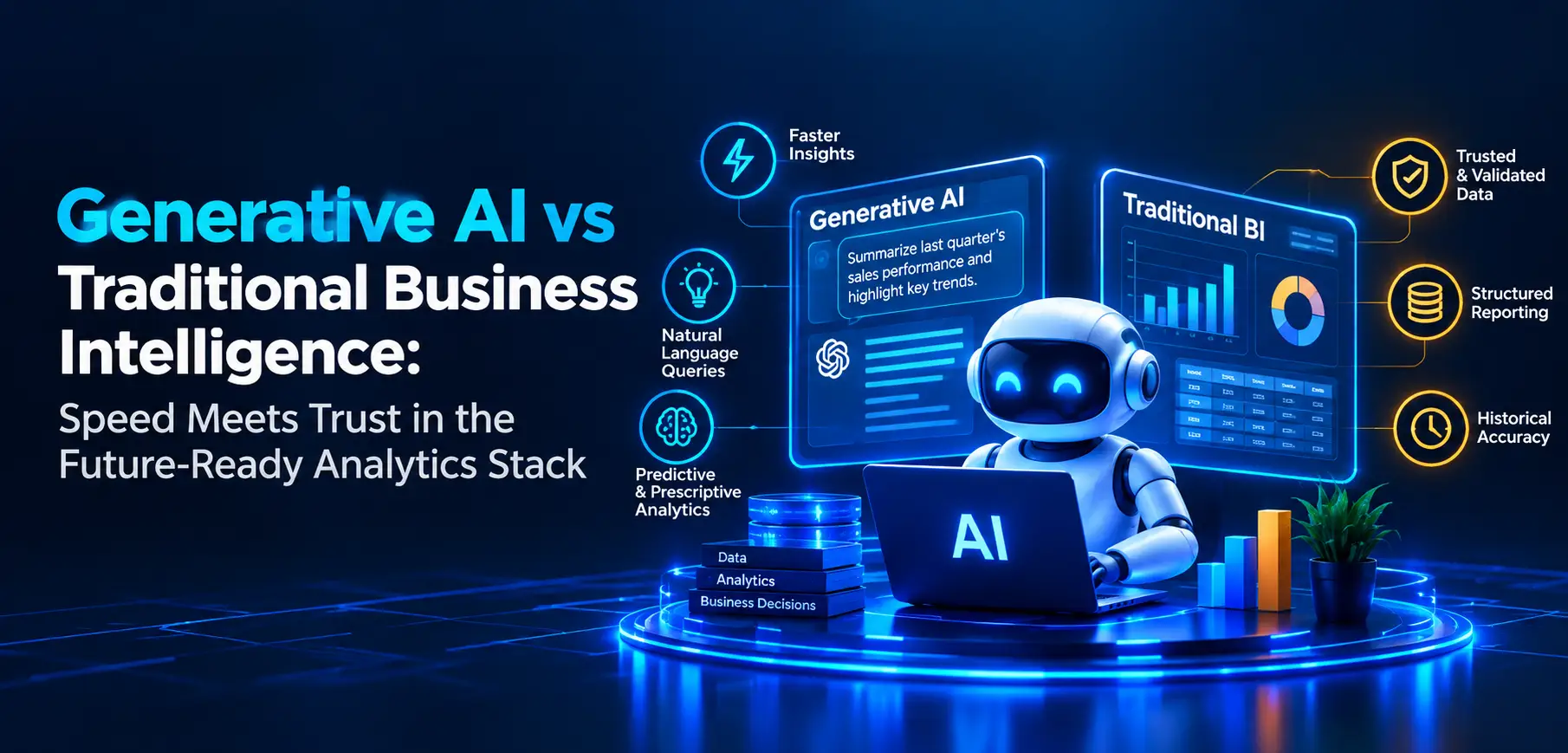
Generative AI vs traditional business intelligence compares AI that writes answers from data on demand with BI that reports governed history through dashboards. Traditional BI is primarily used to show what happened. Generative AI makes it easier to explore why changes occurred and which actions are worth considering.
According to Gartner, 75% of new analytics content will be contextualized using generative AI by 2027. For leaders, the question is no longer which approach to pick. The real question is how to combine both through AI-powered data analytics without losing trust in the numbers.
What Is Generative AI vs Traditional Business Intelligence?
Traditional business intelligence (BI) collects, models, and visualizes structured business data. Dashboards, scheduled reports, and SQL queries show what happened, with metrics defined in advance so results stay consistent and auditable.
Generative AI uses large language models (LLMs) to produce new content from patterns in data. In analytics, that content includes written insights, generated SQL, chart suggestions, and answers to plain-language questions.
In this article, “traditional BI” means the conventional governed model of dashboards and predefined reports. Platforms such as Microsoft Power BI, Tableau, and Looker now add natural-language querying and AI-assisted insights. That is exactly where the two approaches converge.
How each approach works
Conventional BI moves data through a fixed pipeline: extract, transform, load into a warehouse, then visualize in a dashboard. Data teams define and govern shared metrics, so users work from consistent business definitions.
Generative AI rewires that flow. A user asks, “Why did margin drop in the western region last quarter?” and receives a written explanation, a supporting chart, and suggested actions. Production systems rely on four components
- A language model that interprets questions and drafts responses
- Retrieval-augmented generation (RAG) that retrieves relevant company information and supplies it as context for the model, helping ground answers in available business data
- A semantic layer that defines metrics once, so “revenue” means one thing everywhere
- Guardrails that validate outputs and enforce access permissions
Side-by-Side Comparison: Where Each Approach Wins
Dimension | Traditional Business Intelligence | Generative AI |
Core purpose | Primarily reports what happened | Helps explore why and suggests possible next steps |
Data handled | Structured, modeled data | Structured data plus documents, emails, and text |
User interface | Dashboards, filters, and scheduled reports | Conversational questions in plain language |
Consistency | Deterministic: same input, same result | Probabilistic: wording and results can vary |
Governance | Mature, rule-based, and auditable | Requires guardrails, a semantic layer, and review |
Best fit | Financial reporting, compliance, and operational KPIs | Exploration, root-cause analysis, and executive summaries |
These approaches answer different questions, so they work as complements, not substitutes. Generative AI also depends on the governed data foundation that BI teams already maintain.
Are You Ready for Analytics That Talks Back?
Adoption is already moving fast. According to McKinsey & Company, 65% of respondents in its 2024 Global Survey on AI said their organizations regularly use generative AI in at least one business function. Gartner reports that over 50% of the 403 analytics and AI leaders it surveyed already use AI tools for natural-language queries and automated insights.
As AI adoption expands, businesses also need stronger controls around how AI systems access data and applications. Identity and access management for AI agents can help organizations manage permissions, authentication, and access across increasingly autonomous AI workflows.
Speed brings a new risk profile. A SQL query returns the same total every time, but a language model can state an unsupported conclusion with confidence. The same McKinsey survey asked respondents whose organizations had adopted generative AI about inaccuracy, and nearly one-quarter reported negative consequences from it. This makes AI governance an important part of managing AI risks, establishing oversight, and monitoring AI outputs.
Gartner also flags “agent drift,” where autonomous AI agents deviate from intended outcomes. Four controls keep generative AI accountable:
- Ground every answer in retrieved company data.
- Route metric calculations through a governed semantic layer.
- Require human review for financial, legal, and regulatory outputs.
- Apply role-based access so the model never exposes restricted data.
Costs shift as well. Generative AI can lower the cost of asking questions, but it raises the cost of deploying trustworthy answers, with per-query compute charges that grow alongside adoption. Analysts don’t disappear in this model. They move up to curating the semantic layer and validating AI outputs.
When to Use Traditional BI, Generative AI, or Both
Traditional BI is usually best suited to questions with stable definitions and audit requirements. Generative AI is often better suited to open-ended or exploratory questions, especially urgent ones too varied for a prebuilt dashboard. As AI agents become more integrated into business operations, they can also help teams act on these insights and automate parts of the decision-making process.
Use traditional BI for audited, repeatable numbers
- Board-level financial reporting and audited KPIs
- Regulatory and compliance dashboards
- Shared metrics that must match across every department
Use generative AI for speed and explanation
- Fast answers to one-off questions without analyst queue time
- Automated narrative summaries of weekly performance
- Root-cause analysis across data sources and documents
Use both for a hybrid analytics stack
- A conversational layer on top of governed dashboards
- Executive briefings generated from trusted KPIs
- Anomaly alerts with written explanations and suggested actions
In its Predicts 2026 research on analytics, Gartner forecasts that 60% of self-service analytics users will use general-purpose LLMs for ad hoc and exploratory analysis by 2028. Production-grade reporting, it expects, will remain on traditional platforms. Build a hybrid stack in stages. Fix the data foundation, define metrics in a semantic layer, then pilot one grounded use case with a human reviewer before you scale.
How Hotbit Infosoft Can Help
Hotbit Infosoft designs future-ready analytics stacks that pair governed BI with grounded generative AI. Our AI Automation practice helps teams build analytics workflows designed to improve speed while maintaining governance and data quality. Ready to lead the next era of analytics? Talk to an Expert and let’s make it happen.
Generative AI in Business Intelligence: Frequently Asked Questions
1. What is the difference between generative AI and traditional business intelligence?
Traditional BI uses governed data, dashboards, reports, and predefined metrics to deliver consistent insights. Generative AI adds conversational analysis, automated narratives, SQL generation, and exploratory capabilities, making it easier for users to ask questions and investigate business trends.
2. Can generative AI replace traditional business intelligence?
Generative AI is unlikely to completely replace traditional BI. BI remains important for governed, repeatable, and auditable reporting, while generative AI can provide a conversational layer for exploration, explanations, and faster decision support.
3. How does generative AI improve business intelligence?
Generative AI can make BI more accessible by allowing users to ask questions in natural language, generate summaries, explore potential causes of changes, and interact with business data without relying entirely on predefined dashboards or analyst support.
4. Is generative AI reliable for business analytics?
Generative AI can be useful for business analytics when it is connected to trusted data and supported by controls such as semantic layers, retrieval-augmented generation (RAG), access permissions, validation, and human review. Without these safeguards, AI-generated answers may contain inaccurate or unsupported conclusions.
5. Should businesses use generative AI, traditional BI, or both?
For most organizations, a hybrid approach can provide the strongest balance. Traditional BI can handle governed KPIs, financial reporting, and compliance requirements, while generative AI can support conversational analysis, summaries, exploratory questions, and faster insight discovery.
Disclaimer
The information in this article is for general informational purposes only. AI and business intelligence capabilities, platforms, and best practices continue to evolve, so specific technologies and implementation requirements may change over time. Businesses should evaluate their data, security, governance, and compliance requirements before implementing AI-powered analytics.