
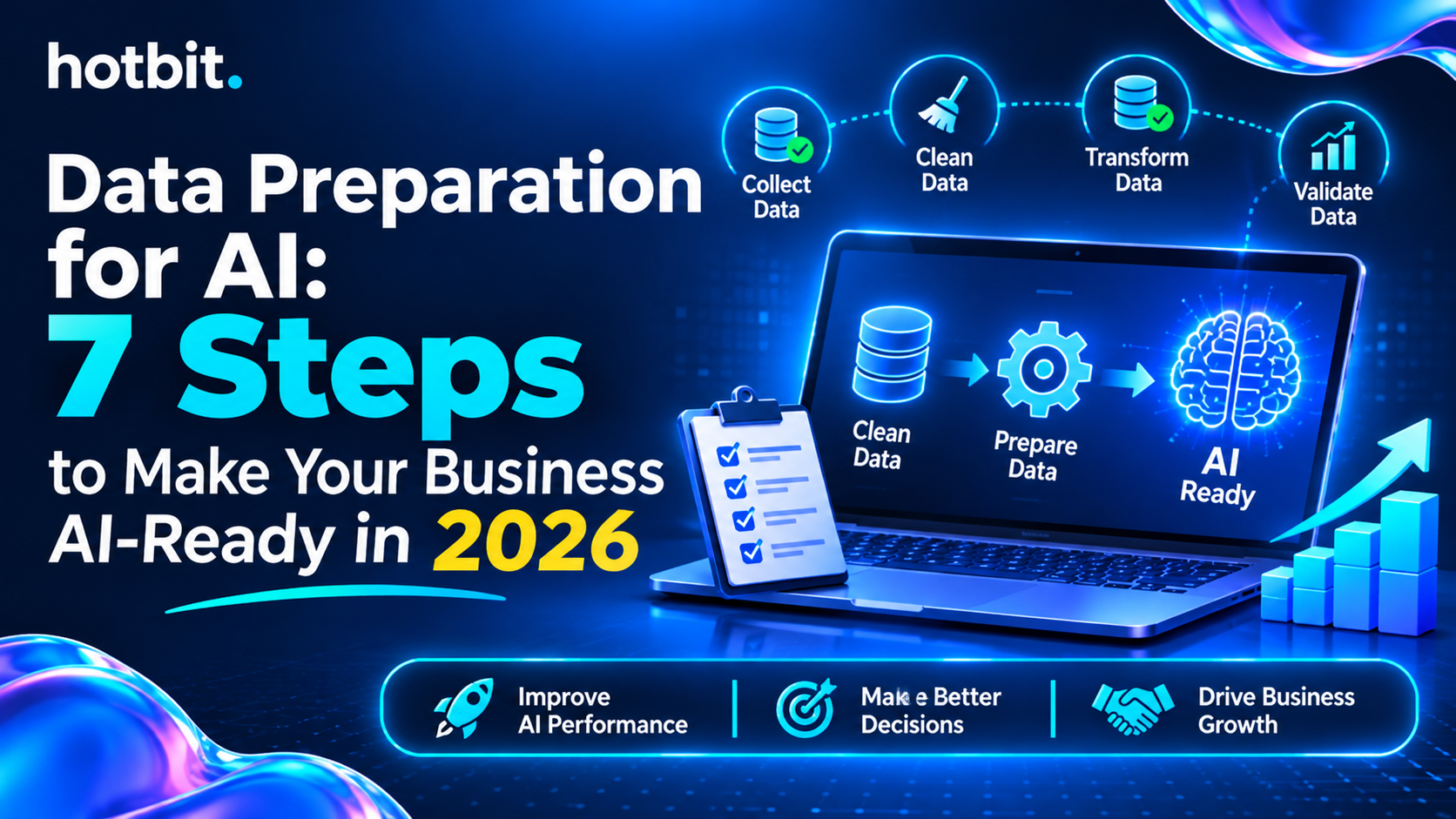
Data preparation for AI is the process of collecting, cleaning, structuring, labeling, and governing business data so that machine learning models and AI applications can learn from it accurately and safely. It is one of the most important factors separating AI projects that reach production from those that stall. Businesses prepare their data for AI by auditing what they have, fixing quality gaps, unifying sources, labeling key records, securing access, and building pipelines that keep data fresh.
According to a February 2025 prediction from Gartner, the global research and advisory firm, organizations will abandon 60% of AI projects through 2026 if those projects are not supported by AI-ready data. Data quality is often a major contributor to AI project failures.
This guide from Hotbit Infosoft, a digital-first technology company specializing in AI Automation, Product Engineering, Business Transformation, Cloud, Team-as-a-Service, and iGaming & Fantasy solutions, explains what data preparation involves, the seven steps to follow, how to choose between approaches, and where teams most often go wrong. Whether you are a founder, CTO, or operations lead, you will leave with a practical plan you can start this quarter.
Effective data preparation is essential for accurate reporting and better business decisions. By using AI-powered data analytics and business intelligence, businesses can transform raw data into meaningful insights, identify trends, improve operational efficiency, and make smarter strategic decisions.
What Is Data Preparation for AI?
Data preparation for AI is the end-to-end work of turning raw, scattered business data into consistent, labeled, and governed datasets that AI models can use. It includes data discovery, cleaning, transformation, integration, labeling, and quality monitoring. The goal is simple: give a model accurate, representative, and legally usable examples, so its outputs can be trusted in real business decisions.
Traditional analytics tolerates some messiness because a human reviews every chart. AI does not. A machine learning model learns patterns directly from the data it receives, so duplicate records, missing values, biased samples, and outdated entries become built-in errors in every prediction. Data quality therefore places an important constraint on model performance, however advanced the algorithm is.
The discipline covers structured data (CRM records, transactions, inventory tables), semi-structured data (JSON logs, API outputs), and unstructured data (emails, PDFs, call recordings, images). Generative AI and retrieval-augmented generation (RAG) systems add a further requirement: unstructured content must be chunked, tagged, and indexed so a model can retrieve the right passage on demand.
Why Data Preparation for AI Matters
Data preparation matters because data quality strongly influences model quality. In many cases, a well-prepared dataset lets a simple model outperform a sophisticated one trained on noisy inputs. Poor preparation causes inaccurate predictions, biased outcomes, compliance exposure, and wasted engineering budgets. Along with maintaining data quality, organizations should also focus on data security and learn how to prevent AI-driven phishing attacks to protect sensitive information from evolving cyber threats.
According to Gartner’s 2020 research, poor data quality costs organizations at least $12.9 million annually on average. AI can magnify the effect of such problems, because models learn directly from the data they receive.
According to Gartner’s July 2024 survey of 1,203 data management leaders, 63% of organizations either do not have, or are unsure whether they have, the right data management practices for AI. This gap can help explain why some pilots succeed in a demo but struggle in production, where real data replaces a hand-curated sample.
The business case runs in both directions. Teams that invest early in preparation often ship faster, spend less on retraining, and can reuse the same governed datasets across multiple use cases, from AI Automation workflows to customer-facing assistants.
What Does AI-Ready Data Look Like?
AI-ready data is data that is accurate, complete, consistent, accessible, timely, and governed for the specific AI use case it supports. Data is not “AI-ready” in the abstract. A dataset that works for demand forecasting may be unusable for a customer-support chatbot.
Use these six attributes as a checklist for every dataset:
- Accuracy: Values match real-world facts, such as correct prices, dates, and customer identifiers.
- Completeness: Required fields are populated, and gaps are documented rather than hidden.
- Consistency: The same entity uses the same format across systems (for example, one customer ID scheme).
- Timeliness: Data is refreshed at the frequency the model needs, whether hourly or monthly.
- Representativeness: The data covers the full range of cases the model will meet, including rare ones.
- Governance: Ownership, access rules, lineage, and consent status are recorded.
A dataset that scores well on all six is likely ready to train, fine-tune, or feed a retrieval system. Material data quality gaps should be assessed and addressed before deployment, because defects found in production are usually more costly to repair.
The 7 Steps to Prepare Your Data for AI
The seven steps of data preparation for AI are: define the use case, audit data sources, clean the data, integrate and structure it, label and enrich it, secure and govern it, and automate pipelines with monitoring. Following them in order prevents the most common failure: building a model before knowing whether the data can support it.
Automating data pipelines with continuous monitoring helps ensure that AI systems receive accurate, up-to-date information. Proper data preparation also creates a strong foundation for implementing AI agents in the workplace, enabling businesses to streamline workflows and improve operational efficiency.
Recalibrate now: define your KPIs once, move time-sensitive data to streaming, and pilot one agentic use case before the market sets the pace. Adoption varies by data maturity, so start where the payoff is clearest.
1. Define the Business Use Case and Success Metric
Start with the decision or workflow the AI will improve, such as reducing invoice-processing time or predicting churn. Write one measurable success metric, like a 30% cut in manual review hours. For example, a retail business planning an AI demand forecasting system might prepare historical sales, seasonal trends, inventory records, and supplier data. The use case decides which data you need, how clean it must be, and how much history is enough. Without it, teams collect everything and prepare nothing well.
1. Define the Business Use Case and Success Metric
Start with the decision or workflow the AI will improve, such as reducing invoice-processing time or predicting churn. Write one measurable success metric, like a 30% cut in manual review hours. For example, a retail business planning an AI demand forecasting system might prepare historical sales, seasonal trends, inventory records, and supplier data. The use case decides which data you need, how clean it must be, and how much history is enough. Without it, teams collect everything and prepare nothing well.
2. Audit and Catalog Your Data Sources
A data audit inventories every system that holds relevant data: CRM, ERP, support desk, product database, spreadsheets, and third-party feeds. For each source, record the owner, format, volume, update frequency, and known quality issues. A data catalog makes this inventory searchable. Most businesses discover duplicate systems and undocumented spreadsheets at this stage, which is exactly why the audit comes first.
3. Clean and Validate the Data
Data cleaning removes duplicates, corrects errors, standardizes formats, and handles missing values. Apply validation rules, such as valid date ranges, allowed category values, and required fields. Decide explicitly how to treat outliers and missing values, because the wrong choice can distort a model. Depending on the use case, missing values can be imputed, kept with a missing-value indicator, or excluded. Document every cleaning rule so results are reproducible and auditable.
4. Integrate and Structure the Data
Integration combines data from separate systems into a unified model, using consistent identifiers and schemas. Not every AI project needs every source combined into one central dataset, so integrate only what the use case requires. Resolve entities, so “Acme Ltd” and “ACME Limited” map to one customer. For unstructured content, extract text, split documents into logical chunks, and attach metadata such as source, date, and department. Modern cloud data platforms make this step scalable by separating storage from compute.
5. Label and Enrich the Data
Labeling is essential for supervised learning, though not every AI approach needs it in the same way. Where labels are used, they must be accurate and consistent. Write clear labeling guidelines, use multiple reviewers for ambiguous cases, and measure agreement between them. Enrichment adds context a model cannot infer alone, such as product categories, geography, or customer segments. For generative AI, enrichment means tagging documents so retrieval returns the correct source.
6. Secure, Govern, and Protect the Data
Governance defines who can access data, how it is used, and how long it is kept. Collect only the data the use case requires (data minimization), and confirm consent and purpose limitations where they apply. Mask or remove personally identifiable information, apply role-based access, and record data lineage from source to model. The National Institute of Standards and Technology (NIST), the U.S. standards agency, publishes its AI Risk Management Framework, which treats data quality, privacy, and bias as core risk areas. In India, businesses should also review the Digital Personal Data Protection Act, 2023 and the DPDP Rules, 2025, which were notified in November 2025 and have phased implementation timelines. Privacy laws in other markets, such as Singapore and Saudi Arabia, may add further obligations that legal teams should confirm.
7. Automate Pipelines and Monitor Quality
One-time cleanup can decay quickly as source systems change. Build automated pipelines that ingest, validate, and transform new data continuously, and monitor for data drift, schema changes, and quality regressions. Set alerts when a metric crosses a threshold. Treat data quality, data drift, and schema changes as separate checks, because each fails in a different way. This step turns data preparation from a project into a standing capability, and it is where Product Engineering discipline pays off.
Data Preparation for AI: Manual vs. Automated vs. Managed Approaches
Businesses can prepare data manually, with automated tooling, or through a managed engineering partner. Manual preparation suits small, one-off datasets. Automated tooling suits recurring pipelines handled by an in-house team. A managed partner suits organizations that need production-grade results without building a specialist team first. Learn how to prepare business infrastructure for AI to build a stronger foundation for efficient data management and AI implementation.
The table below compares the three approaches across the factors that most affect cost and speed.
Factor | Manual Preparation | Automated Tooling (In-House) | Managed Partner (e.g., Hotbit Infosoft) |
Best for | One-off pilots, small datasets | Recurring pipelines, mature data teams | Production AI, limited internal expertise |
Speed to first result | Fast for small data, slow at scale | Moderate; setup time required | Often fast when proven frameworks exist |
Scalability | Low | High | High |
Consistency | Varies by person | High once configured | High; documented standards |
Required skills | Analysts, spreadsheets | Data engineers, MLOps | Provided by the partner |
Governance support | Ad hoc | Built by your team | Depends on partner scope and contract |
Typical risk | Human error, no audit trail | Tool sprawl, skill gaps | Vendor fit, handover planning |
Table 1: Comparison of three data preparation approaches for AI projects.
Most mid-sized businesses blend the approaches. They automate the repeatable cleaning and validation, keep humans in the loop for labeling and edge cases, and bring in specialists for architecture and governance.
Common Data Quality Problems That Break AI Projects
The most common data problems that break AI projects are duplicate records, missing values, inconsistent formats, siloed systems, biased samples, and stale data. Each one produces a predictable failure, and each has a standard fix.
- Duplicates: Inflate certain patterns and skew predictions. Fix with entity resolution and unique identifiers.
- Missing values: Cause models to guess or fail. Fix with documented imputation rules or by excluding unreliable fields.
- Inconsistent formats: Split one entity into many (dates, currencies, units). Fix with enforced schemas at ingestion.
- Data silos: Hide the full customer or process picture. Fix with integration layers and shared definitions.
- Biased samples: Produce unfair or inaccurate outputs for underrepresented groups. Fix by auditing coverage and rebalancing.
- Stale data: Trains models on a business that no longer exists. Fix with scheduled refresh and drift monitoring.
Bias deserves special attention. A model trained on historical hiring, lending, or pricing data inherits the decisions embedded in it. Test datasets for representativeness before training, and document known limitations for reviewers.
How to Prepare Unstructured Data for Generative AI
Preparing unstructured data for generative AI means extracting clean text, splitting it into meaningful chunks, tagging each chunk with metadata, and indexing it for retrieval. This process lets a language model answer questions from your documents instead of guessing.
Follow these five steps:
- Collect and convert documents, emails, and transcripts into machine-readable text, using OCR for scanned files.
- Remove noise, including headers, footers, duplicate versions, and outdated policies.
- Chunk content by logical section, keeping each chunk self-contained so it makes sense on retrieval.
- Tag each chunk with source, owner, date, access level, and topic.
- Index chunks using a suitable retrieval system, such as a vector database or a hybrid search platform, and test retrieval with real employee and customer questions.
Access control is critical here. A retrieval system must respect the same permissions as the original document, or it can expose confidential content to the wrong user.
Who Should Own Data Preparation Inside Your Business?
Data preparation should be owned jointly by a named business owner and a technical data owner. The business owner defines what “correct” means for each dataset, while the technical owner builds and maintains the pipelines. Without both, quality rules drift and accountability disappears.
A workable ownership model has three layers:
- Executive sponsor (founder, CEO, or CTO): funds the work and resolves cross-team conflicts.
- Domain data owners (operations, finance, product leads): define rules, approve definitions, and fix source-system errors.
- Data engineering team: builds ingestion, cleaning, and monitoring pipelines.
Data preparation should be owned jointly by a named business owner and a technical data owner. The business owner defines what “correct” means for each dataset, while the technical owner builds and maintains the pipelines. Without both, quality rules drift and accountability disappears.
If you lack in-house data engineers, Team-as-a-Service can help you add pre-vetted specialists to your project without a long hiring cycle, depending on the roles available and the engagement scope. This can be faster than recruiting for hard-to-fill roles.
How Long Does Data Preparation for AI Take?
Data preparation often takes a large share of an AI project’s timeline, sometimes longer than model development itself. As a rough planning estimate, a focused use case with two or three relatively clean data sources may take four to eight weeks. Larger enterprise projects involving legacy systems, complex integrations, or extensive labeling can take several months, often delivered in phases. Before starting development, businesses should also validate their project idea before development to understand user needs, assess market demand, and avoid investing resources in an untested concept.
Three factors drive duration: the number of source systems, the current level of data quality, and the volume of labeling required. Starting with one high-value use case, instead of an organization-wide cleanup, shortens time to value and builds internal confidence. Each completed dataset then becomes reusable for the next project, which lowers cost and time for every later initiative.
This incremental model aligns with broader Business Transformation programs, where data readiness is built alongside process redesign rather than as a separate, one-time effort.
Measuring Whether Your Data Is Ready
You can measure AI data readiness with a small set of quantitative checks: completeness rate, duplicate rate, validation pass rate, freshness lag, and label agreement. Set a target for each before development starts, and track them on a shared dashboard.
These thresholds are illustrative benchmarks, not universal standards. Common starting points include completeness above 95% for required fields, a duplicate rate below 1%, and inter-annotator agreement above 90% for labeled data, measured with a method such as Cohen’s kappa or Krippendorff’s alpha. Actual targets should depend on the use case, dataset characteristics, risk level, and evaluation method. A medical or financial use case needs stricter targets than an internal summarization tool.
Treat readiness as a gate. If a dataset misses its thresholds, the project pauses for remediation instead of proceeding on hope. A formal gate helps catch data problems before they reach production, where they are usually more costly to fix.
How Hotbit Infosoft Helps Businesses Prepare Data for AI
Hotbit Infosoft, a digital-first technology company specializing in AI Automation, Product Engineering, Business Transformation, Cloud, Team-as-a-Service, and iGaming & Fantasy solutions, helps businesses move from scattered data to production-ready AI. With 15+ years of experience, 100+ delivered success stories, and clients across 10+ countries, Hotbit combines data engineering with delivery discipline. Businesses looking to explore tailored technology solutions can contact Hotbit Infosoft to discuss their project requirements and business goals.
Engagements can cover a data audit, a prioritized use-case roadmap, pipeline and integration engineering, governance design, and monitoring. Hotbit’s AI Automation team builds the workflows that consume the prepared data, while its Cloud specialists design the storage and compute foundation. Explore the full range of capabilities on the What We Do page
Conclusion: Treat Data Readiness as an AI Strategy
Data preparation for AI strongly influences whether an AI investment delivers measurable results or stalls in the pilot phase. Businesses that build a governed, reusable data foundation can launch later AI initiatives faster and with less risk.
Hotbit Infosoft’s AI Automation and data engineering teams help organizations turn that foundation into working products. Talk to an Expert to request a data readiness assessment and map your first AI use case, and let’s make it happen.
Frequently Asked Questions About Data Preparation for AI
What is data preparation for AI?
Data preparation for AI is the process of collecting, cleaning, organizing, labeling, and managing data so AI models can use it effectively. It includes correcting errors, removing duplicates, combining data from different sources, and protecting sensitive information. Well-prepared data helps improve AI accuracy, reliability, and performance.
How do you prepare data for AI?
You can prepare data for AI in seven steps: define the use case, audit data sources, clean the data, integrate and structure it, label and enrich it, apply security and governance, and automate pipelines with ongoing monitoring. Start with one specific business use case and improve the process as your AI requirements grow.
Why is data preparation important for AI?
Data preparation is important because the quality and relevance of data can directly affect AI results. Gartner predicted in February 2025 that organizations would abandon 60% of AI projects unsupported by AI-ready data through 2026. Proper preparation helps reduce data errors, improve consistency, address potential bias, and support more reliable AI applications.
How much time does data preparation take in an AI project?
Data preparation can take several weeks or months, depending on the project. As a rough planning estimate, a focused use case with a few accessible data sources may take four to eight weeks. Larger projects involving multiple legacy systems, complex data cleaning, or extensive labeling may take several months. The actual timeline depends on data quality, project scope, and technical requirements.
What tools are used for data preparation for AI?
Common data preparation tools include cloud data warehouses, ETL and ELT platforms, data catalogs, data quality frameworks, and data labeling tools. Teams may also use Python libraries such as pandas and orchestration tools to automate workflows. For generative AI applications using retrieval-augmented generation (RAG), vector databases or hybrid search systems may also be useful. The right tools depend on your data, use case, technical skills, and budget.
Disclaimer
This article is intended for informational and educational purposes only. The information, statistics, tools, timelines, and recommendations discussed are general guidance and may vary depending on business requirements, data quality, technology, and project scope. Data protection requirements differ across jurisdictions, so businesses should consult qualified legal and technical professionals before implementing AI data practices. References to third-party research and frameworks belong to their respective owners. Mention of Hotbit Infosoft’s services is for informational purposes and does not guarantee specific project outcomes.