
Gartner, the global research and advisory firm, expects enterprise spending on AI governance platforms to reach $492 million in 2026. It projects that spending will cross the billion-dollar mark by 2030.
As businesses move toward more autonomous AI systems, understanding how these systems are designed and governed becomes increasingly important. Agentic workflow engineering provides a framework for building AI-powered workflows that can plan, act, and coordinate across business systems while maintaining defined permissions and human oversight.
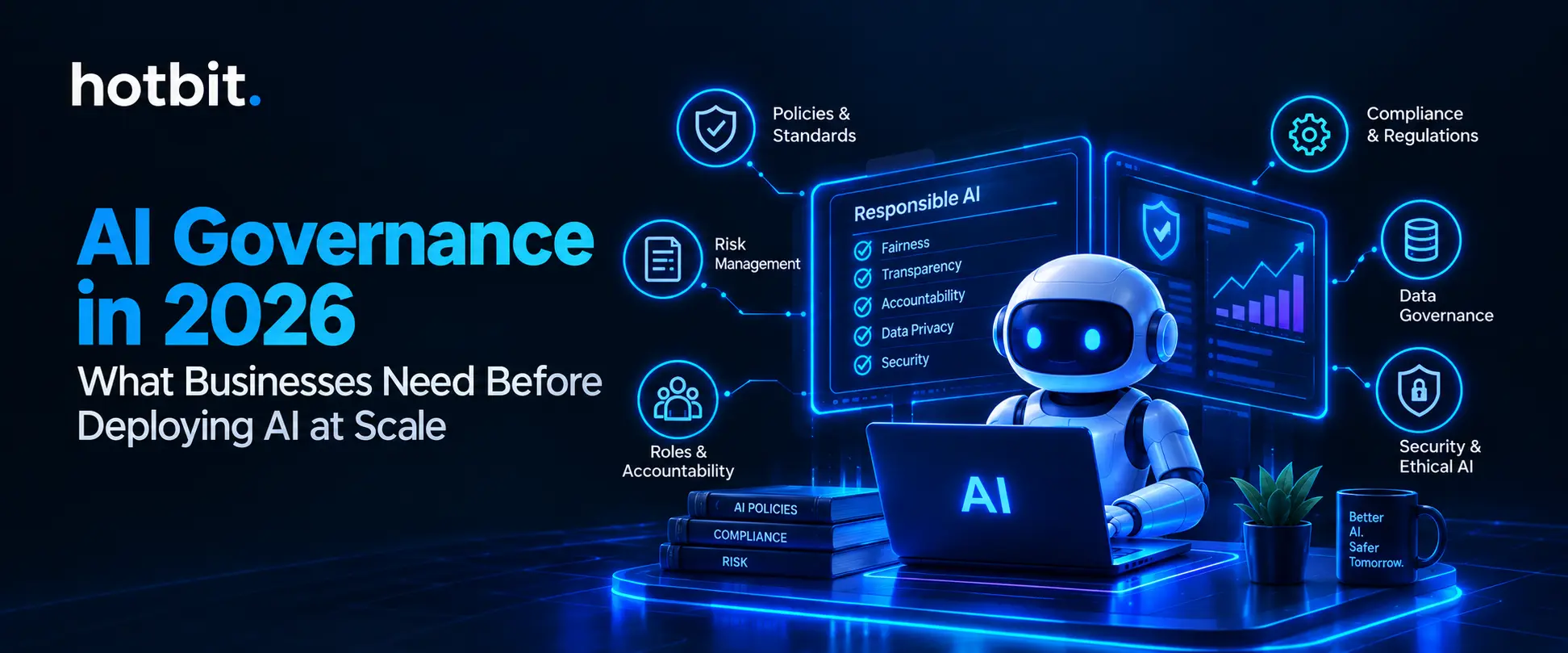
AI governance is the system of policies, roles, processes, and technical controls that decides how an organization builds, buys, deploys, and monitors artificial intelligence. Its job is to keep AI safe, compliant, and accountable.
If you’re planning an enterprise-wide rollout, understanding AI agents, RPA, and workflow automation is an important step before establishing the AI governance layer that determines whether AI scales or stalls.
This guide covers what AI governance means in 2026 and how the regulatory picture shifted this year. It also walks through seven components of a practical framework and a step-by-step plan to put them in place before you scale.
It comes from Hotbit Infosoft, a digital-first technology company with 15+ years of delivery experience across 200+ global brands. Hotbit specializes in AI Automation, Product Engineering, Business Transformation, Cloud, Team-as-a-Service, and iGaming & Fantasy solutions.
What Is AI Governance?
AI governance is the framework of policies, accountability structures, risk controls, and monitoring practices that guides how an organization uses artificial intelligence. It covers the full lifecycle, from choosing a use case and sourcing data to deploying a model and retiring it.
As AI agents increasingly interact with business systems, organizations should also consider how MCP connects AI agents to CRM, ERP, databases, and SaaS tools as part of their governance and access-control strategy.
An AI governance program answers four practical questions: who owns each AI system, what risks it carries, which rules it must follow, and how its behavior gets checked after launch. If you can’t answer all four for every system you run, you have gaps.
Effective AI governance combines three things.
People means an accountable owner and a cross-functional review group. Process means risk classification, approval gates, and incident response. Technology means model inventories, access controls, audit logs, and output monitoring.
One widely used reference framework is the NIST AI Risk Management Framework, published by the U.S. National Institute of Standards and Technology. Another is ISO/IEC 42001, the international standard for AI management systems.
As AI adoption continues to evolve, businesses should also stay informed about the latest AI trends and developments to understand how emerging technologies may affect their operations and risk-management strategies.
The goal isn’t to slow AI down. It’s to make scaling AI repeatable and defensible, which mature AI automation [LINK: AI Automation] programs depend on.
How much structure you need depends on how many AI systems you run and how much risk they carry.
Why AI Governance Matters More in 2026
Three pressures arrived at once in 2026: binding regulation, the shift to autonomous AI agents, and board-level demand for proof that AI is under control. As organizations scale AI workloads, cloud computing infrastructure can provide the foundation needed to support these systems while managing data, security, and scalability.
AI regulation introduced concrete compliance timelines.
EU lawmakers amended the EU AI Act, the European Union’s AI law, this year rather than pausing it. The Digital Omnibus on AI was published in the Official Journal on July 24, 2026, and entered into force on July 27, 2026.
It extended the application timeline for certain high-risk AI systems. Rules for high-risk systems listed in Annex III apply from December 2, 2027. Rules for high-risk AI embedded in regulated products covered by Annex I apply from August 2, 2028.
The timeline extension did not cover every AI Act obligation. Article 50 transparency obligations apply from August 2, 2026. They cover certain AI interactions and AI-generated or manipulated content.
A limited grace period runs to December 2, 2026. It applies only to the marking and detection obligations for systems placed on the market before August 2, 2026.
If your product includes a customer-facing chatbot or generates synthetic content, check which of these duties apply to you.
India also introduced national guidance. The Ministry of Electronics and Information Technology (MeitY), India’s national technology ministry, unveiled the India AI Governance Guidelines in November 2025.
The guidelines rest on seven core principles. They emphasize using existing legislation wherever possible and give sectoral regulators an important role. For businesses operating in India, existing sector rules remain an important reference point.
Globally, Gartner projects that by 2030, AI regulations will quadruple and affect 75% of the world’s economies.
Adoption outpaced scale. In its 2025 State of AI research, McKinsey & Company, the global management consultancy, found that 88% of organizations regularly use AI in at least one business function. Yet nearly two-thirds have not begun scaling it across the enterprise.
Senior ownership of AI governance is also far from universal. In the same 2025 research, 28% of AI-using organizations reported that their CEO oversees AI governance, while 17% said their board does. As organizations expand their use of AI, understanding how AI agents are changing business operations can help leaders think more clearly about governance, oversight, and responsible implementation.
Caption: Key EU AI Act compliance dates after the 2026 Digital Omnibus amendment.
AI Governance vs. AI Ethics vs. Data Governance
AI ethics sets values, data governance controls information, and AI governance enforces how AI systems behave in practice. The three overlap.
AI governance brings together the evidence regulators and auditors may need to assess how AI systems are approved, owned, and monitored. AI-powered data analytics can also help organizations turn operational data into actionable business insights, making it easier to monitor performance, identify trends, and support informed decision-making.
Picture an auditor asking who approved your credit-scoring model. An ethics charter won’t answer that question, but an approval record with a named owner will.
Caption: How AI governance differs from AI ethics and data governance.
The Seven Core Components of an AI Governance Framework
You can organize a practical AI governance framework around seven components: an AI inventory, risk classification, named ownership, data and model controls, human oversight rules, continuous monitoring, and incident response.
Missing any one of these components creates a blind spot. You usually find it only after an incident.
1. AI system inventory
An AI inventory is a living register of every model, AI feature, and third-party AI tool in use. It includes “shadow AI” that employees adopt without approval.
A sales rep pasting customer notes into a free chatbot is a common example. You can’t govern what you can’t see.
2. Risk classification
You can assign each AI system an internal risk tier, such as low, limited, or high. Base the tier on the system’s impact on people, money, and legal exposure.
A marketing copy assistant and a credit-scoring model should never pass through the same approval path.
If you operate in the EU, map those internal tiers against the EU AI Act’s applicable risk categories.
3. Named ownership and accountability
Each AI system needs one accountable owner. A cross-functional committee from legal, security, data, and business teams backs that owner up.
McKinsey, citing the 2025 NACD Private Company Board Practices Oversight Survey, reports that fewer than 25% of companies have board-approved, structured AI policies. That gap is a good reason to make ownership explicit.
Write a person’s name into each inventory entry, not just a team name.
4. Data and model controls
Data and model controls cover training data provenance, access permissions, version control, and vendor terms. Secure cloud [LINK: Cloud] infrastructure and data platforms can help you put these controls into practice.
Vendor terms deserve extra attention. Check whether a provider can use your prompts or data to train its own models.
5. Human oversight rules
For high-risk AI systems, human oversight rules should define when a qualified person must review, approve, override, or intervene in an AI-supported decision. Hiring and lending tools are common examples.
The exact controls depend on the system and the requirements that apply to it. Spell out who the reviewer is and what they check, so review doesn’t turn into a rubber stamp.
6. Continuous monitoring and audit trails
Models can drift, and changes in prompts or surrounding workflows can affect system behavior.
Monitoring tracks accuracy, bias, cost, and security events. Audit logs record who approved what and when.
If you’re building AI into software products, design this telemetry in from day one through disciplined product engineering [LINK: Product Engineering] practices.
7. Incident response and escalation
An AI incident plan defines what counts as an incident and who gets alerted. It also sets how fast issues reach leadership and how your team pauses or rolls back a system.
Consider a support chatbot that starts quoting the wrong refund policy. Someone needs clear authority to switch it off right away.
How to Build an AI Governance Program Before Scaling AI
Building an AI governance program takes six steps. Complete them before a pilot becomes a company-wide rollout.
- Map every AI system, including vendor tools and employee-adopted apps, into one inventory.
- Classify each system by risk tier and map it against the EU AI Act, India’s MeitY guidelines, or other rules in your markets.
- Assign an executive sponsor and one owner per system, supported by a cross-functional AI committee.
- Adopt a reference framework, such as the NIST AI Risk Management Framework or ISO/IEC 42001, instead of writing policy from scratch.
- Embed controls into delivery pipelines, so approval gates, logging, and testing run automatically inside your AI workflow automation [LINK: AI Automation] stack.
- Monitor, report, and review on a schedule suited to each system’s risk and impact, with AI metrics reaching leadership regularly.
The order matters. A risk tier means little if the system isn’t in your inventory yet.
Organizations without enough in-house specialists for steps four and five may need outside support. Hotbit Infosoft helps close that gap by pairing governance-aware engineering with AI talent through Team-as-a-Service (TaaS)
Hotbit also redesigns the operating model through Business Transformation [LINK: Business Transformation] programs. You can explore the full range of Hotbit’s technology services [LINK: confirm destination] to see how these pieces connect.
Tiered AI Governance for AI Agents
AI agents need tiered governance, because an agent’s risk depends on both what it can do and what systems it can reach.
Gartner warns that applying uniform governance to all AI agents, regardless of autonomy level and scope, can lead to enterprise AI agent failure. Gartner predicts that by 2027, 40% of enterprises will demote or decommission autonomous agents because of governance gaps discovered only after production incidents.
A practical approach is to govern agents according to their autonomy, permissions, and potential impact. Read-only agents may require less operational control than agents that can change records or execute transactions, depending on the data and decisions involved.
Agents that send payments, change records, or contact customers need scoped permissions, runtime limits, and human checkpoints. An agent that drafts refund emails for approval belongs in a lower tier than one that issues the refunds itself. Learn more about the team and expertise behind these technology solutions through Hotbit Infosoft.
Before you give any agent write access, decide which tier it belongs in. Its permissions matter more than its label.
Gartner also projects that by 2030, 50% of AI agent deployment failures will stem from insufficient runtime enforcement in AI governance platforms. For agents with consequential actions, governance controls should also operate at execution time, not only in policy documents.
For a deeper look, read our guide to scaling agentic AI in the enterprise [LINK: Agentic AI guide].
Conclusion: Govern First, Then Scale
AI governance gives you a repeatable way to move AI from pilot to production.
In 2026, regulators set firm dates, AI agents raised the stakes, and senior ownership of AI governance remains uneven. If you plan to scale AI, establish your inventory, risk tiers, ownership, and monitoring processes before broad rollout. Businesses looking to scale AI responsibly can also explore AI and technology solutions that support broader digital transformation and implementation needs.
Hotbit Infosoft brings 100+ delivered success stories and 12+ industries of experience to building governed AI. That work ranges from automated compliance checks inside AI workflows to cloud architectures with structured logging and monitoring.
Planning to deploy AI at scale? Talk to an Expert [LINK: Contact Us] about building your AI inventory and risk tiers before rollout.
Frequently Asked Questions About AI Governance
What is AI governance?
AI governance is the set of policies, roles, processes, and technical controls an organization uses to manage artificial intelligence safely and legally.
It defines how teams approve AI systems, who owns them, which risks they carry, and how the business monitors their outputs. Strong AI governance lets you scale AI with confidence.
Why is AI governance important?
AI governance is important because unmanaged AI creates legal, financial, and reputational risk.
Article 50 transparency obligations under the EU AI Act apply from August 2, 2026. A limited transition applies to certain marking and detection obligations for systems placed on the market before that date.
India’s MeitY has also issued national AI governance guidelines. On ownership, McKinsey’s 2025 research found only 28% of AI-using organizations say their CEO oversees AI governance.
What are the key components of AI governance?
In the practical framework this guide uses, the key components of AI governance are an AI system inventory, risk classification, named ownership, data and model controls, human oversight rules, continuous monitoring, and incident response.
Together, these seven elements show what AI a company runs, how risky each system is, and who acts when something goes wrong.
Who is responsible for AI governance in an organization?
Responsibility for AI governance sits with senior leadership, usually the CEO or a designated executive such as a Chief AI Officer.
A cross-functional committee from legal, security, data, and business teams runs daily oversight. Each AI system also needs one named owner who answers for its performance and risk.
What is an AI governance framework?
An AI governance framework is a documented structure of principles, policies, and controls that guides AI use across an organization.
Common reference points include the NIST AI Risk Management Framework and ISO/IEC 42001, the international standard for AI management systems. Companies then adapt their framework to their industry, data, and regulators.
Disclaimer
This article is for general informational purposes only and does not constitute legal, regulatory, or professional advice. AI regulations, standards, and compliance requirements may change and vary by jurisdiction and industry. Readers should verify current requirements with official sources and consult qualified professionals before making AI governance or compliance decisions. Third-party statistics, forecasts, and opinions are provided for informational purposes and do not constitute endorsements.