
According to Gartner, the technology research and advisory firm, roughly 20% of enterprise application spending- about $234 billion is currently exposed to what Gartner calls “agentic arbitrage” by 2030. That figure means the spending is at risk of being displaced, not that it already has been.
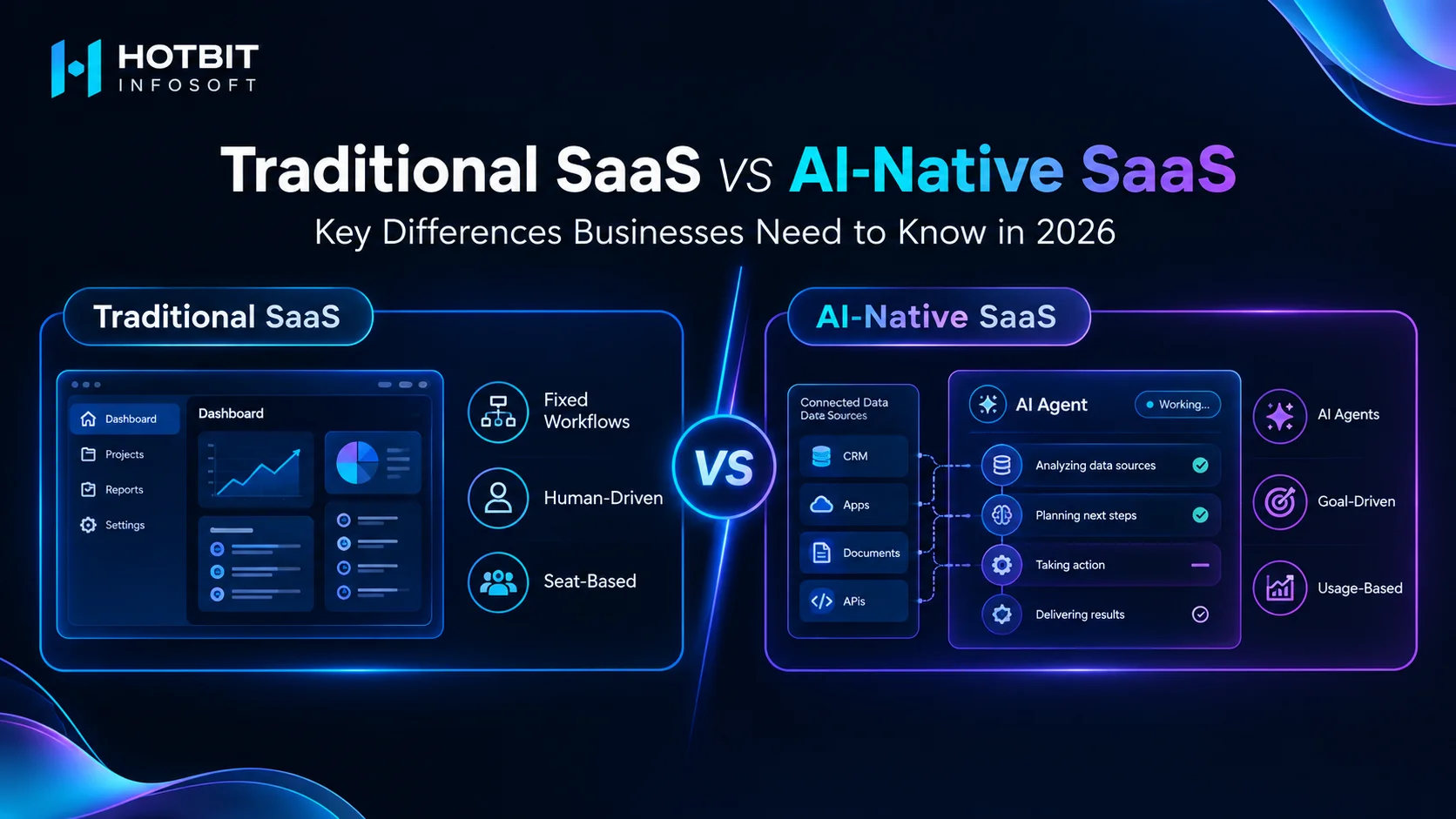
Traditional SaaS is software that centers the user interface and predefined workflows a human operates step by step, while AI-native SaaS is software that places AI models and agentic capabilities deeper into the product’s core architecture, so an agent can plan and execute multi-step work with a human supervising the outcome.
Traditional SaaS products can and often do include AI, automation, and dynamic features. The real dividing line is architectural, not simply whether AI is present.
For founders, CTOs, and IT directors evaluating a new platform or deciding whether to modernize an existing one, this distinction now drives real budget decisions. Cross-platform development can also be an important consideration when products need to deliver consistent experiences across web, mobile, and console environments. This article breaks down the architectural, pricing, and operational differences between the two models, backed by named industry data, so you can decide which approach fits your roadmap.
What Is Traditional SaaS?
Traditional SaaS is a software delivery model in which an application is hosted centrally by a vendor and accessed by users over the internet on a subscription basis, typically priced per user seat per month. The workflow generally stays centered on human interaction with the application’s interface, even when automation handles individual steps behind the scenes.
Tools like conventional CRM, HR, and project-management platforms fall into this category. Traditional SaaS has powered enterprise IT for two decades because it is predictable, auditable, and straightforward to price against headcount.
What Is AI-Native SaaS?
AI-native SaaS is a working industry term not yet a standardized category for software built from its first architectural decision around embedded AI models and autonomous agents, rather than having AI added as a feature layer on top of an existing product. Instead of a human clicking through a workflow, an AI-native platform can interpret a goal, reason across connected data sources, take multi-step action, and adjust its behavior based on context, with a human approving or overseeing the result.
Multiple market-research firms now track AI-powered SaaS as a distinct, fast-growing segment, though estimates of its exact size vary widely depending on how narrowly or broadly each firm defines the category. That variance itself signals how new and unsettled this space still is. Gartner’s figure is the clearer, better-sourced signal: it measures how much of existing enterprise software spend is now at risk of shifting toward this model.
As AI-native SaaS products scale, API infrastructure becomes increasingly important for connecting applications, data sources, and third-party services without rebuilding the underlying systems.
Traditional SaaS vs AI-Native SaaS: The Key Differences
Dimension | Traditional SaaS | AI-Native SaaS |
Core interaction model | Human clicks through a fixed UI, step by step | AI agent plans and executes multi-step tasks; human supervises |
Automation type | Can include rule-based and ML-driven automation, initiated by a user | Model-driven reasoning that can act on a goal with less step-by-step input |
Pricing model | Per-seat, per-user subscription | Usage-based, outcome-based, or hybrid consumption pricing |
Data handling | Often organized within the application’s own database, with integrations | Built to continuously ingest and reason across multiple connected data sources |
Personalization | Configured manually by an admin, or set by fixed rules | Can use models, context, and user or organizational data to personalize behavior |
Time to value | Requires onboarding, training, and manual setup | Can be faster to operate once agents are scoped and governed, but requires new governance work upfront |
Best suited for | Stable, well-defined, compliance-heavy workflows | Dynamic, high-volume, judgment-based workflows |
Neither model is universally better. A compliance-heavy finance workflow may still be safest on a traditional SaaS backbone, while a high-volume support or research workflow may offer a clearer starting point for evaluating AI-native capabilities. Understanding the software development life cycle can also help businesses assess how these different approaches fit into planning, development, testing, deployment, and ongoing maintenance.
How Pricing Models Differ Between Traditional and AI-Native SaaS
Traditional SaaS has historically relied heavily on per-seat licensing: the more users you add, the more you pay, regardless of how much work each user completes. AI-native SaaS breaks that link because an agent can complete work that used to require a seat.
This shift is particularly relevant for businesses experiencing the warning signs of digital transformation, where growth increasingly depends on scaling systems and automation rather than simply adding headcount.
Gartner says agentic pricing needs to shift “from interface-based value to outcome-based value” as AI agents take on tasks previously billed by headcount. Three common pricing approaches are emerging in practice: usage-based pricing, billed per action or API call; outcome-based pricing, billed only when a defined result is achieved; and an AI layer priced as an add-on to an existing seat-based tier.
Several major vendors, including Salesforce, Microsoft, and ServiceNow, now offer some combination of these models across their AI products. The exact structure can vary by specific product and plan, so buyers should confirm the pricing model for the specific SKU they’re evaluating rather than assume a vendor uses only one approach. This same evaluation mindset is important when choosing enterprise software, where businesses should compare requirements, implementation costs, integrations, and total cost of ownership before selecting a platform.
Why Some Enterprises Are Shifting Toward AI-Native SaaS
The shift is underway, though its pace is still a forecast, not a settled fact. Gartner projects that 40% of enterprise applications will include task-specific AI agents by the end of 2026, up from less than 5% in 2025.
Forrester, the research and advisory firm, has documented software stocks losing over $1 trillion in combined market capitalization in a single week in early 2026, driven by investor concern that AI agents could displace legacy, per-seat SaaS workflows. Forrester frames this as a reaction to that risk, not proof that displacement has already occurred, and its own analysis expects the enterprise core of SaaS to persist through this shift rather than disappear.
Deloitte, the professional services firm, describes SaaS applications evolving toward “a federation of real-time workflow services that can learn from their experiences.” That’s a structural prediction about where the category is heading, not a description of every product on the market today. As software development itself evolves, approaches such as vibe coding vs. traditional software development are also changing how teams think about building, governing, and scaling these increasingly intelligent applications.
Challenges of Migrating from Traditional SaaS to AI-Native SaaS
Migrating an existing traditional SaaS product or an internal deployment to an AI-native model carries real technical and organizational risk. The most common failure points are:
- Treating AI as a bolt-on feature instead of rearchitecting the data layer agents need to reason over
- Underestimating the governance and human-oversight layer that autonomous action requires
- Choosing a usage-based or outcome-based pricing model without modeling expected volume first, which can make AI-native pricing more expensive than the seat-based model it replaced
- Migrating high-compliance workflows before the audit trail and approval steps have proven reliable
A phased approach to AI-native software development, starting with a bounded, high-volume, lower-compliance-risk workflow before expanding autonomous capability further, can reduce implementation risk compared with attempting a full-platform rebuild in one pass.
Where Hotbit Infosoft Fits In
Hotbit Infosoft, a digital-first technology company specializing in AI Automation, Product Engineering, Business Transformation, Cloud, Team-as-a-Service, and iGaming & Fantasy solutions, works with teams navigating exactly this kind of migration. Hotbit helps decide which parts of a platform to keep, which to rebuild agent-first, and how to govern and price the result. If you’re scoping a similar move, talk to a Hotbit Infosoft expert or explore the full range of services.
Traditional SaaS and AI-native SaaS aren’t opposing categories so much as two points on a spectrum enterprise software buyers are now navigating. If you’re weighing which of your platforms might be ready for this kind of shift, talk to Hotbit Infosoft about scoping it.
Frequently Asked Questions About AI Governance
What is the difference between traditional SaaS and AI-native SaaS?
Traditional SaaS centers a fixed interface that a human operates step by step. AI-native SaaS places AI models and agentic capabilities deeper into the architecture, so an agent can plan and execute multi-step work with human oversight. The distinction is architectural, not simply whether AI is present.
Is AI-native SaaS just traditional SaaS with AI features added?
Not typically. Adding a chatbot or AI feature to an existing product doesn’t make it AI-native. The term generally describes software architected from the start so agents can reason across the data layer and take multi-step action, rather than AI sitting on top of an unchanged workflow.
What are examples of AI-native SaaS platforms?
Salesforce Agentforce and Intercom Fin are examples of products built around increasingly autonomous AI workflows, alongside AI-native customer support platforms that resolve tickets with minimal human handling, sales tools that qualify leads and book meetings, and document-processing platforms that extract and act on data with reduced manual review.
Will AI-native SaaS replace traditional SaaS entirely?
Forrester’s analysis expects the enterprise core of SaaS to persist even as agentic AI reshapes specific workflows. Compliance-heavy, highly regulated processes tend to stay on traditional, auditable SaaS longer, while high-volume, judgment-based workflows are shifting toward AI-native models faster.
How is AI-native SaaS priced compared to traditional SaaS?
Traditional SaaS is typically priced per user seat per month. AI-native SaaS more often uses usage-based pricing, outcome-based pricing, or an AI layer added to an existing seat tier. The exact model can vary by vendor and product, so it’s worth confirming before comparing costs directly.
Is it worth migrating an existing SaaS product to an AI-native architecture?
It depends heavily on the specific workflow, current architecture, and governance readiness. High-volume, repetitive, judgment-based processes are often among the first candidates evaluated, though Gartner’s more recent research also points to specialized, domain-specific agents as a strong source of measurable ROI. Compliance-critical workflows usually wait until AI oversight and audit trails are proven in that regulatory context.
Disclaimer
The information provided in this article is for general informational and educational purposes only and should not be considered legal, financial, technical, or business advice. References to Gartner, Forrester, Deloitte, Salesforce, Microsoft, ServiceNow, Intercom, or other third-party organizations and products are provided for informational context and do not imply endorsement or affiliation unless explicitly stated.